Last Tuesday, you might have stood in the yards as the pregnancy tester called out another “empty” cow, feeling that familiar knot in your stomach as you calculated the lost potential for the coming season. It’s a heart-wrenching moment for any West Gippsland producer who pours their heart into their herd. When you’re facing variable pasture quality and a calving season that seems to drift further out every year, improving cattle conception rates can feel like an uphill battle. We understand that these animals are more than just a line on a spreadsheet; they’re your livelihood and a testament to your hard work.
We agree that the pressure to achieve a calf per cow every 365 days is immense, especially when environmental factors feel out of your control. This guide promises to provide you with evidence-based strategies to optimise your herd’s reproductive performance and finally achieve that tighter calving pattern you’ve been working towards. We’ll explore how a partnership focused on nutritional precision, low-stress welfare, and proactive veterinary diagnostics like bull fertility testing can transform your results. By focusing on the bond between health and productivity, you can look forward to a more manageable season and a more secure future for your farm family.
Key Takeaways
- Understand why focusing on Body Condition Scores (BCS) rather than just pasture appearance is the key to managing the “365-day challenge” on your farm.
- Learn why a “working” bull isn’t always a fertile one and how bull fertility testing can safeguard your next calving season.
- Discover the “golden window” for vaccinations to protect your herd from the silent diseases that often hinder improving cattle conception rates.
- Explore how reaching critical mating weights in your heifers and using early pregnancy testing can help you build a more profitable and manageable herd.
The Fundamentals of Reproductive Performance in West Gippsland
There is a special kind of pride in seeing a healthy mob grazing across our rolling green hills, yet we know that behind that peaceful scene lies a complex biological clock. For many of our local farming families, the goal is simple: a healthy calf from every cow, every year. This “365-day challenge” is the heartbeat of a profitable farm. When we focus on improving cattle conception rates, we’re looking at the very foundation of your herd’s future. It isn’t just a technical goal; it’s about ensuring your cows stay productive and your calving season remains manageable for years to come.
In our region, it’s vital to distinguish between conception rates and pregnancy rates. While conception refers to a single successful mating event, the pregnancy rate tells the story of your whole mob over the joining period. A tighter calving pattern, where the majority of cows conceive in their first cycle, leads to a much more uniform line of weaners. This consistency is exactly what buyers look for at the Koonwarra or Sale saleyards, often resulting in better prices for your hard work. Local benchmarks suggest we should aim for a 95% pregnancy rate over a 9-week joining period, though achieving this consistently requires a deep understanding of our unique Gippsland environment.
The Biological Timeline of the Cow
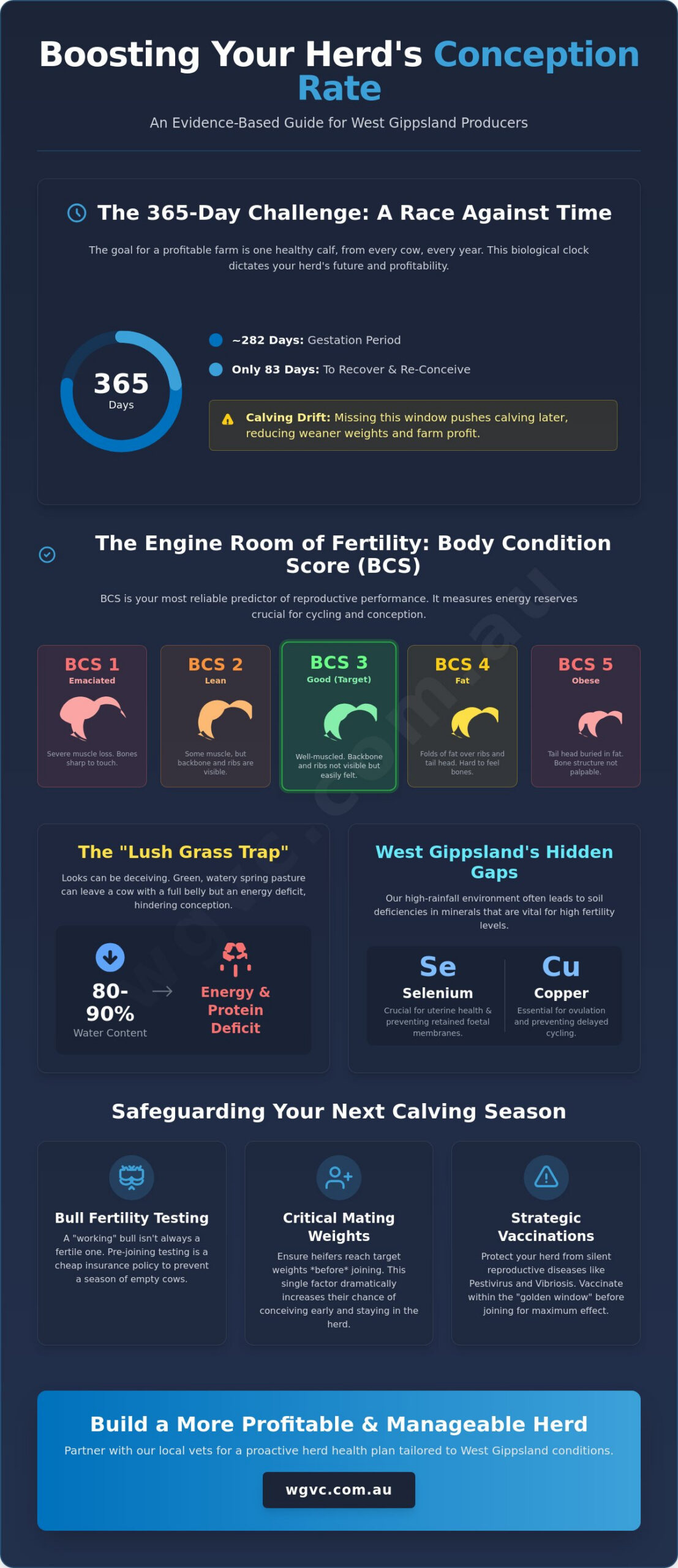
The window for success is narrower than many realise. After a cow calves, her body needs time to heal and restart its reproductive cycle, a period known as anaestrus. With a gestation period of roughly 282 days, she only has about 83 days to recover and conceive again to stay on a yearly schedule. If she misses those first two cycles, she begins to “drift” later into the season. This calving drift is a quiet thief of profit. Late-born calves have less time to put on weight before weaning, and their mothers often become the first candidates for culling when winter feed gets tight.
Why West Gippsland is Unique for Reproduction
Our stunning landscape brings its own set of rules for breeders. Transitioning from our cold, wet winters into the rapid flush of spring growth can be quite a shock to a cow’s system. Our high-rainfall environment often impacts mineral availability, particularly magnesium and selenium, which are crucial for maintaining high fertility levels. While foundational knowledge on dairy cattle reproduction provides a useful baseline for understanding bovine cycles, our local beef herds require a strategy that accounts for these specific soil and weather patterns. Partnering with a livestock vet West Gippsland producers trust ensures your herd strategy is built for our specific conditions. This collaborative approach helps you move from simply reacting to problems to proactively improving cattle conception rates through better nutrition and health planning.
Nutrition and Body Condition: The Engine Room of Fertility
When we talk about improving cattle conception rates, we often look at the bulls or the calendar first. However, the real work happens in the paddock. A cow’s Body Condition Score (BCS) is your most reliable tool for predicting how quickly she’ll return to cycle after calving. It’s a reflection of her internal energy reserves; if she’s too lean, her body will prioritise her own survival and her current calf over starting a new pregnancy. We see this often in our region, where the demands of a wet winter can strip condition off even the hardiest cows before you’ve even noticed.
It’s easy to fall into the “Lush Grass Trap” during a typical Gippsland spring. While those paddocks look magnificent and bright green, that watery growth is often 80% to 90% water. A cow can graze all day and have a physically full belly, yet still be starving for actual energy. This lack of dry matter intake is a common reason why cows fail to conceive during the first cycle. To support a rising plane of nutrition, her diet needs a careful balance of energy and protein. Our local soils are famously productive, but they often carry hidden deficiencies. Selenium and Copper are vital for fertility, yet they are frequently low in our high-rainfall areas. If you’re concerned about mineral gaps, our team can provide tailored herd health advice to ensure your cows have everything they need to thrive.
Step-by-Step: Scoring Your Herd for Success
We recommend performing a BCS check at weaning and again 60 days before calving. On a scale of 1 to 5, you’re looking for that “sweet spot” of 2.5 to 3.0. At this level, the cow has enough cover over her ribs and tailhead to support lactation without draining her reserves. If you identify “tail-end” cows that are falling below a 2.0, drafting them into a separate mob for priority feeding before joining can significantly boost your overall pregnancy rates. It’s a small act of care that pays dividends in calf uniformity later on.
Managing Dry Matter Intake on Gippsland Pastures
Calculating dry matter requirements is a balancing act, especially when comparing a growing heifer to a mature lactating cow. During those lush periods, providing access to high-quality hay or silage is essential to “harden” the diet and provide necessary fibre. This slows down the passage of feed through the rumen, allowing the cow to actually absorb the nutrients. During the “hungry gap” in late winter, strategic supplementation ensures she doesn’t lose too much weight before the spring flush, keeping her on track for a successful joining.
Managing the ‘Other Half’: Bull Soundness and Heifer Growth
While the condition of your cows is the engine, the performance of your bulls and the preparation of your heifers are the steering and fuel for your reproductive success. It’s a common heartbreaker to see a bull out in the paddock, actively following cows, only to find a high “empty” rate months later. A bull that is physically “working” isn’t always a fertile one. In our hilly West Gippsland terrain, a bull needs more than just libido; he needs the physical structural soundness to cover ground and the biological capability to get the job done. By ensuring both sides of the mating equation are healthy, you’re taking a vital step toward improving cattle conception rates across the entire mob.
Managing the bull-to-cow ratio is equally important, especially in our larger Gippsland mobs. For a mature, healthy bull, a ratio of one bull to 40 or 50 cows is generally effective. However, for younger bulls still finding their feet, a lighter load of 25 to 30 cows is much safer. When selecting your future sires, looking at the genetics of fertility can offer long term benefits. Focus on Estimated Breeding Values (EBVs) for scrotal circumference and shorter days-to-calving, as these traits are directly linked to how quickly his daughters will reach puberty and cycle after their first calf.
The Bull Breeding Soundness Evaluation (BBSE)
A professional BBSE is much more than a quick glance in the yards. It involves a thorough physical examination of the feet, legs, and sheath to ensure the bull can handle our wet, sometimes slippery winter conditions. We also perform a detailed semen analysis, checking both motility and morphology. This ensures the sperm are not only moving but are correctly formed to achieve fertilisation. Investing in bull fertility testing in Victoria acts as a non-negotiable insurance policy, protecting you from the devastating financial impact of a sub-fertile or infertile sire.
Heifer Development: Setting the Foundation
Your heifers are the future of your family farm, and their first joining sets the tone for their entire productive life. The magic number to remember is 65%. A heifer should reach 65% of her expected mature body weight before she’s joined. This ensures she has reached puberty and is cycling strongly. Heifers that conceive early in their first joining period are statistically more likely to remain in the herd longer and produce more kilograms of weaner over their lifetime. After they’re joined, it’s crucial to keep their nutrition steady. If a heifer “slips” in condition during her first pregnancy, she’ll struggle to grow, feed her calf, and get back in calf for the second time. Ensuring every calf she produces gets the best possible start — including following a calf disbudding Gippsland humane practice checklist — helps protect your weaning weight targets and the long-term productivity of your herd.
Disease Prevention and the Impact of Stress on Conception
Protecting your herd from invisible threats is an act of devotion that goes far beyond simple farm management. While we often focus on what we can see, like pasture height or bull activity, there are “silent thieves” that can quietly undermine your hard work. These sub-clinical diseases don’t always show obvious symptoms, yet they are often the primary culprits behind a disappointing pregnancy testing day. By taking a proactive stance against these hidden risks, you’re making a significant commitment to improving cattle conception rates and ensuring the long-term vitality of your breeding program.
The timing of your preventative care is just as important as the treatments themselves. We consider the month before joining to be the “golden window” for vaccinations. This period allows the cow’s immune system to reach its peak effectiveness exactly when she needs it most. Administering boosters during this time ensures that the developing embryo is protected from the very start. It’s a small, rhythmic part of the farming year that provides immense peace of mind for you and safety for your animals.
Key Reproductive Diseases in Gippsland
In our local area, Pestivirus (BVDV) remains a significant concern. If a persistently infected (PI) animal is present in the mob during joining, the resulting reproductive failure can be devastating for a family business. Vibriosis and Leptospirosis are also common, but fortunately, they are manageable with the right protocols. We generally recommend a combination of 7-in-1 and Vibrio vaccinations to provide a solid shield for your herd. Diagnostic testing, often using simple hair or blood samples, allows us to identify these risks before they become a crisis. If you want to build a more resilient prevention strategy, we can provide tailored herd health advice to help you stay ahead of these challenges.
The Welfare-Fertility Connection
There is a profound physiological link between an animal’s emotional state and its ability to conceive. When cattle experience fear or high stress, their bodies release cortisol, a hormone that can directly interfere with the delicate balance needed for a successful pregnancy. Rough handling in the yards, especially during the sensitive joining period, can even lead to early embryonic loss. Using low-stress stockmanship techniques isn’t just about being kind; it’s a professional approach that yields better results. Designing your yard systems to encourage natural movement and reduce anxiety creates a calmer environment where your cows can thrive. It’s about working with their natural instincts to create a stable, productive atmosphere for the whole herd.
Proactive Herd Health: Partnering with Your Local Gippsland Vet
Managing a farm in West Gippsland is a rewarding but demanding way of life. It’s easy to feel like you’re constantly reacting to the next challenge, moving from one “fire” to the next as the seasons change. By shifting toward a strategic partnership with your local vet, you move away from reactive troubleshooting and into a space of calm, planned management. This collaborative approach is the most effective way of improving cattle conception rates while significantly reducing the mental load that often comes with the joining and calving seasons. When we look at the data through the lens of improving cattle conception rates, every percentage point gained represents more than just profit; it represents a more sustainable and less stressful way of farming.
Early pregnancy testing using ultrasound is a game-changer for modern mob management. It isn’t just about identifying which cows are “empty”; it’s about knowing exactly when each cow is due to calf. This precise data allows you to draft your mob into early, mid, and late calvers, ensuring that those who need the most nutritional support get it at the right time. Understanding your options for cattle pregnancy testing in Gippsland — including the differences between manual and ultrasound methods — can help you choose the approach that delivers the most accurate foetal aging and the best management outcomes for your herd. When we review this data together during an annual reproductive audit, we can identify specific bottlenecks, perhaps a dip in nutrition or a silent disease issue, and adjust our plan for the following year. It’s about building a narrative for your herd that gets stronger every season.
The Power of Data and Diagnostics
We use pregnancy testing results to help you make informed culling decisions, prioritising the retention of your most fertile, early-calving females. By analysing calving histograms, we can track your herd’s progress over several years, visually mapping how your calving pattern is tightening. We also work with you to customise a health calendar that accounts for our specific West Gippsland climate. This ensures vaccinations and mineral supplements are timed perfectly for our local conditions, protecting your animals when they are most vulnerable.
Why Choose West Gippsland Vet Care?
Our team is deeply committed to the local farming community, from the dairies of Warragul to the beef runs of Neerim South. We aren’t just clinicians; we’re your neighbours who understand the unique pressures and joys of Gippsland agriculture. We value the relationship we have with our clients and view ourselves as an extension of your support system. We invite you to sit down with us and discuss your herd’s unique goals, whether you’re looking to expand or simply want a more manageable lifestyle. Organise a herd health consultation with our livestock team today to start building a more profitable and peaceful future for your farm.
Securing Your Herd’s Future Success
Improving cattle conception rates is a journey we take together, balancing the daily needs of your animals with the long term goals of your family farm. By focusing on precise body condition scoring and ensuring your bulls are physically fit for our Gippsland hills, you create a foundation of reproductive resilience. We’ve seen how proactive disease prevention and low stress handling can turn a drifting calving season into a tight, manageable window that rewards your hard work at the saleyards. It’s about more than just numbers; it’s about the well being of your livestock and the stability of your livelihood.
Our team has been a fixture in the local community for years, supporting both beef and dairy producers with a proven track record of care. We bring comprehensive on farm diagnostic equipment directly to your yards, ensuring you have the data needed to make confident decisions for your herd’s future. We invite you to book a bull fertility test or herd health review with WGVC so we can help you navigate the season ahead. We’re here to listen and to ensure your herd thrives for generations to come.
Frequently Asked Questions
How can I improve my cattle’s conception rate quickly?
Improving cattle conception rates quickly often starts with ensuring a “rising plane of nutrition” and verifying bull fertility. You can achieve a rapid boost by providing high-quality supplementation three to four weeks before joining to ensure cows are gaining weight. Simultaneously, having a vet perform a fertility test on your bulls prevents the risk of turning out sub-fertile sires that could cost you an entire breeding cycle.
What is a good conception rate for beef cattle in Australia?
A strong benchmark for beef cattle in Australia is a 95% pregnancy rate over a nine week joining period. In West Gippsland, we aim for the majority of these pregnancies to occur in the first two cycles. This creates a tight calving pattern, which ensures your weaners are a uniform size and weight when they eventually head to the Koonwarra or Sale saleyards.
Why are my cows not getting in calf even though they look healthy?
Cows can appear physically fit while struggling with internal mineral deficiencies or sub-clinical reproductive diseases. In our high rainfall Gippsland soils, low levels of Selenium and Copper are common culprits that quietly hinder fertility. It is also possible that a “silent thief” like Pestivirus is circulating in the mob, causing early embryonic loss that isn’t visible during a standard paddock inspection.
Does the timing of vaccinations affect cattle conception?
Timing is everything when it comes to vaccinations and improving cattle conception rates. We recommend a “golden window” of approximately four weeks before joining to administer essential boosters like 7-in-1 or Vibrio. This allows the cow’s immune system to reach its peak strength just as she is conceiving, providing the best possible protection for the developing embryo during its most vulnerable stage.
How much does a Bull Breeding Soundness Evaluation cost in Gippsland?
The investment for a Bull Breeding Soundness Evaluation (BBSE) depends on the number of bulls being tested and the specific diagnostic requirements of your property. While we don’t provide fixed prices here, we encourage you to contact our clinic for a tailored quote. Investing in this evaluation acts as a vital insurance policy against the significant financial loss of an infertile or sub-fertile bull.
Can I use ‘lush’ spring grass to get cows into condition for joining?
Lush spring grass is often deceptive because its high water content can lead to a “dry matter gap.” Even if your cows have physically full bellies, they might not be receiving enough actual energy to support a new pregnancy. We suggest “hardening” these pastures with high quality hay or silage to ensure your cows maintain the true body condition needed for a successful joining period.
What are the signs of Pestivirus in a breeding herd?
Pestivirus is often called a silent disease because it rarely shows obvious physical symptoms in mature cows. You might only notice a problem when you see a high number of “empty” cows at pregnancy testing or an increase in late term abortions. Sometimes, it presents as “weak” calves that fail to thrive or have unusual neurological issues from birth, which can be devastating for a breeding program.
Is ultrasound pregnancy testing better than manual palpation?
Ultrasound pregnancy testing offers several advantages regarding accuracy and management, particularly the ability to detect pregnancies as early as 35 days. This is significantly sooner than manual methods allow. Ultrasound also enables us to age the foetus precisely. This helps you draft your mob into early and late calving groups, allowing for much more efficient nutritional management as the calving season approaches. For a detailed breakdown of both approaches, our guide on cattle pregnancy testing in Gippsland comparing manual vs. ultrasound methods can help you decide which option best suits your herd’s needs.