
What if the difference between a peaceful night at home and a frantic, forty-five minute dash to Warragul was a single, preventative decision? If you share your life with a large or deep-chested breed, you likely already know the quiet dread that comes with the word ‘bloat’. It’s a heavy weight to carry, especially when you’re unsure if ‘bloat’ and GDV are the same thing or if gastropexy surgery for dogs is truly necessary for your healthy mate.
We understand that the thought of surgery can be daunting; you only want what is safest for your family. This article explores the truth about these life-saving procedures and explains how modern, laparoscopic ‘keyhole’ options make recovery much faster and more comfortable for your pet. We’ll clear up the confusion between simple bloating and the dangerous twisting of GDV, giving you the facts you need to make an informed choice. You’ll gain a clear understanding of the risks and the confidence to choose a prevention plan that ensures your dog stays safe, happy, and right by your side.
Key Takeaways
- Understand the critical difference between a simple upset stomach and the life-threatening surgical emergency known as Gastric Dilatation-Volvulus (GDV).
- Discover how gastropexy surgery for dogs acts as a permanent ‘stomach stitch’ to prevent the stomach from twisting during a bloat episode.
- Identify whether your companion is among the high-risk breeds common in West Gippsland, including local favourites like German Shepherds and large Doodles.
- Learn why modern laparoscopic ‘keyhole’ techniques offer a much gentler recovery and smaller incisions compared to traditional open surgery.
- Find out how to organise a proactive prevention plan and what to expect during a consultation at our Warragul or Drouin clinics.
‘Bloat is Just a Tummy Ache’ and Other Dangerous Misconceptions
It is a common sight for dog owners in West Gippsland. Your mate has a slightly rounded belly after a big dinner or a long run in the paddock. You might think they’ve just overindulged or have a bit of wind. However, for large and deep-chested breeds, this “tummy ache” can quickly turn into a life-threatening condition known as Gastric Dilatation-Volvulus (GDV). While people often use the word “bloat” to describe any swollen stomach, there is a massive difference between simple gastric dilatation and the deadly “Volvulus” part of the equation.
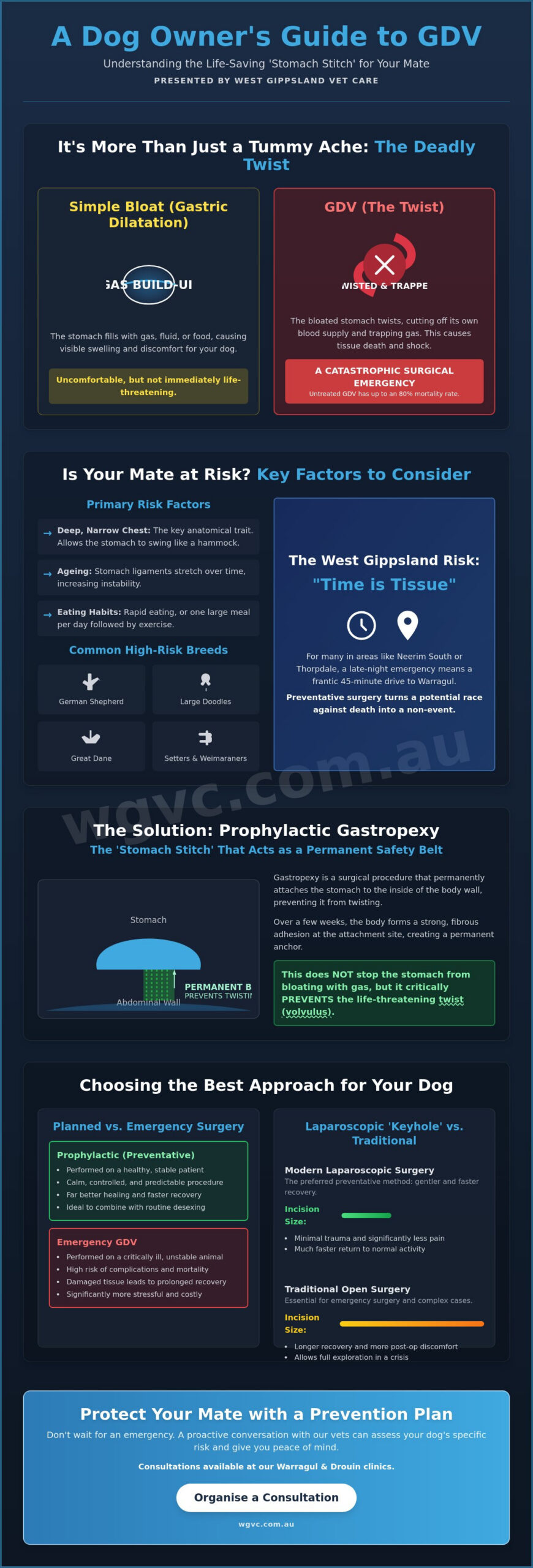
Simple bloat happens when the stomach fills with gas or fluid. It’s uncomfortable, but the real danger begins when the stomach actually twists on its axis. This rotation creates a closed loop, sealing off both the entrance from the oesophagus and the exit to the intestines. One of the most dangerous myths we hear is that a dog can “just burp it out.” Once that twist occurs, gas is trapped. It cannot escape. Without immediate intervention, the pressure continues to build, and the mortality rate for untreated GDV cases can reach a staggering 80 per cent. This is why gastropexy surgery for dogs is such a vital conversation for our local community to have.
The Anatomy of a Twist: Why It Happens
Deep-chested dogs have a unique internal anatomy where the stomach sits somewhat like a hammock. It has more room to move than in smaller breeds. Over time, the ligaments that hold the stomach in place can stretch, especially as our companions age. When the stomach becomes heavy with food or gas, it can swing and flip. This twist does more than just trap gas; it physically strangles the blood vessels supplying the stomach and other vital organs like the spleen. This lack of blood flow causes tissue death almost immediately, turning a digestive issue into a full-scale surgical emergency.
Why Gippsland Dogs Face Unique Risks
Living in beautiful rural areas like Neerim South, Willow Grove, or Thorpdale offers a wonderful lifestyle for active dogs. However, our geography adds a layer of risk. If your dog develops GDV at 11:00 pm, a forty-five minute drive to our emergency facilities in Warragul can feel like a lifetime. In a GDV event, every minute counts because “time is tissue.” Many of our local working dogs or active family pets have high energy levels and specific feeding schedules that can intersect with their exercise routines. Choosing gastropexy surgery for dogs as a preventative measure means you aren’t gambling with the distance to the clinic during a midnight crisis. A Canine gastropexy provides a permanent bond that keeps the stomach in its proper place, ensuring that even if your dog does experience gas buildup, the fatal twist is prevented.
The Science of the ‘Stomach Stitch’: How Gastropexy Actually Works
Visualising gastropexy as a strategic safety belt helps make sense of how this procedure protects your dog. It isn’t just a temporary fix; it’s a permanent bond created between the outer layer of the stomach and the inside of the abdominal wall. During the procedure, our surgeons carefully “tack” the stomach into its correct anatomical position. Over the following week or two, your dog’s body naturally forms a strong, fibrous connection at this site. This ensures the stomach stays exactly where it belongs, even during active play or after a large meal.
A vital point to clarify is that this surgery doesn’t stop a dog from ever feeling bloated. Their stomach can still fill with gas if they eat too quickly or swallow air. However, the procedure prevents the life-threatening rotation that cuts off the blood supply. As noted by the American College of Veterinary Surgeons, it is the volvulus, or the twist, that creates the true medical crisis. By securing the stomach, we remove the most dangerous part of the condition. Many families choose to combine this with other procedures, making gastropexy surgery for dogs a practical and proactive addition to a routine desexing.
Prophylactic vs. Emergency Gastropexy
Performing a preventative gastropexy surgery for dogs is a much calmer experience for everyone involved compared to an emergency intervention. In a crisis, we are often dealing with bruised or necrotic tissue because the blood supply has been compromised for some time. A planned, prophylactic procedure is performed on healthy, pink tissue, which heals far more reliably and quickly. If you are already planning a laparoscopic spay for your girl, we can often perform the gastropexy at the same time. This means your companion only needs one session of anaesthesia and one recovery period.
Long-term Efficacy: Does the Stitch Hold?
The long-term results of this procedure are incredibly reassuring for pet owners. Without a gastropexy, the recurrence rate for GDV in dogs who have previously bloated can be as high as 70 per cent. With the surgery, that risk drops to less than 5 per cent. It is a quiet, invisible safeguard that doesn’t interfere with your dog’s appetite, digestion, or their ability to enjoy a good zoom around the backyard. If you’re curious about how this might fit into your pet’s health plan, feel free to chat with our friendly team during your next visit to the clinic.
‘My Dog Isn’t at Risk’: Identifying High-Risk Breeds in West Gippsland
Many of our clients in Warragul and Drouin assume that if they don’t own a Great Dane, their dog is safe from the threat of a twisted stomach. While it’s true that Great Danes face a high lifetime risk, they aren’t the only ones in the danger zone. In our neck of the woods, we see plenty of German Shepherds, Standard Poodles, and those lovely large Doodles that are just as much a part of the Gippsland family. These breeds share that characteristic deep, narrow chest that makes gastropexy surgery for dogs a sensible precaution. Even if your dog isn’t a giant, breeds like Basset Hounds can still be at risk due to their unique body shape. Genetics play a massive role too. If your dog has a parent or sibling who suffered from GDV, their own risk increases by 63 per cent.
There is also a common myth that small dogs are entirely immune. While it is certainly rarer in smaller companions, any dog with a chest that is significantly deeper than it is wide can experience gastric torsion. As the Veterinary Information Network explains prophylactic gastropexy, the goal is to mitigate these anatomical risks before an emergency occurs. Recognising your dog’s specific build is the first step in creating a tailored health plan that keeps them safe during their daily adventures.
The Deep-Chest Test: Does Your Dog Fit the Profile?
You can perform a simple visual assessment at home by looking at your dog’s chest-to-waist ratio. A “narrow and deep” chest, where the ribcage sits much lower than the tuck of the waist, is the primary anatomical red flag for stomach rotation. Beyond physical build, temperament is a surprising factor. Research indicates that anxious or fearful dogs are statistically more prone to GDV. If your mate is the type to get stressed during thunderstorms or when visitors arrive, their risk profile might be higher than a more laid-back companion of the same breed.
Lifestyle Factors That Increase Risk
Living on a property in Gippsland often means plenty of room to move, but it also brings specific lifestyle considerations. There is an ongoing debate about elevated feeders; however, modern research actually suggests they might increase the risk of bloat in some dogs. It is generally safer to feed several small meals throughout the day rather than one large “wolfed down” dinner. We also need to be mindful of exercise. The old “30-minute wait” rule is a good start, but high-intensity paddock running or jumping should be avoided right after a meal. Investing in gastropexy surgery for dogs provides that extra layer of security for those times when your dog decides to chase a stray rabbit across the gully right after breakfast. Large and active breeds in Gippsland are also prone to other orthopaedic concerns, and if you’ve ever noticed your dog pulling up lame after a run, our guide to dog knee surgery in Gippsland and cruciate ligament care is an essential resource for understanding your options.
Modern Surgery Myths: Laparoscopic vs. Traditional Gastropexy
A common worry for pet owners is the thought of their dog undergoing a major operation with a long, painful recovery. Many people picture a massive 15 to 20 centimetre incision along the belly, requiring weeks of strict confinement. While this was once the standard, modern technology has completely changed the experience of gastropexy surgery for dogs. At West Gippsland Vet Care, we utilise laparoscopic or “keyhole” techniques to achieve the same life-saving results with far less impact on your dog’s body.
Instead of one large opening, we use two or three tiny ports, each only about the size of a pencil. Through these ports, we insert a specialised camera called a laparoscope. This provides our surgeons with a magnified, high-definition view of the internal organs. This level of precision allows us to perform the procedure with minimal tissue handling and significantly less bleeding. For a Gippsland dog used to a busy “paddock life,” this means a much lower risk of post-operative infection and a faster return to their favourite activities.
The Laparoscopic Advantage: Less Pain, Faster Healing
The most significant benefit of the laparoscopic approach is the comfort of your pet. Because we aren’t making a large abdominal incision, post-operative pain scores are much lower. We’ve invested in this technology because we believe our community’s pets deserve the same advanced care available in major cities. Most dogs are back on their feet and ready for a gentle lead-walk around Drouin or Warragul much sooner than those having traditional surgery. This faster healing time means less stress for you and a quicker return to normalcy for your mate. Our dog surgery recovery tips for West Gippsland pet owners can help you feel fully prepared for the days following your companion’s procedure.
Combining Procedures: The ‘Two-for-One’ Approach
For many families, the ideal time to consider this is during a routine desexing. Performing a laparoscopic spay and gastropexy surgery for dogs simultaneously is widely considered the gold standard for young, large-breed females. This “two-for-one” approach means your dog only undergoes one anaesthesia session and one healing period. It reduces the overall stress on her system and provides you with peace of mind from an early age. If you’re planning a desexing for your pup, you can book a consultation with our team to discuss if a combined procedure is right for her.
Organising a Gastropexy at West Gippsland Vet Care
At West Gippsland Vet Care, we view ourselves as a vital part of your pet’s support system. We’re dedicated to providing the high level of surgical care usually reserved for major cities right here in our local community. Choosing gastropexy surgery for dogs is a significant step in your pet’s health journey, and we’re here to walk alongside you every step of the way. Our team combines clinical expertise with a nurturing approach to ensure that both you and your companion feel safe, informed, and respected throughout the process.
When you visit our Warragul or Drouin clinics, you’ll find a team that prioritises the individual bond you share with your dog. We don’t believe in one-size-fits-all medicine. Instead, we focus on open dialogue, listening to your concerns and answering your questions with honesty and warmth. Our goal is to create a prevention plan that offers you genuine peace of mind, knowing your mate is protected from the silent threat of GDV.
Your Pre-Surgical Consultation
During your initial visit, we’ll take a close look at your dog’s specific risk factors, including their breed, family history, and anatomical build. We use our in-house laboratory to perform thorough pre-operative blood tests, alongside detailed heart checks, to ensure your pet is ready for anaesthesia. We’re committed to transparency, so we’ll provide a clear, detailed estimate of what the procedure involves. This consultation is a collaborative effort where we’ll discuss whether a standalone gastropexy surgery for dogs or a combined laparoscopic procedure is the best fit for your family.
Aftercare: Supporting Your Pet’s Recovery
The first 48 hours after surgery are the most important for a smooth recovery. We’ll provide you with clear, easy-to-follow instructions on managing rest and medication at home. While laparoscopic procedures involve much smaller incisions, your dog will still need a quiet space to heal. Because we value our relationship with you, we offer 24-hour emergency support to our existing clients. If you have any concerns in the middle of the night, you won’t be left wondering what to do. For comprehensive guidance on what to expect once you arrive home, our detailed dog surgery recovery tips cover everything from managing rest to spotting signs of infection. We’ll also schedule final check-ups to monitor the healing process and give you the “all clear” for your dog to return to their favourite Gippsland adventures.
Book a consultation with our surgical team to discuss gastropexy for your dog.
Protecting Your Companion with Proactive Care
Understanding the difference between a simple upset stomach and the life-threatening reality of GDV is the first step toward keeping your dog safe. We’ve explored how modern laparoscopic techniques have transformed gastropexy surgery for dogs into a gentle, highly effective way to prevent stomach rotation. By choosing a proactive approach, you’re removing the fear of a midnight emergency and ensuring your mate can enjoy their active Gippsland lifestyle without unnecessary risk.
Our experienced surgical team in Warragul and Drouin is proud to offer advanced keyhole equipment to our local community. We’re here to support you with professional expertise and a compassionate, personal touch. For your peace of mind, we also provide 24-hour emergency care for our existing clients, so you’re never alone if concerns arise. Taking this small step now can make all the difference for your dog’s future health and happiness. We would love to chat about how we can help you create a tailored safety net for your pet.
Book a consultation with our surgical team to discuss gastropexy for your dog.
Frequently Asked Questions
What is the best age for a dog to have gastropexy surgery?
Most veterinarians recommend performing this procedure when a dog is between six and twelve months old. This often coincides with their routine desexing, allowing for a single anaesthesia session. Performing the surgery at a younger age ensures your companion is protected before they enter the higher-risk adult and senior years. It is a proactive way to build a safety net for your pet’s long-term health.
Can a dog still get bloat after a gastropexy?
Yes, a dog can still experience gastric dilatation, which is the stomach filling with gas or fluid. However, gastropexy surgery for dogs is specifically designed to prevent the “volvulus” or the life-threatening twist. While a bloated stomach still requires a trip to the vet for relief, the surgery ensures it doesn’t become the fatal emergency that occurs when blood supply is cut off.
How much does gastropexy surgery cost in Victoria?
The cost of a gastropexy varies depending on several factors, including your dog’s weight, their overall health, and whether the procedure is performed on its own or alongside another surgery. Using advanced laparoscopic equipment can also influence the total. We recommend contacting your local clinic for a detailed, transparent estimate that covers anaesthesia, surgical fees, and the specific care your dog requires.
Is the surgery covered by pet insurance?
Most pet insurance providers cover gastropexy if it is performed as an emergency life-saving measure during a GDV event. Whether they cover a prophylactic or preventative surgery depends entirely on your specific policy and “wellness” inclusions. It is always a good idea to check with your insurer beforehand to see if they support preventative care for high-risk breeds.
How long is the recovery period after a keyhole gastropexy?
Recovery from a laparoscopic or “keyhole” procedure is typically much faster than traditional surgery, with most dogs feeling like themselves within seven to ten days. While the small external incisions heal quickly, the internal bond between the stomach and abdominal wall takes a little longer to become fully secure. We usually recommend restricted activity and lead-only walks for about two weeks post-surgery.
What are the signs of bloat I should look for even after surgery?
Even after a successful gastropexy surgery for dogs, you should watch for a distended or hard abdomen, unproductive retching, and excessive drooling. Other signs include restlessness or pacing as if they can’t get comfortable. Because the stomach can still fill with gas, these symptoms indicate your dog is in distress and needs professional help to relieve the pressure before it causes further discomfort.
Is gastropexy only for female dogs being desexed?
Not at all, as this procedure is equally beneficial for both males and females. While it is very common to perform the surgery alongside a laparoscopic spay, many owners of high-risk male dogs choose to have it done during their desexing or as a standalone preventative measure. Any dog with the characteristic deep-chested build can benefit from the protection this “stomach stitch” provides.
Does my dog need to stay overnight at the vet after surgery?
In most cases, a planned preventative gastropexy is a day procedure, meaning your dog can return to the comfort of their own bed that evening. We monitor them closely until they are fully awake and their pain is well-managed. If the surgery is part of an emergency response or if a dog has other health concerns, an overnight stay ensures they receive the round-the-clock care they need.