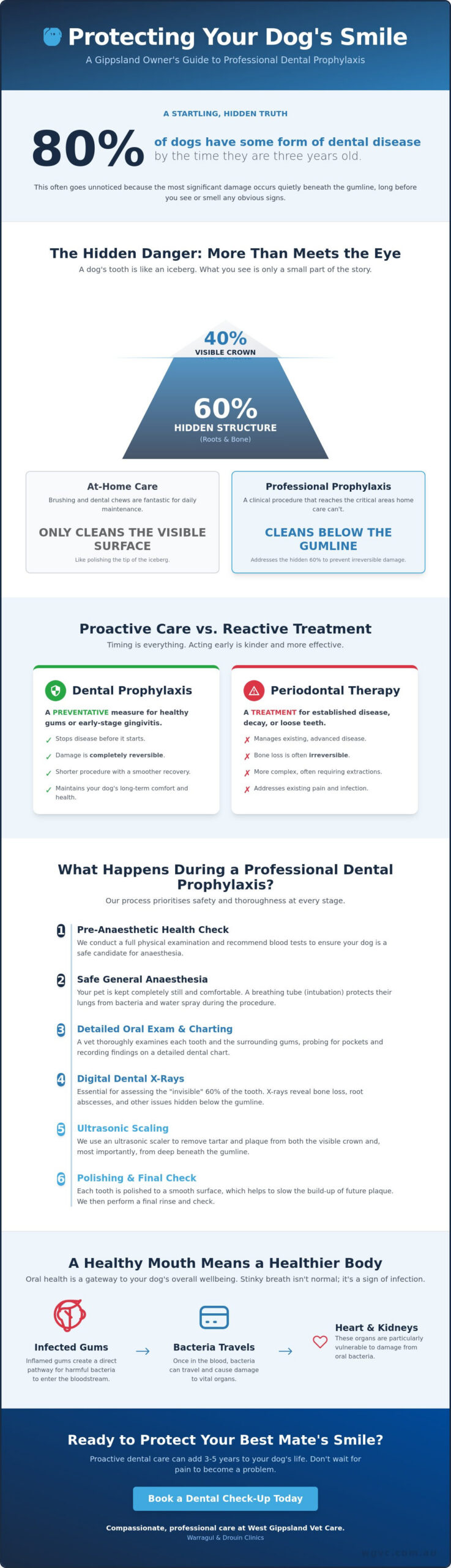
Did you know that by the time your dog celebrates their third birthday, there’s an 80% chance they are already living with some form of dental disease? It’s a startling statistic, yet the condition often goes unnoticed because the real damage happens quietly beneath the gumline. You might have noticed a bit of a smell when your pup gives you a lick, but many Gippsland owners don’t realise that stinky breath is actually a sign of discomfort. We know you want the best for your companion, and it’s natural to feel a little anxious about procedures involving general anaesthesia or to feel a bit of guilt about those dental smells.
In this guide, you’ll discover exactly why professional dental prophylaxis for dogs is the gold standard for protecting your best friend’s long term health and happiness. We’ll clear up the confusion between a basic scale and polish and a true medical prophy, providing a step by step look at how we keep your pet safe and comfortable throughout the process. From pre-op preparation to the moment they’re back in your arms with fresh breath and a pain free smile, you’ll gain the confidence you need to manage your dog’s oral health with ease.
Key Takeaways
- Learn how dental prophylaxis for dogs acts as a proactive shield, protecting your companion from hidden pain and irreversible bone loss.
- Understand why professional care is vital for reaching the 60% of the tooth structure that remains invisible beneath the gumline.
- Discover what happens during the procedure, from detailed oral charting to using digital X-rays to find issues that a simple visual check might miss.
- Get clear, practical advice on how to prepare your pup for their visit, including fasting instructions and the importance of pre-anaesthetic health checks.
- See how choosing a locally-owned Gippsland clinic provides your pet with a specialised dental suite and a team dedicated to a gentle, stress-free experience.
What is Dental Prophylaxis for Dogs?
Many pet owners naturally assume a dental visit is just about making teeth look pearly white again. However, professional dental prophylaxis for dogs is actually a comprehensive clinical treatment designed to protect your dog’s health long before problems become visible. The word “prophylaxis” literally means to prevent or guard against. It’s a preventative measure specifically for pets with healthy gums or very early-stage gingivitis. By choosing this proactive path, we can stop irreversible bone loss and keep your dog’s smile intact. In our Gippsland community, we truly believe that prevention is always kinder and more effective than waiting for a cure. It’s the difference between a routine maintenance check and a major repair.
The Vital Link Between Oral Health and Overall Wellbeing
Oral health isn’t just about the mouth; it’s a window into your dog’s total body health. When Dental disease takes hold, the gums become inflamed and porous. This creates a direct gateway for harmful bacteria to enter the bloodstream. Once inside, these bacteria can travel to and colonise vital organs, specifically affecting the heart valves and kidneys. That heavy “stinky dog breath” many people expect from older dogs isn’t a normal part of ageing. It’s often the first warning sign that active infection is present. Maintaining a healthy mouth can extend a dog’s lifespan by up to three to five years. It’s about much more than a fresh smell. It’s about giving them more years of comfort and vitality by your side.
Prophylaxis vs. Periodontitis: When to Act
Timing is everything when it comes to your dog’s comfort. We use dental prophylaxis for dogs when the mouth is in Stage 0 or Stage 1 gingivitis, meaning the damage is still completely reversible. If we wait until there is visible tooth decay, loose teeth, or deep pockets around the roots, we are no longer performing a “prophy.” At that point, the treatment shifts to periodontal therapy, which is more invasive and often requires extractions. Waiting for visible signs of decay makes the procedure more complex and can lead to unnecessary pain for your pet. We encourage you to drop into our Warragul or Drouin clinics for regular checks. Catching things early ensures a shorter procedure, a smoother recovery, and a much happier, pain-free companion.
Why Professional Dental Cleaning Beats At-Home Care
It is wonderful to see so many Gippsland families taking an active role in their dog’s oral hygiene. Whether you’re brushing their teeth every night or using VOHC-approved dental chews, these habits are fantastic for daily maintenance. However, even the most diligent home care has its limits. Think of it like our own dental routine. We brush and floss daily, but we still visit the dentist for a professional dental cleaning to reach the spots we simply cannot get to at home. We view ourselves as your partners in this journey, helping you bridge the gap between daily brushing and clinical health.
The challenge with canine teeth is that roughly 60% of the tooth structure is hidden beneath the gumline. This subgingival area is where bacteria love to hide and where the real damage of periodontal disease begins. While a chew might scrape plaque off the visible crown, it cannot reach the “invisible” areas where bone loss starts. This is why a clinical approach is necessary to ensure your dog stays pain-free. Relying only on surface cleaning is like painting over rust; it might look better for a while, but the underlying problem continues to grow.
You might have heard about “anaesthesia-free” dental cleaning. While it sounds appealing because it avoids the perceived risks of anaesthesia, it is actually quite stressful and potentially harmful for your dog. Scraping a conscious dog’s teeth only cleans the surface and can leave microscopic scratches in the enamel that actually trap more bacteria later. It’s a cosmetic fix that ignores the actual health of the gums and can even mask serious infections. True care requires a deeper, safer approach that only a veterinary professional can provide.
Why General Anaesthesia is Non-Negotiable for Safety
To perform a thorough dental prophylaxis for dogs, we need them to be completely still and relaxed. Anaesthesia allows us to clean deeply under the gingival margin without causing any distress or pain to your companion. We also use intubation, which involves placing a tube in the airway to ensure they breathe easily. This is critical because it protects your dog’s lungs from the water and bacteria released during the cleaning process. At our West Gippsland facility, we use modern monitoring equipment to track heart rate, oxygen levels, and blood pressure, ensuring your best friend is safe every second they are with us.
The Limitations of Dental Chews and “Raw Bones”
Dental chews are great for slowing down plaque, but once that plaque hardens into calculus, it becomes as hard as concrete. No chew can remove established calculus. We also see many dogs with painful fractured teeth caused by chewing on hard raw bones or antlers. These fractures often lead to infections and extractions that could have been avoided. Home care and professional prophys should work together as a team. If you’re worried about your dog’s breath, our friendly team is here to help you decide on the best next steps for your pet’s comfort.
Step-by-Step: What Happens During a Dental Prophylaxis?
We understand that leaving your dog at the clinic for a procedure can feel a bit daunting. Knowing exactly what happens behind the scenes can help ease that worry. A dental prophylaxis for dogs is a methodical, five-step process designed to leave your pup with a healthy, comfortable mouth. It’s far more involved than a quick brush; it’s a clinical reboot for their oral health. Our team treats every patient with the same gentle care we’d give our own pets, ensuring they feel safe and secure from start to finish.
The procedure follows a precise sequence to ensure nothing is missed:
- Step 1: A comprehensive oral exam and charting of every single tooth.
- Step 2: Digital intra-oral radiography to identify problems hidden beneath the gumline.
- Step 3: Ultrasonic scaling to remove plaque and calculus above and below the gums.
- Step 4: Polishing the enamel to smooth out the surface.
- Step 5: A final fluoride treatment or sealant application to strengthen the teeth.
Clinical Examination and Digital Radiography
Once your dog is safely under anaesthesia, we begin a detailed inspection. We use a specialised periodontal probe to check for “pockets” or gaps between the tooth and the gum. These pockets are often where bacteria hide and cause silent pain. Because we can’t see what’s happening inside the jawbone with our eyes alone, digital X-rays are vital. They help us find abscesses, root rot, or resorptive lesions that would otherwise go untreated. We document all these findings in a dental chart, which allows us to track your dog’s oral health journey over many years. This professional dental cleaning ensures we aren’t just guessing about your pet’s comfort.
Scaling and Polishing: The Core Treatment
The next stage involves an ultrasonic scaler. This tool uses high-frequency vibrations to gently shatter stubborn calculus without damaging the tooth itself. It’s incredibly effective at cleaning the subgingival space where brushes can’t reach. However, scaling can leave microscopic scratches on the enamel. If left alone, these tiny grooves would act like a magnet for new bacteria. That’s why polishing is such a critical part of dental prophylaxis for dogs. We use a soft rubber cup and a special paste to buff the teeth back to a smooth, glassy finish. This “clean slate” effect makes it much harder for plaque to stick in the future, giving your dog the best possible start for their home care routine.
How to Organise and Prepare for Your Dog’s Dental Day
Preparing for your companion’s dental visit is just as much about your peace of mind as it is about their physical health. We know that the morning of a procedure can feel a little stressful for any pet parent. By understanding the steps involved in dental prophylaxis for dogs, you can help ensure the day goes smoothly. Our team at the Warragul clinic is here to support you from the moment you walk through our doors, making sure both you and your pup feel calm and well-informed.
The journey begins before the actual cleaning starts. Every patient undergoes a thorough pre-anaesthetic health check. This physical exam allows us to listen to their heart and lungs, ensuring they are ready for their treatment. We treat every dog as an individual, tailoring our approach to their specific age, breed, and health history. This careful preparation is part of our commitment to providing the safest possible experience for your furry family member.
Pre-Op Preparation and Fasting
Safety is our absolute priority. To ensure the anaesthesia is as safe as possible, we follow a strict “nil by mouth” protocol. Most Gippsland pets will need to fast for approximately 8 to 12 hours before their appointment. Usually, this means no food after 8:00 pm the night before, though a small amount of water is typically fine until the morning. We also strongly recommend pre-anaesthetic blood work. These tests, performed in our in-house laboratory, allow us to check liver and kidney function. Since these organs process the anaesthetic, knowing they are healthy gives us an extra layer of confidence before we begin the dental prophylaxis for dogs.
On the morning of the visit, try to keep your routine as quiet and normal as possible. A short, gentle walk can help your dog burn off a little energy and settle their nerves. When you arrive at our Warragul centre, a nurse will go through the consent forms with you and answer any last-minute questions you might have.
Post-Procedure Care and Home Maintenance
When you pick up your dog in the afternoon, they might still be a little groggy or quiet. This is completely normal as the anaesthesia wears off. We suggest keeping them in a warm, quiet spot at home where they won’t be disturbed by other pets or busy family activity. You can usually offer a small, soft meal later that evening, such as boiled chicken or a softened version of their regular food. Most dogs are back to their bouncy selves within 24 hours.
Once the gums have had a few days to settle, it is the perfect time to resume your home brushing routine. We’ll schedule a follow-up check at West Gippsland Vet Care to see how the healing is progressing and to help you fine-tune your preventative plan. If you are ready to give your dog the gift of a healthy smile, contact our friendly team today to book a consultation.
Compassionate Dental Care at West Gippsland Vet Care
At West Gippsland Vet Care, we view our work as a vital service to the families who trust us with their animals. Choosing an independent, locally-owned practice means you’re not just another number in a corporate system. You are our neighbour. We’ve been a reliable fixture in this community since 1989, and that history allows us to build deep, lasting relationships with both our clients and their companions. When you bring your pet to us for a dental prophylaxis for dogs, you are placing them in the hands of a team that truly cares about their long-term comfort and happiness.
Our clinics are equipped with a specialised dental suite designed to provide the highest standard of care. This isn’t just about having the right tools; it’s about creating a safe, nurturing environment where your pet feels secure. Whether we are looking after a pampered Drouin poodle or a hardworking Neerim South kelpie, we tailor every dental plan to suit the specific needs of the individual dog. We understand that every pet has a unique personality and health history, and our commitment extends to all your companions — including feline family members who can benefit from our professional cat grooming in Drouin for a stress-free, vet-backed experience. We respect that bond in everything we do, from the first check-up to the final recovery.
Our Advanced In-House Diagnostic Facilities
Having an advanced diagnostic laboratory right here on-site makes a significant difference for your dog’s safety. It means we can get rapid results for pre-operative blood tests, allowing us to confirm your pet’s organ health before they even enter the dental suite. Our digital dental X-ray equipment provides the precision needed to see exactly what is happening beneath the gums. This ensures no hidden infection or root damage is left behind. We also place a heavy emphasis on proactive pain management. Our surgical team carefully monitors every patient, using tailored protocols to ensure a smooth, comfortable recovery from their dental prophylaxis for dogs.
A Personalised Approach for Every Gippsland Companion
We believe that open, honest communication is the foundation of great veterinary care. We invite you to give us a call to chat about your dog’s specific needs or any worries you might have about their oral health. Our goal is to provide a family-oriented environment where you feel heard and your pet feels loved. We are here to act as an extension of your support system, guiding you through every step of your dog’s health journey with kindness and expertise. Our seasoned professionals remain down-to-earth, prioritising the well-being of your companions above all else.
Ready to take the next step for your best friend’s health? Book a dental assessment for your dog at West Gippsland Vet Care and let us help you keep that tail wagging and that breath fresh for years to come.
Giving Your Dog the Gift of a Healthy, Pain-Free Smile
Your dog’s oral health is a journey that starts with the small choices you make every day. By understanding that dental prophylaxis for dogs is a medical necessity rather than a cosmetic luxury, you’re actively choosing a longer, more comfortable life for your best friend. We’ve explored how professional care uncovers hidden issues beneath the gumline and why a clinical environment ensures the safest possible outcome for your pet.
As an independent, locally-owned practice, we take pride in being a reliable part of your support system. Our advanced in-house diagnostic laboratory and dedicated dental suite are here to provide the precise care your companion deserves. We even offer 24-hour emergency care to our existing clients, giving you peace of mind that we’re always here when you need us most. This commitment to excellence ensures that your pet receives the highest standard of treatment in a nurturing, family-oriented environment.
Book your dog’s dental health check with our caring team today and let’s work together to keep those licks fresh and those tails wagging. We look forward to seeing you and your pup at our Warragul or Drouin clinics soon.
Frequently Asked Questions
Is dental prophylaxis for dogs safe for older pets?
Age itself is not a barrier to dental care, and we take extra precautions to ensure our senior patients are safe. We perform comprehensive pre-anaesthetic blood tests and physical exams to tailor the anaesthesia to your dog’s specific health needs. For many older pets, a professional dental prophylaxis is actually vital because it prevents oral bacteria from spreading to their heart and kidneys.
How much does a dog dental cleaning cost in Warragul?
The cost of a dental procedure depends on your dog’s size, age, and the current state of their oral health. Because every pet’s needs are unique, we provide a detailed range of costs following an initial dental assessment at our clinic. This ensures you have a clear understanding of the treatment plan and associated fees before we begin any work.
How often should my dog have a professional dental prophylaxis?
Most dogs benefit from a professional dental prophylaxis for dogs once every twelve months to keep their gums healthy. However, some breeds or individuals who are prone to rapid plaque build-up may require a check-up every six months. Regular visits allow us to catch early signs of gingivitis before they turn into more painful or complex problems.
Will my dog be in pain after the dental procedure?
Since a prophylaxis is a preventative treatment for healthy or mildly inflamed gums, most dogs feel immediate relief rather than pain. We use proactive pain management protocols to ensure your companion wakes up feeling comfortable and relaxed. Most pets are happy to eat a soft meal and return to their normal activities by the following morning.
Can I clean my dog’s teeth at home instead of a vet visit?
Daily brushing and dental chews are excellent for maintenance, but they cannot replace a clinical cleaning. Home care is unable to remove hardened calculus or reach the bacteria living deep beneath the gumline. Think of your at-home efforts as the daily maintenance that makes the professional deep clean even more effective for your dog’s longevity.
What happens if my vet finds a bad tooth during the prophylaxis?
If we discover a fractured or infected tooth during the procedure, we will contact you immediately to discuss our findings. We follow the guidelines of the Veterinary Practitioners Registration Board of Victoria by obtaining informed consent before performing any extractions. This ensures you are always in control of your pet’s treatment plan and the associated costs.
How long does the dental prophylaxis procedure take?
The clinical cleaning and X-ray process usually takes between 45 and 90 minutes to complete thoroughly. Your dog will stay with us for the day so that our nursing team can provide dedicated one-on-one monitoring during their recovery. This allows us to ensure they are fully awake, comfortable, and ready to head home with you in the afternoon.
Does my dog really need to be put under general anaesthesia?
Yes, general anaesthesia is the only safe way to perform a complete oral exam and a deep subgingival cleaning. It allows us to protect your dog’s airway from water and bacteria while ensuring they remain perfectly still for accurate X-rays. Most importantly, it removes any potential for stress or pain, making the experience much kinder for your pet.