Did you know that German Shepherds represent more than 25% of all emergency bloat cases? For many local families, the constant worry that their happy, active dog might suddenly face a life-threatening stomach twist is a heavy burden to carry. We understand that your Shepherd is more than just a pet; they’re a cherished member of your family. That’s why more owners are choosing prophylactic gastropexy for German Shepherds Drouin as a gentle, proactive way to ensure their best friend stays safe. It’s completely natural to feel anxious about the idea of surgery, but modern veterinary care has made protecting your dog simpler and kinder than ever before.
In this guide, you’ll learn how a preventative stomach tack can transform a 30% mortality risk into a manageable safety net, giving you total peace of mind. We’ll explore why local owners are choosing advanced keyhole surgery to provide a faster, low-pain recovery compared to traditional methods. From understanding the best age for the procedure to seeing how our team supports you every step of the way, you’ll discover how this simple step helps your dog live a long, healthy life by your side.
Key Takeaways
- Understand why the German Shepherd’s deep-chested build puts them at high risk for GDV and how to distinguish between simple bloat and a life-threatening stomach twist.
- Learn how prophylactic gastropexy for German Shepherds Drouin provides a permanent “stomach tack” that prevents the stomach from twisting, even if gas builds up.
- Compare the benefits of advanced keyhole surgery against traditional methods to ensure your dog experiences less discomfort and a much speedier return to their favourite activities.
- Discover why combining this preventative step with your dog’s desexing procedure is the gold standard for minimising anaesthesia and recovery time.
- Get practical tips for managing your dog’s recovery at home in West Gippsland, ensuring their tiny surgical sites heal perfectly while keeping them calm and comfortable.
Understanding GDV: Why Drouin German Shepherd Owners Are Concerned
Owning a German Shepherd in Drouin often means enjoying long walks through the rolling hills of West Gippsland. However, for many owners, there is a quiet anxiety that sits in the back of the mind. It is the fear of “bloat,” a condition that can turn a normal evening into a life-threatening crisis in minutes. While many people use the term bloat to describe a stomach filled with gas, the true danger lies in a condition called Gastric Dilatation Volvulus (GDV). This occurs when the gas-filled stomach actually twists on its axis, trapping the air and cutting off vital circulation. Because of their unique, deep-chested build, German Shepherds are significantly more prone to this rotation than other breeds.
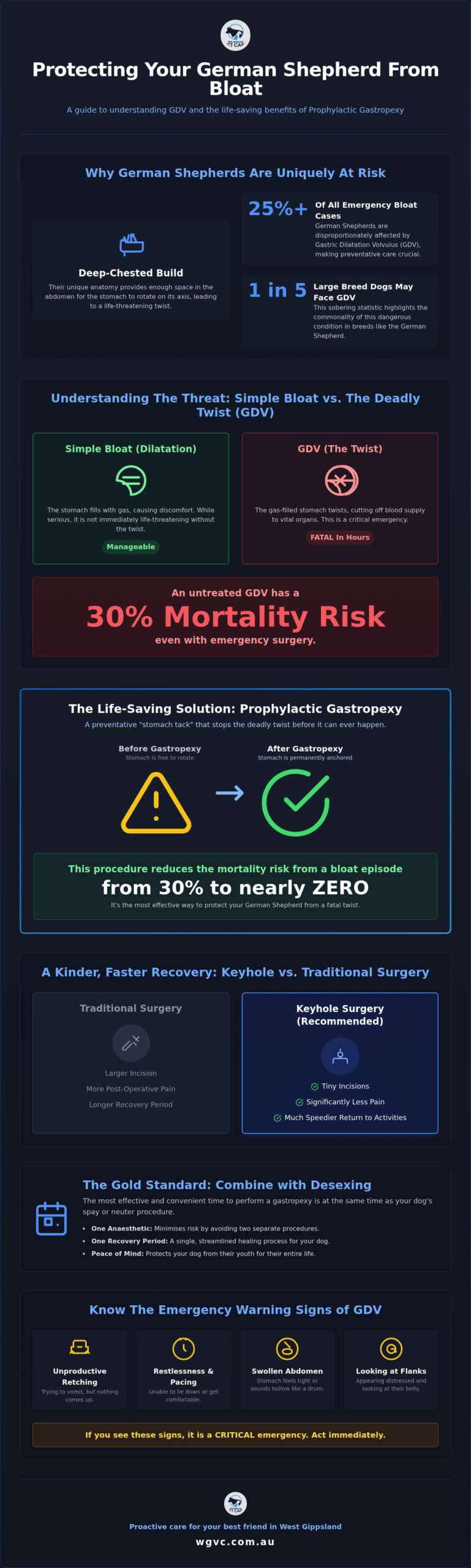
Current research indicates that as many as 20% to 25% of large breed dogs may face this condition during their lifetime. For local families, this “one in five” statistic is a sobering reality. It means that without preventative measures like prophylactic gastropexy for German Shepherds Drouin, the risk is a constant companion. The speed of GDV is particularly terrifying; the stomach can twist and begin to suffer tissue death within just an hour or two. In our regional area, where reaching an emergency vet centre can take time, every second is precious.
The Anatomy of a Stomach Twist
Imagine the stomach as a heavy bag suspended by two points. In deep-chested dogs, there is enough physical space in the abdomen for this bag to swing and eventually flip over. When this rotation happens, the entry and exit points of the stomach are pinched shut. Gas produced by digestion stays trapped, causing the stomach to swell like a balloon. This pressure doesn’t just cause immense pain; it compresses the large blood vessels returning to the heart. Because the spleen is attached to the stomach, it often twists along with it, leading to further internal bleeding and severe organ damage.
Recognising the Warning Signs in Your Shepherd
Speed is the only ally when GDV strikes. The most common sign is unproductive retching, where your dog looks like they are trying to vomit but nothing comes up. You might also notice their abdomen feeling tight or sounding hollow like a drum when tapped. Most Shepherds will become incredibly restless, pacing the floor or looking at their flanks in distress. If you see these signs, it is a critical emergency. This high-stakes reality is exactly why many owners now choose prophylactic gastropexy for German Shepherds Drouin to stop the twist before it ever has a chance to happen.
What is Prophylactic Gastropexy (A Preventative Stomach Tack)?
Choosing prophylactic gastropexy for German Shepherds Drouin isn’t just about a medical procedure; it’s about making a lifelong promise to your dog. In the simplest terms, “prophylactic” means preventative. Rather than waiting for an emergency to strike and reacting under pressure, you’re taking a proactive step while your dog is healthy and strong. It’s a strategic safety net that addresses the mechanical vulnerability of the German Shepherd’s deep chest, providing a level of security that every large breed owner deserves.
One of the most important things to understand is what this surgery actually does. It doesn’t stop a dog’s stomach from filling with gas, which is known as simple bloat, but it does stop that gas-filled stomach from performing the fatal rotation known as volvulus. Expert research from Cornell University on GDV explains that the twist is what creates the true medical crisis by cutting off blood flow to vital organs. By anchoring the stomach, we remove that life-threatening risk from the equation.
How the Procedure Saves Lives
During the surgery, the vet creates a permanent connection between the outer layer of the stomach and the abdominal wall. As this heals, it forms a strong, fibrous bond that keeps the stomach in its correct position. Prophylactic gastropexy is a permanent surgical anchor for the stomach. This anchor is incredibly effective; studies show it can reduce the recurrence of twisting from 80% down to less than 5% in dogs that have previously bloated. In preventative cases, it brings the mortality risk of a bloat episode down from 30% to nearly zero. It’s the difference between a manageable trip to the vet for gas relief and a frantic, high-stakes emergency surgery.
Why This Matters for West Gippsland Dogs
Living in beautiful areas like Drouin or Warragul is wonderful for active Shepherds, but it can feel very isolated when every minute counts. If your dog’s stomach twists at 11:00 PM on a Sunday, the time it takes to recognise the signs and drive to an emergency centre can be the difference between a recovery and a tragedy. The emotional toll of making life-or-death decisions in the middle of the night is immense. By opting for advanced care from an Orthopaedic Vet Gippsland families trust, you’re ensuring that the crisis never happens in the first place. It’s about giving yourself the peace of mind that your mate is protected, no matter where your local adventures take you. If you’re wondering if this is the right path for your dog, we’re always here for a gentle chat about your pet’s needs.
Keyhole vs. Traditional Gastropexy: Choosing the Best Path
When you decide to protect your dog from the risk of a stomach twist, the next question is usually about the “how.” For decades, the traditional approach involved “open” surgery. This method requires a large abdominal incision, often between 10 and 20 centimetres long, to allow the vet to see and reach the stomach directly. While effective, this larger wound involves cutting through significant layers of muscle and tissue, which naturally leads to more post-operative discomfort and a longer journey toward full healing.
Modern veterinary medicine has provided a much kinder alternative. Choosing prophylactic gastropexy for German Shepherds Drouin now frequently means opting for the laparoscopic or “keyhole” method. Instead of one large opening, the surgeon uses two or three tiny ports, each about the size of a five-cent piece. This approach focuses on precision and minimal trauma, which is why it has quickly become the modern gold standard for proactive owners in West Gippsland.
The Laparoscopic Advantage for Active Breeds
German Shepherds are built for movement, and their athletic nature makes them sensitive to internal trauma. Keyhole surgery uses high-definition cameras that provide the surgeon with exceptional visualisation, often better than what can be seen with the naked eye during traditional surgery. Because the internal organs are handled far less, there is a massive reduction in the inflammatory response that causes pain. These smaller wounds also mean a significantly lower risk of surgical site infections, which is a relief for owners of curious dogs who love to explore the local Drouin paddocks.
Recovery Timelines: What to Expect
The difference in the days following surgery is where the benefit of the keyhole approach truly shines. A traditional open surgery usually demands 10 to 14 days of strict confinement to ensure the large incision doesn’t pull or tear. For a high-energy Shepherd, two weeks of total rest can be incredibly stressful for both the dog and the family. In contrast, dogs undergoing Prophylactic Gastropexy via the laparoscopic method are often ready for gentle lead walks within just a few days. We prioritise a “Fear-Free” surgical experience here in Gippsland, focusing on calm preparation and smooth recovery. This gentler intervention means your mate can return to their favourite routines much sooner, with far less discomfort and a much smaller scar to show for it.
Timing and Logistics: When Should Your Shepherd Have Surgery?
Finding the right window for your dog’s surgery is a key part of their long-term health plan. For most German Shepherds, the ideal time to perform a preventative stomach tack is between 6 and 12 months of age. This timing is chosen carefully to allow your dog’s skeletal system and major organs to develop sufficiently while still protecting them before they reach their peak “at-risk” years. Because Shepherds are a large breed with specific growth requirements, we always tailor the schedule to your individual dog’s physical maturity and lifestyle.
One of the most significant advantages for local owners is the ability to choose a combined procedure. By performing the prophylactic gastropexy for German Shepherds Drouin at the same time as their desexing, we can achieve two major health goals in a single visit. This approach is widely considered the gold standard because it limits your dog to a single anaesthetic event. Minimising the number of times a pet undergoes anaesthesia reduces overall risk and means they only have one recovery period to navigate, rather than two separate healing journeys weeks or months apart.
Combining Keyhole Spay and Gastropexy
The efficiency of the laparoscopic method is truly remarkable. During a combined keyhole spay and gastropexy, our surgeons can often utilise the same tiny port sites to complete both tasks. This streamlined approach is much kinder to your dog’s body, as it involves less internal handling and fewer incisions. It is also a far more cost-effective option for families. By grouping the procedures, you significantly reduce the cumulative costs of surgical theatre time, anaesthetic monitoring, and post-operative medications. If you are a member of the breeding community, consulting with a Canine Reproduction Vet Victoria expert can help you coordinate these preventative steps with other essential health screenings.
Pre-Surgical Preparation in Drouin
We want you to feel completely at ease on the morning of your dog’s procedure. Our preparation process is designed to be as calm and thorough as possible. We generally provide clear fasting instructions for the night before to ensure your dog’s stomach is empty and safe for anaesthesia. Once you arrive at the clinic, our team performs a comprehensive physical assessment. Pre-anaesthetic blood work is a vital safety check at West Gippsland Vet Care. By using our in-house laboratory, we can review your dog’s kidney and liver function in real-time, giving us the green light to proceed with the highest level of confidence. If you’re ready to plan this protective step for your mate, book a consultation with our friendly Drouin team to discuss the best timing for your dog.
Post-Operative Care for Your Mate in West Gippsland
Once your best friend returns home after their prophylactic gastropexy for German Shepherds Drouin, the focus shifts to a calm and steady recovery. While the laparoscopic approach is significantly gentler than traditional surgery, your dog has still undergone a meaningful internal procedure. In the lush, open spaces of West Gippsland, managing a high-energy Shepherd can be a bit of a challenge. Even if they feel like jumping and playing within a day or two, their internal “stomach tack” needs time to form a strong, permanent bond with the abdominal wall. Our team is here to guide you through this transition, ensuring your dog stays comfortable and safe while they heal.
One of the biggest advantages of the keyhole method is the size of the surgical sites. You’ll only need to monitor two or three tiny port sites, which are usually less than a centimetre long. We recommend checking these daily for any unusual redness, discharge, or significant swelling. Modern veterinary medicine prioritises comfort, so we’ll provide a tailored pain management plan to keep your dog relaxed. Most owners find that their Shepherds are surprisingly bright and happy after surgery, but keeping them quiet remains the priority for the first week.
Managing the First 48 Hours
The first two days are all about rest. It’s best to set up a quiet “recovery zone” indoors where your dog can’t be tempted by the local wildlife or other pets. Lead-only toilet breaks on Gippsland farms are essential during this window. Even if your property is securely fenced, a sudden dash after a bird or a rabbit could put unnecessary strain on their internal sutures. If you ever feel concerned about your dog’s progress, remember that we provide 24-hour emergency support to our existing clients, so expert help is only a phone call away.
Feeding After Gastropexy
Digestion plays a role in how the stomach settles after surgery. We typically recommend offering small, frequent meals for the first few days rather than one large bowl of kibble. This reduces the physical weight in the stomach while the adhesion is at its most delicate. Moving forward, maintaining a “bloat-prevention” lifestyle is a great habit for any Shepherd owner. This includes using slow-feeder bowls or slightly elevated feeding stations to reduce the amount of air swallowed during mealtime. While you are focusing on preventative health, it is also a good time to review your general emergency preparedness, such as knowing the signs of Snake Bite Treatment for Dogs in Gippsland, especially as the weather warms up across our local paddocks and trails.
Protecting Your Best Friend’s Future
Choosing to protect your dog from the sudden threat of bloat is one of the most compassionate decisions you can make as an owner. By opting for prophylactic gastropexy for German Shepherds Drouin, you’re replacing constant worry with the certainty that your mate is safe from a life-threatening stomach twist. Our team at West Gippsland Vet Care is proud to be a locally-owned independent practice dedicated to providing the highest standard of care for our community. We use advanced keyhole surgery to ensure your dog experiences less pain and a much faster recovery, allowing them to get back to their favourite Gippsland trails sooner.
We believe in being a partner in your pet’s health journey. That’s why we offer 24-hour emergency support for all our surgical clients, giving you total peace of mind long after you leave our clinic. If you’re ready to take this proactive step for your dog’s well-being, we invite you to have a gentle chat with our experts. Book a preventative gastropexy consultation with our Drouin team today. Together, we can ensure your Shepherd enjoys a long, happy, and active life by your side.
Frequently Asked Questions
Is prophylactic gastropexy 100% effective in preventing bloat?
Prophylactic gastropexy is over 95% effective at preventing the life-threatening stomach twist known as volvulus. It’s important to understand that while the surgery doesn’t stop the stomach from filling with gas, it ensures the organ stays anchored in its correct position. This transforms a potential surgical emergency into a much more manageable situation that can often be treated with medical therapy alone, providing a vital safety net for your dog.
Will my German Shepherd still be able to run and play normally after a stomach tack?
Absolutely, your dog will return to their full, active lifestyle once the initial healing period is complete. The “stomach tack” is designed to be a permanent, internal anchor that doesn’t restrict movement or affect digestion in any way. After about two weeks of restricted activity to allow the bond to strengthen, your Shepherd can get back to running through the Drouin paddocks and playing just as they did before.
Can keyhole gastropexy be performed on an older dog, or is it only for puppies?
Keyhole surgery is a fantastic option for adult dogs and seniors as well as puppies. While many owners choose to combine the procedure with desexing, we can perform a prophylactic gastropexy for German Shepherds Drouin at any stage of their life. We’ll simply perform a thorough health check and pre-anaesthetic blood work to ensure your older mate is a healthy candidate for the procedure before moving forward.
What is the cost difference between traditional and laparoscopic gastropexy in Drouin?
Laparoscopic gastropexy generally involves a higher initial investment than traditional open surgery because of the advanced specialised equipment and high-definition cameras required. However, many local families find the overall value is exceptional. When you factor in the reduced need for post-operative pain medications, fewer follow-up visits for wound complications, and a much faster return to your dog’s normal routine, the modern keyhole approach is a very sensible choice.
How long does the gastropexy surgery take at West Gippsland Vet Care?
A stand-alone prophylactic gastropexy typically takes between 45 and 60 minutes of surgical time. If we are performing a combined procedure with a keyhole spay, the total time under anaesthesia is usually around 90 minutes. Our team focuses on a calm, steady pace to ensure every step is completed with precision, prioritising your dog’s safety and comfort throughout their entire stay at our Drouin clinic.
What happens if my dog needs emergency bloat surgery and hasn’t had a preventative tack?
Emergency surgery for a stomach that has already twisted is a high-stakes, intensive procedure that carries a much higher risk for your pet. Without a preventative tack, the surgeon must untwist the stomach, assess for tissue death, and potentially remove the spleen if it has been damaged. This is why we advocate for a proactive approach, as it avoids the trauma and uncertainty of a middle-of-the-night medical crisis.
Can I see the laparoscopic equipment used for my dog’s surgery?
We would be more than happy to show you our advanced laparoscopic suite during your consultation. As a locally-owned practice, we take great pride in our investment in modern technology for the West Gippsland community. Seeing the tiny cameras and specialised instruments often helps owners feel much more at ease about the “keyhole” nature of the procedure and understand how we achieve such small incisions for their pets.
Is gastropexy covered by pet insurance for German Shepherds?
Coverage for preventative procedures varies significantly between Australian insurance providers and specific policies. Most standard plans view a prophylactic gastropexy for German Shepherds Drouin as an elective preventative step, similar to desexing, and may not cover it unless you have a “routine care” add-on. We always recommend giving your insurer a quick ring to clarify your specific level of cover before you decide to book the surgery.