

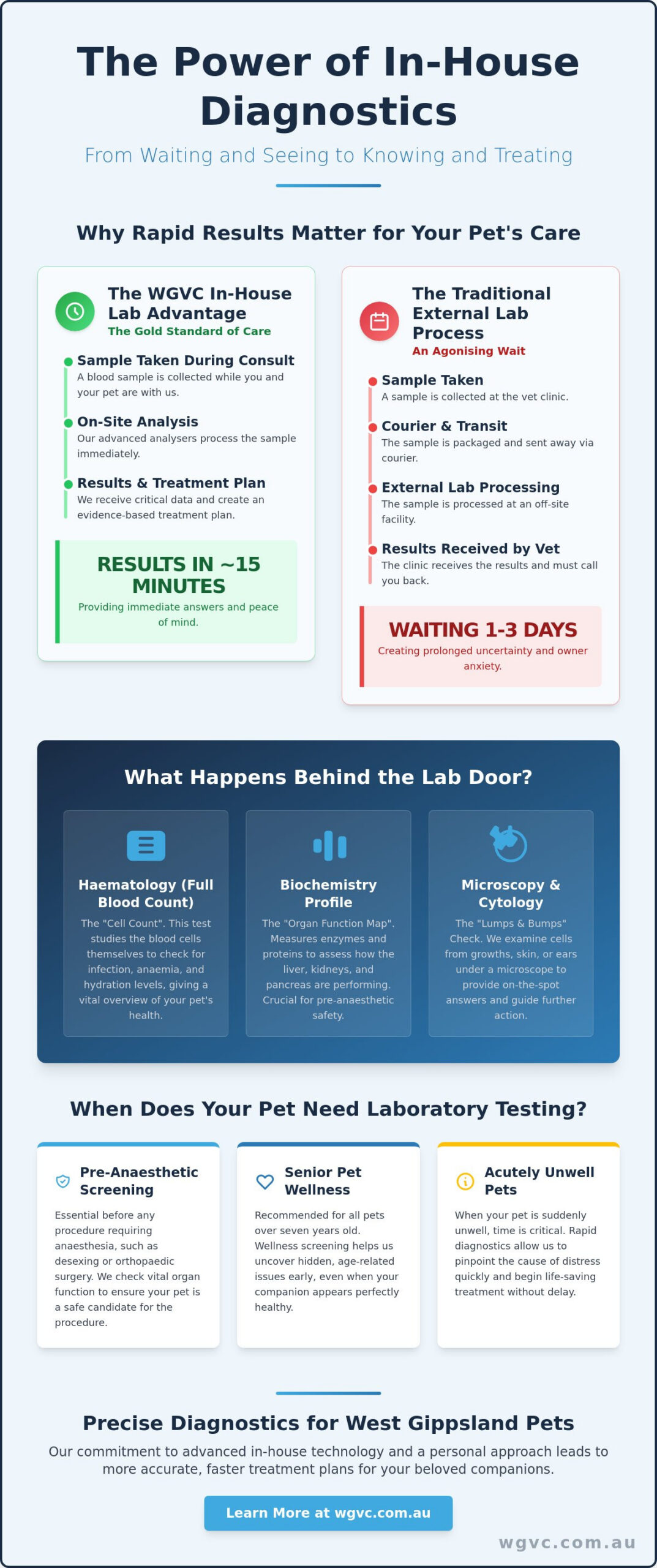
Imagine sitting by the phone for three long days, heart in your mouth, waiting for an external lab to call back with your senior dog’s results. It’s an agonising wait that no pet owner in West Gippsland should have to endure, especially when your companion’s health feels fragile. We understand that your animals are cherished members of the family, and when they’re unwell, you need answers now, not next week. That’s why our in-house vet laboratory is such a cornerstone of our practice. By performing diagnostic tests right here on-site, we’re able to move from uncertainty to a clear, evidence-based treatment plan in a matter of minutes.
In this guide, you’ll learn how our rapid diagnostics create a safer experience during routine desexing or orthopaedic surgery by checking vital organ function beforehand. We’ll also discuss how we stay ahead of the curve, adhering to the new April 2026 regulatory standards for in-house testing to ensure your pet receives the most precise care possible. You’ll discover how we uncover hidden issues in older pets and provide the reassurance you need to help them live their happiest life. Let’s explore how we turn “waiting and seeing” into “knowing and treating” for your beloved companions.
Key Takeaways
- Learn how an in-house vet laboratory provides the “Gold Standard” of care by delivering immediate data for clinical decisions right inside our surgery.
- Understand the vital role of blood chemistry profiles and full blood counts in evaluating your pet’s internal organ health and hydration levels.
- Discover the specific situations where we utilise our on-site suite for rapid answers versus when we partner with external specialists for complex pathology.
- Find out why “wellness screening” is essential for senior cats and dogs over seven years old, even when they appear perfectly healthy on the outside.
- See how combining advanced diagnostic technology with a gentle, personal approach leads to more precise treatment plans for your local companions.
The Role of an In-House Vet Laboratory in Modern Pet Care
An in-house vet laboratory is much more than just a collection of machines in a back room; it’s a dedicated suite of diagnostic tools located right inside our surgery. Having these resources on-site allows us to practice what we call the “Gold Standard” of care. This means we don’t have to guess what’s happening inside your pet’s body. Instead, we gather immediate, objective data to guide our clinical decisions while you’re still in the consultation room. For our West Gippsland community, where a trip to the vet might involve a drive from a surrounding farm or a busy town centre, this efficiency is vital. We often start with a “Minimum Database” of tests for any sick patient. This baseline provides a clear picture of your pet’s health, ensuring we don’t miss hidden clues that a physical exam alone might not reveal.
Our commitment to maintaining a high-quality in-house vet laboratory means your pet always has access to the most reliable information. We take this responsibility seriously, ensuring our equipment and processes align with the latest industry benchmarks. This dedication to precision allows us to act as a trusted partner in your pet’s health journey, providing clarity when you need it most.
Why Speed Matters in Veterinary Medicine
When a pet is acutely unwell, their internal organ function can shift with surprising speed. Waiting 24 to 48 hours for an external lab to process samples is often too long when every hour counts. Our on-site facility reduces that wait to just 15 minutes. This rapid turnaround isn’t just about medical efficiency; it’s about your peace of mind. We’ve seen how the heavy cloud of owner anxiety lifts when we can provide answers during the very same visit. By understanding the science of veterinary clinical pathology, we can pinpoint the cause of distress and start the right treatment immediately.
The Technology Behind the Results
Our laboratory is equipped with advanced analysers that handle both haematology and biochemistry with incredible precision. These machines look at everything from red blood cell counts to liver and kidney enzymes. We also utilise digital microscopy, which is a powerful tool for identifying tiny parasites or abnormal cells that might be causing your pet discomfort. To ensure the highest level of care, every result is automatically integrated into your pet’s digital medical records. This creates a seamless history of their health, allowing us to track subtle changes over time and collaborate more effectively on their long-term wellness. It’s about using modern technology to support the timeless bond you share with your companion.
Essential Diagnostic Tests: What Happens Behind the Lab Door?
When you bring your pet to us because they’re “just not themselves,” we often need to look beneath the surface to find the cause. Behind the laboratory door, our team performs a variety of precise tests that act as a window into your pet’s internal world. One of the most common tools we use in our in-house vet laboratory is the Full Blood Count, or FBC. This test allows us to check for signs of infection, identify anaemia, and assess hydration levels. In our rural West Gippsland environment, where pets might encounter local irritants or hidden illnesses, having this data on hand within minutes is a game changer for their recovery.
We also frequently perform cytology, which involves using a microscope to examine cells from “lumps and bumps” or itchy ears. Instead of sending a sample away and waiting for a courier, we can often give you an answer during your appointment. This immediate feedback helps us decide if a growth is a simple fatty lipoma or something that requires more attention. It’s about giving you the facts so we can make the best decisions for your companion together.
Haematology and Biochemistry Explained
It helps to think of blood testing in two distinct parts. Haematology is the study of the blood cells themselves, such as the red cells that carry oxygen and the white cells that fight disease. Biochemistry is different; it’s a chemical map of internal organ health. A biochemistry profile tells us how the liver, kidneys, and pancreas are performing by measuring specific enzymes and proteins in the blood. We also look closely at electrolytes, which are vital minerals that keep the body’s systems in balance. These results are essential for guiding intravenous fluid therapy during emergency care, ensuring your pet receives exactly what their body needs. This level of diagnostic rigour mirrors the high standards supported by the FDA’s Vet-LIRN network, which emphasises the importance of laboratory precision in protecting animal health.
Urinalysis and Parasitology
A urine sample is often just as revealing as a blood test, particularly for our senior dogs and cats. Urinalysis provides a vital window into metabolic health and can flag early-stage kidney issues or diabetes before physical symptoms even appear. In our in-house vet laboratory, we also screen for crystals or bacteria to prevent the development of painful bladder stones. Because we live in a beautiful but rugged part of Victoria, we also use parasitology to check for Gippsland-specific parasites through faecal analysis. By identifying the exact type of worm or protozoa affecting your pet, we can prescribe the most effective treatment rather than relying on a “one size fits all” approach. This targeted care keeps your pet comfortable and protects the rest of your family too.
In-House vs. External Pathology: Choosing the Right Path
While we are incredibly proud of our extensive in-house vet laboratory, we view it as a vital part of a much larger diagnostic network. It isn’t a matter of one being better than the other; rather, it’s about choosing the most effective tool for your pet’s specific situation. Our vets carefully organise the diagnostic path based on clinical urgency and the depth of information required. By balancing on-site speed with the depth of external specialist knowledge, we ensure your companion receives the most thorough care possible.
To maintain the highest standards, we treat our on-site equipment with the same rigour as a major reference facility. We use external labs for regular quality control programmes, ensuring our machines remain perfectly calibrated and accurate. This level of precision allows us to offer diagnostic insights comparable to world-renowned institutions like Cornell’s Animal Health Diagnostic Center, right here in West Gippsland. It’s about bringing global standards to our local community.
When In-House is the Only Choice
There are moments when waiting even a few hours isn’t an option. In emergency trauma cases, every minute is a precious resource for survival. We need to know immediately if there is internal bleeding or organ distress to begin life-saving treatments. Similarly, we rely on our in-house vet laboratory for pre-anaesthetic checks on the morning of a scheduled surgery. Whether your pet is here for a routine desexing or a complex orthopaedic procedure, these last-minute checks confirm they are in the best possible shape for the anaesthetic. For pets staying in our Warragul hospital, real-time monitoring allows us to adjust treatments and fluid therapy as their condition changes throughout the day.
The Value of Specialist External Pathology
Some health journeys require a more specialised lens. When we perform a biopsy on a complex lump, we send the tissue to external veterinary pathologists who specialise in histopathology. These experts provide a detailed “second opinion” on cell architecture, which is crucial for staging certain cancers or identifying rare skin diseases. External labs are also our go-to for ultra-specific hormone markers or genetic testing that requires highly specialised equipment. We understand that sending samples away can feel like a delay, so we manage the entire process for you. From coordinating the specialised couriers to interpreting the final report, we keep you informed every step of the way, ensuring the specialist’s findings are integrated into a clear, personal treatment plan for your pet.
When Does Your Pet Need Laboratory Testing?
One of the most frequent questions we hear from pet owners is: “My dog is acting normally, so why do we need blood work?” It is a fair question. However, pets are naturally stoic and have evolved to hide discomfort until a condition is often quite advanced. Using our in-house vet laboratory for routine wellness screening is particularly vital for senior cats and dogs aged seven and over. Just as we might have more regular check-ups as we age, these tests help us catch early signs of kidney decline, thyroid issues, or diabetes before your pet actually feels unwell. By detecting these shifts early, we can often manage conditions with simple diet changes or medication, ensuring your companion stays comfortable for years to come.
Diagnostics aren’t just for when things go wrong; they are a proactive tool for long-term health. Whether your pet is a playful puppy or a quiet senior, these tests provide a baseline that we can compare against in the future. This allows us to spot subtle trends that might otherwise go unnoticed during a physical exam alone. It’s about having a complete picture of your pet’s internal health, giving you the confidence that you’re doing everything possible for their well-being.
This proactive approach to well-being is increasingly common in human medicine too, where digital tools make it easier to stay on top of your health; for instance, you can visit Aussie Scripts to learn more about convenient telehealth options.
The Pre-Anaesthetic Safety Net
Before any procedure involving anaesthesia, such as a routine desexing or orthopaedic surgery, we strongly recommend a pre-surgical blood panel. This acts as a vital safety net to ensure your pet’s liver and kidneys are functioning well enough to process the medications. Industry data suggests that roughly 1 in 10 pets who appear perfectly healthy on the outside have a hidden underlying issue that is only discovered through these pre-op tests. If we do find an abnormality, it doesn’t always mean we cancel the surgery. Instead, it allows us to adjust the anaesthetic protocol, provide extra intravenous fluid support, or tailor the pain management plan to keep your pet as safe as possible throughout the procedure.
Gippsland Emergencies: Snake Bites and Toxicity
Living in our beautiful part of West Gippsland means our pets share the landscape with local wildlife, which can occasionally lead to dangerous encounters. During the warmer months, tiger and brown snake bites are a significant concern for local pet owners. In these high-pressure moments, our in-house vet laboratory is indispensable. We can perform rapid blood clotting tests to confirm a snake bite and determine its severity within minutes. This speed is critical for starting life-saving anti-venom treatment. We also use our lab to monitor for tick paralysis or the effects of local plant toxicities. Knowing how to respond in the moments before you reach us can make a real difference, which is why we recommend familiarising yourself with our pet first aid guide for West Gippsland pet owners so you feel confident and prepared in any emergency. For cat owners in particular, understanding the steps involved in cat injury treatment before arriving at our clinic can be just as important as the diagnostic work we perform on-site. For our existing clients, having access to these diagnostic tools during emergency care provides a vital layer of protection when every second counts. If you want to be fully prepared for these frightening situations, our detailed guide on snake bite treatment for dogs in Gippsland walks you through exactly what to do and what to expect.
Precise Diagnostics for West Gippsland Pets at WGVC
Our team at West Gippsland Vet Care is deeply committed to providing the families of Drouin, Warragul, and the surrounding districts with the very best in modern veterinary technology. While our in-house vet laboratory is filled with sophisticated analysers, we never forget that there is a beloved family member behind every blood sample. We view these diagnostic tools as a way to honour the bond you share with your pet by providing the most accurate and compassionate care possible. Our staff undergo regular, intensive training to ensure they can interpret complex data with precision, turning raw numbers into meaningful health outcomes for your companion. It is this blend of clinical expertise and a down-to-earth, local approach that defines our practice.
We understand that a visit to the vet can sometimes feel overwhelming, especially when tests are involved. That is why we prioritise a gentle authority that puts both you and your pet at ease. Whether you are coming in from a farm in Neerim South or a home in the heart of Warragul, you can expect a warm welcome and a team that truly cares about your pet’s story. We are here to act as a reliable community fixture, ensuring that high-level medical care is always accessible and delivered with a personal touch. This commitment to professional, local service is a value shared by many healthcare leaders internationally; for example, you can visit Ready Health to see how private human medical care is being transformed through dedicated home visits.
A Partnership in Your Pet’s Health
We believe that you are the most important member of your pet’s healthcare team. Because you know your pet’s quirks and habits better than anyone, your observations are a vital part of the diagnostic puzzle. When we receive results from our in-house vet laboratory, we sit down with you to explain the findings in plain English. We steer clear of confusing medical jargon because we want you to feel empowered and informed about your pet’s health. This collaborative approach ensures that the treatment plan we create together is based on evidence and tailored to your pet’s unique lifestyle and needs. It’s about building a relationship of trust where your concerns are heard and your pet’s well-being is always the priority.
Getting Started with Proactive Care
The best time to think about diagnostics is before a health concern arises. We encourage local owners to consider routine wellness checks during annual pet vaccinations. These screenings provide a “healthy baseline” that can be incredibly useful if your pet ever becomes unwell in the future. If we recommend a blood or urine test, we’ll guide you through the simple preparation steps, such as fasting your pet for a few hours to ensure the most accurate readings. By taking these proactive steps, we can work together to catch potential issues early and keep your companion by your side for as long as possible. If you have any questions about how these tests could benefit your dog or cat, please feel free to reach out. We invite you to Contact West Gippsland Vet Care to discuss your pet’s health needs and discover how our dedicated team can support your pet’s journey toward a long and vibrant life.
Providing Clarity and Care for Your Best Friend
Choosing to investigate your pet’s health through our in-house vet laboratory is about more than just gathering data; it’s about gaining the peace of mind that comes from swift, accurate answers. We have explored how these rapid diagnostics turn anxious minutes into clear milestones, whether we are ensuring a safe path through surgery or identifying a hidden health concern in a senior companion. As an independent, locally owned Gippsland practice, we are proud to offer this advanced technology alongside our specialised laparoscopic and orthopaedic surgery suite. Our commitment to your family doesn’t end when the sun goes down, as we also provide 24-hour emergency care to our existing clients when they need us most.
We are here to be your trusted partner, helping your animals live long, happy lives by your side. If you’re ready to take a proactive step in your pet’s health journey, we would love to help. Book a wellness check or consultation at our Warragul clinic today. Let’s work together to ensure your cherished companion enjoys many more vibrant, healthy years in our beautiful West Gippsland community.
Frequently Asked Questions
Why does my pet need a blood test if they seem healthy?
Blood tests for healthy pets are primarily about early detection and establishing a baseline for the future. Pets are naturally stoic and often hide signs of illness until a condition is quite advanced. Our in-house vet laboratory can spot subtle changes in organ function or blood cell counts before physical symptoms appear, which is especially vital for senior pets. Catching a shift in kidney or liver health early allows us to manage the condition proactively with diet or simple medications.
How long will it take to get the results from the in-house lab?
Most results from our on-site facility are available within 15 to 20 minutes. This rapid turnaround allows our vets to discuss the findings with you during your initial consultation. Instead of waiting days for an external courier and a lab report, you’ll receive a clear treatment plan and peace of mind on the very same day. This speed is a cornerstone of our commitment to providing efficient, compassionate care for West Gippsland families.
Is blood collection painful for my dog or cat?
Blood collection is a quick and well-tolerated procedure that feels much like a minor pinprick. Our team uses gentle handling techniques and plenty of reassurance to keep your companion calm and comfortable throughout the process. Most pets are quite relaxed during the collection, and we always take the time to ensure the experience is as stress-free as possible for both you and your animal friend.
What is a pre-anaesthetic blood test, and is it mandatory?
A pre-anaesthetic blood test checks your pet’s internal organ function to ensure they can safely process anaesthetic medications. While we don’t always make it mandatory for every young, healthy patient, we strongly recommend it as a vital safety net for any surgery. It allows our team to customise the anaesthetic protocol or provide extra intravenous fluid support based on your pet’s specific health profile on the morning of their procedure.
Can you test for snake bites in your Warragul laboratory?
Yes, we can perform rapid blood clotting tests in our surgery to help diagnose tiger or brown snake bites. In our local environment, these encounters are a serious risk, and these tests are critical for confirming a diagnosis within minutes. This immediate information allows us to start life-saving anti-venom treatment straight away, which significantly improves the chances of a successful recovery in these high-pressure emergency situations.
What happens if the in-house results show an abnormality?
If an abnormality is found, we will sit down with you to explain the results in plain English and discuss the best path forward. This might involve further diagnostic imaging, starting a specific medication, or simply adjusting your pet’s nutrition. Our goal is to work as a partner in your pet’s care, ensuring you have all the information needed to make an evidence-based decision for their long-term well-being.
Do I need to fast my pet before a laboratory appointment?
We often recommend fasting your pet for 8 to 12 hours before a scheduled blood test, as recent meals can affect certain levels like blood sugar and fats. However, you should always keep fresh water available to ensure they stay hydrated. If your pet is coming in for an emergency or if they are a very young puppy, these requirements may change, so please check with our friendly team when booking your appointment.
Are in-house lab tests more expensive than external ones?
Testing within our in-house vet laboratory is generally comparable in price to using an external facility. Because we perform the analysis on-site, you avoid external courier fees and the emotional cost of waiting several days for answers. Many owners find that the ability to receive immediate results and start the correct treatment right away provides significant value and reassurance during a stressful time for the family.