A standard vaccination chart pinned to the shed wall often leaves stock unprotected while quietly wasting farm investment. Successful livestock vaccination program design Neerim South producers can rely on requires looking beyond generic advice and tailoring disease prevention directly to our rich red soils, wet gullies, and rapid pasture flushes.
It’s completely understandable to feel uncertain about whether your cattle require 5-in-1 or 7-in-1 coverage, or how to manage calf booster intervals and cold chain storage alongside an already demanding calving cycle. Losing a healthy animal to sudden clostridial death or reproductive illness is devastating, particularly when you have invested so much heart and hard work into your property.
In this guide, you will discover how to build a tailored livestock vaccination schedule that suits Neerim South pastures, seasonal weather shifts, and your production goals. We’ll examine core herd defences, practical timing strategies from joining to weaning, and the simple handling habits that safeguard your animals against preventable losses year after year.
Key Takeaways
- Explore how high local rainfall and lush pasture growth shape effective livestock vaccination program design Neerim South graziers need for robust stock protection.
- Identify the vital differences between universal clostridial coverage and risk-based vaccines that shield against regional reproductive and environmental threats.
- Learn how to map an annual vaccination calendar around your specific calving or lambing dates to ensure peak maternal antibody transfer.
- Master on-farm cold chain integrity and hygienic injection protocols to prevent silent vaccine degradation before administering doses in the yards.
- Discover the benefits of working alongside experienced local vets who understand West Gippsland soils and seasonal herd health patterns.
Why Neerim South Pastures Require Customised Livestock Vaccination Program Design
West Gippsland is renowned for its reliable climate, but these exact conditions demand a more considered approach to preventative health. Generic charts designed for dry inland pastoral zones fall short in our corner of Victoria. Effective livestock vaccination program design Neerim South producers implement must account for high annual rainfall, deep volcanic red soils, and rapid seasonal pasture growth across the Tarago catchment.
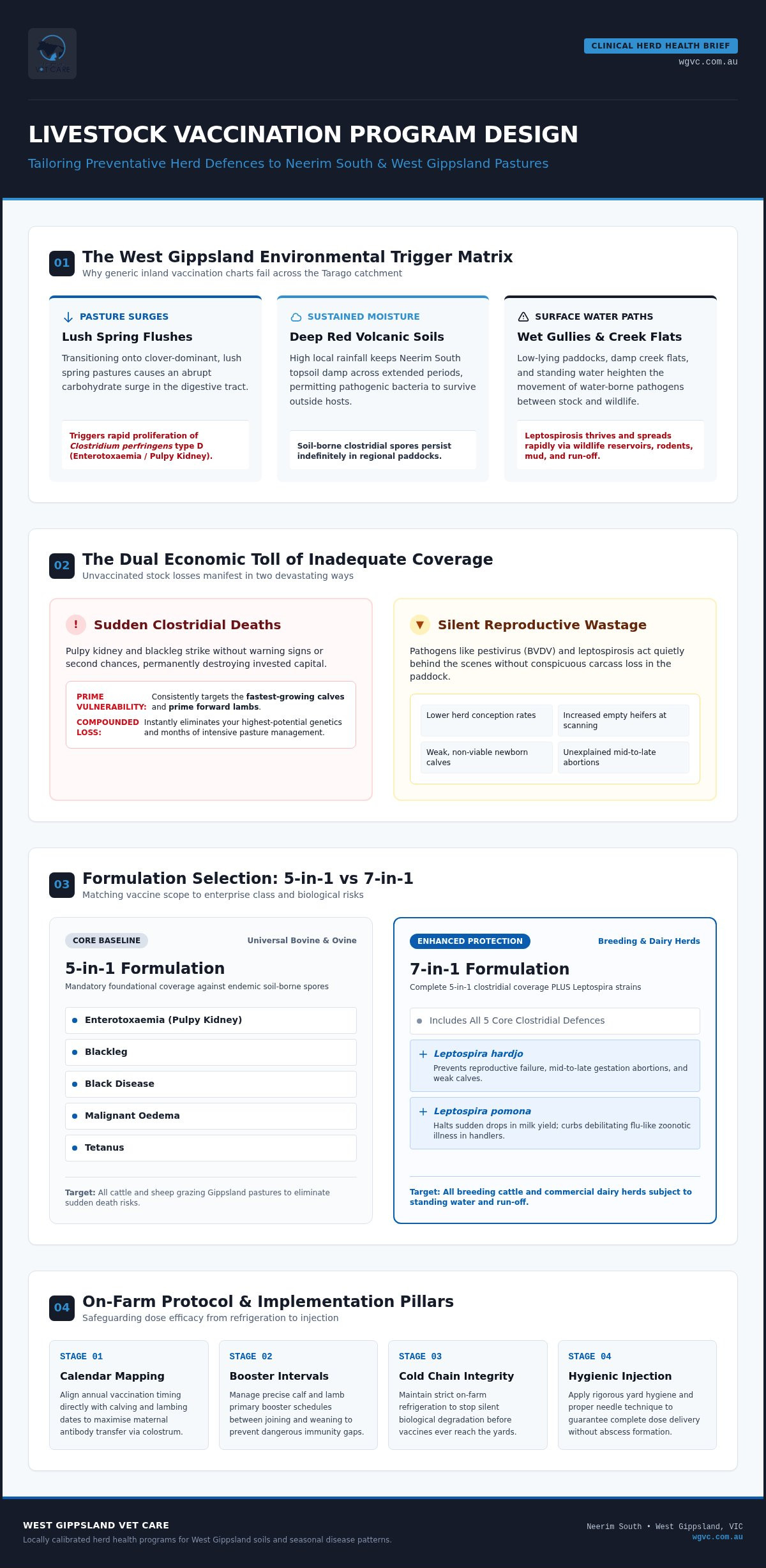
When livestock transition onto clover-dominant, lush spring pastures, their digestive environment shifts quickly. This carbohydrate surge creates prime conditions for opportunistic bacteria like Clostridium perfringens type D to proliferate rapidly in the gut, causing enterotoxaemia (pulpy kidney). Standard baseline schedules often miss these local timing windows. Tailoring pharmaceutical protocols to our local landscape ensures your stock build peak immunity before high-risk environmental triggers arrive.
High-Rainfall Environmental Triggers in West Gippsland
Neerim South’s sustained moisture keeps topsoil wet across extended periods, creating an ideal habitat for bacteria to survive outside the host. Low-lying paddocks, damp creek flats, and standing surface water dramatically heighten the spread of water-borne pathogens. In particular, leptospirosis thrives in damp environments, moving easily between wildlife reservoirs, rodents, and grazing herds through contaminated mud and run-off. While national frameworks like standard Australian cattle vaccination protocols outline fundamental disease targets, they do not account for the extended survival rates of pathogens in Gippsland’s persistent damp.
Economic Impact of Unvaccinated Stock Losses
Skipping preventative coverage carries a heavy toll that reaches far beyond the value of an individual beast. In prime grazing conditions, the economic fallout hits herds in two primary ways:
- Sudden Clostridial Deaths: Pulpy kidney and blackleg rarely offer warning signs or second chances. Cruelly, these diseases consistently target the fastest-growing calves and prime forward lambs, wiping out your highest-potential genetics and months of careful pasture management overnight.
- Silent Reproductive Wastage: Reproductive pathogens such as pestivirus (BVDV) and leptospirosis act silently. Instead of sudden deaths in the paddock, they present as lower conception rates, higher numbers of empty heifers at pregnancy scanning, weak newborn calves, and unexplained mid-to-late term abortions.
Sound livestock vaccination program design Neerim South graziers adopt turns uncertain seasonal risks into reliable herd protection. Establishing structured, proactive immunisation protects your bottom line, safeguards animal welfare, and ensures your cattle and sheep convert West Gippsland’s exceptional pasture growth into sustained, profitable production.
Core Livestock Vaccines vs Risk-Based Additions: What Does Your Mob Need?
Every grazing mob requires a reliable defence, but treating every mob identically often leads to wasted expense or overlooked risks. Practical livestock vaccination program design Neerim South graziers rely on separates universal baseline coverage from targeted, enterprise-specific additions. Core immunisations shield every animal against pervasive soil pathogens, while risk-based vaccines address specific reproductive, respiratory, and environmental vulnerabilities across your property.
The Backbone: Understanding 5-in-1 and 7-in-1 Formulations
Every bovine and ovine animal grazing Gippsland pastures needs clostridial coverage. A standard 5-in-1 vaccine protects stock against enterotoxaemia (pulpy kidney), blackleg, black disease, malignant oedema, and tetanus. These bacterial spores persist indefinitely in regional soils, making universal vaccination the only dependable barrier against sudden, catastrophic death.
For breeding cattle and commercial dairy herds, upgrading to a 7-in-1 formulation provides critical extra security. Along with the five standard clostridial protections, 7-in-1 adds coverage against Leptospira hardjo and Leptospira pomona. These bacteria cause mid-to-late gestation abortions, weak newborn calves, and sudden drops in milk yield. Because leptospirosis also causes debilitating flu-like illness in humans, routine 7-in-1 administration shields both herd reproductive performance and farm workers handling cattle in wet conditions.
Targeted Protection: Pestivirus, Vibriosis, and Bovine Respiratory Disease
Beyond baseline clostridial and leptospiral protection, breeding herds and young stock face distinct production threats. Evaluating your farm enterprise helps pinpoint which targeted vaccines deliver genuine economic returns:
- Pestivirus (BVDV): Bovine viral diarrhoea virus spreads quietly through carrier animals. Infection during joining causes empty cows, fetal mummification, and the birth of persistently infected (PI) calves that shed the virus continuously. Strategic herd vaccination stops this destructive cycle.
- Vibriosis: This sexually transmitted bacterial disease causes severe infertility and prolonged calving periods. Vaccinating bulls well ahead of joining protects virgin heifers and helps maintain tight calving windows.
- Bovine Respiratory Disease (BRD): Yard-weaned calves, feedlot cattle, and stock destined for high-stress transport face elevated respiratory risks. Incorporating viral and bacterial respiratory coverage before mixing mobs limits lung damage and preserves growth rates.
Achieving peak herd health involves aligning cow immunity with whole-herd management, including bull fertility testing to verify working sires match your investment in maternal genetics. For a complete look at practical herd planning, explore our dedicated livestock vet West Gippsland herd strategy to keep your production goals on track.
How to Build an Annual Vaccination Calendar Aligned with Calving and Lambing
A calendar pinned to your wall should work alongside your routine paddock tasks rather than disrupt them. Effective livestock vaccination program design Neerim South producers rely on weaves disease prevention directly into existing breeding and muster schedules. By sequencing biological protection around reproduction, you eliminate redundant yard sessions while building continuous immune cover across the herd.
Building this calendar involves five practical steps:
- Step 1: Audit seasonal dates. Map your joining, scanning, and calving or lambing windows across all breeding mobs.
- Step 2: Administer maternal boosters. Vaccinate pregnant cows and ewes four to six weeks before calving or lambing begins.
- Step 3: Deliver the young stock sensitiser. Give calves and lambs their first priming dose at marking or tagging.
- Step 4: Administer the follow-up booster. Give the vital second injection four to six weeks after the initial sensitiser.
- Step 5: Lock in annual boosters. Maintain lifetime immunity for mature cows, ewes, and working bulls with yearly single doses.
Maternal Immunity and Passive Transfer to Newborns
Timing pre-calving or pre-lambing boosters correctly transforms the mother into an immune factory. Vaccinating four to six weeks prior to birth drives circulating maternal antibodies directly into colostrum. Because newborn ruminants enter the world without systemic immunity, they rely on absorbing these protective immunoglobulins during their first twelve hours of life. This concentrated passive transfer shields young stock through their most vulnerable weeks until marking.
The Crucial Priming and Booster Timing for Young Stock
A single sensitiser dose simply introduces the pathogen to the immature immune system. It produces low, temporary antibody levels that leave growing stock vulnerable. The second booster dose, delivered four to six weeks later, locks in lasting biological memory. Missing this crucial timing window resets the immune response, forcing you to restart the protocol from scratch.
Synchronising Herd Health with Marking and Pregnancy Testing
Running cattle or sheep through the yards takes physical effort and creates muster stress. Smart livestock vaccination program design Neerim South graziers use integrates injections with established husbandry events:
- Combine pre-joining bull vaccinations with scheduled breeding evaluations and soundness checks.
- Deliver replacement heifer boosters alongside seasonal pregnancy testing runs.
- Pair marking and castrating with the initial young stock sensitiser to streamline race handling.
Structuring your calendar around these natural contact points keeps yard flow calm, reduces paddock disruption, and keeps your herd comprehensively protected year-round.
On-Farm Vaccine Storage, Cold Chain Integrity, and Administration Hygiene
Even the most carefully timed calendar collapses if the product loses biological potency before reaching the animal. Successful livestock vaccination program design Neerim South graziers rely on depends heavily on unbroken cold chain storage and hygienic paddock delivery. Vaccines consist of fragile biological proteins and delicate adjuvants that degrade rapidly when exposed to fluctuating temperatures, sunlight, or physical contamination.
A failed vaccine rarely looks spoiled in the bottle. Instead, cold chain breakdown happens invisibly, leaving producers with a false sense of security until preventable disease strikes an apparently protected herd.
Protecting the Cold Chain from Clinic to Paddock
All livestock vaccines require strict temperature regulation between 2°C and 8°C. Domestic bar fridges in dusty shearing sheds often fluctuate wildly, either heating up during warm afternoons or freezing bottles stored against the back plate. Freezing is catastrophic; ice crystal formation permanently shatters protein antigens and destroys water-in-oil adjuvants.
Safeguarding product integrity requires disciplined transport and yard habits:
- Collect vaccines in a well-insulated esky packed with ice bricks, using cardboard or cloth dividers to prevent direct contact freezing.
- Monitor your farm fridge with a minimum-maximum digital thermometer to verify temperatures stay consistently in range.
- Keep vaccine bottles inside a portable cooler while drafting and drenching at the crush, shielding them from direct sunlight and ambient yard heat.
Injection Technique, Needle Hygiene, and Site Selection
Delivering vaccines correctly ensures the animal mounts a robust immune response without sustaining tissue damage. Always administer standard clostridial and reproductive vaccines subcutaneously into the loose skin on the side of the neck, well ahead of the shoulder.
Injecting into prime hindquarter or rump cuts risks deep sterile abscesses and bruising, leading to painful tissue damage and costly carcass trim penalties at the abattoir. Use the “tenting” technique with one hand to lift the loose neck skin, directing the short needle smoothly beneath the skin layer without entering underlying muscle.
Needle hygiene is equally critical. Replace needles every 10 to 15 head, or immediately if a needle bends, dulls, or picks up paddock mud. A burred needle tears skin fibres, introducing environmental bacteria that cause localized swellings and hinder absorption.
For trusted support on fine-tuning storage setups and stock delivery protocols, speak with West Gippsland Vet Care to discuss your upcoming herd requirements.
Partnering with West Gippsland Vet Care for Tailored Herd Health Advice
Every agricultural holding across West Gippsland has its own distinct rhythm. A property nestled in the Tarago river flats faces damp paddocks and standing water, while an elevated holding near Neerim Junction contends with steep topography and exposed prevailing weather. Because drainage profiles, stocking densities, and past management histories vary widely between neighbouring boundaries, off-the-shelf advice rarely delivers complete protection. Successful livestock vaccination program design Neerim South producers depend on begins with an open conversation about your specific paddocks, stock flow, and enterprise goals.
West Gippsland Vet Care works side by side with local farmers to design practical preventative schedules that safeguard animal welfare while protecting operating margins. Rather than offering detached recommendations, our experienced production animal vets take the time to listen, assess your layout, and build a program suited to your daily routine.
On-Farm Herd Health Consultations and Risk Audits
Paddock-level assessments allow our veterinary team to identify underlying pathogen risks before they turn into losses. We review historical stock issues, scrutinise past booster records, and evaluate property boundaries to identify coverage gaps.
Our vets also distinguish between closed breeding herds and operations that regularly introduce outside genetics. Bringing in replacement heifers, lease bulls, or saleyard store cattle introduces novel biosecurity risks that require targeted quarantine protocols alongside tailored immunisation schedules.
Comprehensive Production Animal Services for Gippsland Producers
Preventative herd management reaches far beyond the vaccination gun. Our production animal vets offer complete, on-farm services designed to elevate lifetime herd performance:
- Reproductive Management: Pair annual booster schedules with routine livestock pregnancy testing to pinpoint non-pregnant females early and protect seasonal calving patterns.
- Sire Soundness: Safeguard your investment in maternal vaccines by scheduling thorough bull fertility testing ahead of joining, ensuring your bulls are sound, active, and disease-free.
- Calf Welfare: Access humane calf disbudding carried out with veterinary-grade local anaesthesia and long-acting pain relief, promoting rapid recovery and steady growth rates.
Registered farm clients enjoy genuine peace of mind through dedicated 24-hour emergency care when unexpected difficulties arise. You can easily strengthen your herd’s health and productivity by exploring our comprehensive livestock vet herd strategy today.
Building Lasting Herd Resilience Across West Gippsland
Guarding your stock against preventable disease comes down to consistent timing, careful handling, and deep respect for local conditions. When you align clostridial and reproductive coverage with your calving cycle, maintain unbroken cold chain storage, and target regional risks, your stock can thrive on West Gippsland’s rich pastures without interruption.
Effective livestock vaccination program design Neerim South producers depend on is always a shared journey. As an independent local veterinary practice embedded in our farming communities, our experienced production team is here to support you with practical on-farm herd health advice, bull fertility testing, and preventative planning. Registered farm clients also rest easy knowing our 24-hour emergency veterinary care stands behind them whenever urgent help is required.
Taking a proactive approach today shields your hard work and gives your mob the strong foundation it deserves. When you are ready to refine your seasonal calendar, book a herd health consultation with West Gippsland Vet Care. Together, we’ll keep your livestock healthy, productive, and secure across every season ahead.
Frequently Asked Questions
What is the primary difference between 5-in-1 and 7-in-1 vaccines for cattle in Neerim South?
A standard 5-in-1 vaccine covers five clostridial conditions, including pulpy kidney, tetanus, and blackleg. In contrast, a 7-in-1 formulation provides identical clostridial coverage while adding protection against two distinct strains of leptospirosis. In wet Neerim South environments, 7-in-1 is essential for breeding cattle to prevent late-term abortions, poor calf vigour, and the transmission of leptospirosis to farm handlers.
When is the best time of year to vaccinate my beef herd in West Gippsland?
Beef herds in West Gippsland should be vaccinated according to their calving cycle rather than an arbitrary calendar month. Pre-calving cow boosters should be administered four to six weeks prior to calving to maximise maternal antibodies in colostrum. Structuring livestock vaccination program design Neerim South graziers rely on around marking and weaning windows ensures complete herd cover without extra yard passes.
Why is a booster shot required four to six weeks after the initial livestock vaccination?
The initial sensitiser injection simply introduces the target antigen, producing a modest, temporary immune response that declines quickly. Delivering a booster dose four to six weeks later triggers an explosive secondary response, establishing durable memory cells and long-lasting immunity. Missing this narrow administration window prevents long-term defence, requiring you to restart the two-shot priming series from scratch.
Can I administer cattle vaccines into the rump or hip instead of the neck?
No, you should never administer livestock vaccines into the rump, hip, or hindquarters. Subcutaneous vaccines must be injected strictly into the loose skin on the side of the neck ahead of the shoulder. Injecting into high-value cuts risks localized reactions, sterile abscesses, and permanent muscle damage that results in severe carcass trim losses at the abattoir.
What should I do if my livestock vaccine was accidentally left out of the fridge overnight?
You should safely discard the product and purchase a fresh pack. Livestock vaccines contain sensitive biological proteins and adjuvants that deteriorate rapidly when exposed to temperatures outside the 2°C to 8°C range. Administering warm or compromised vaccine gives you a false sense of security while leaving your animals completely unprotected against aggressive, fatal diseases.
How do high rainfall and wet paddocks in Neerim South increase livestock disease risk?
High rainfall and damp pasture soils create prolonged survival windows for bacterial pathogens outside the animal host. Low-lying Neerim South paddocks, surface puddles, and muddy race tracks accelerate the spread of leptospirosis through contaminated run-off. Additionally, rapid clover flushes driven by Gippsland moisture disrupt rumen microflora, dramatically increasing susceptibility to fatal pulpy kidney outbreaks in prime stock.
Do breeding bulls require different vaccination protocols than cows and replacement heifers?
Yes, breeding bulls require specific reproductive coverage beyond standard clostridial injections. Sound livestock vaccination program design Neerim South beef producers implement includes vaccinating bulls against vibriosis and pestivirus well ahead of joining. Because bulls can spread venereal infections across dozens of clean cows, safeguarding working sires protects pregnancy rates and prevents costly calving delays.