What if the most stressful part of your dog’s operation isn’t the surgery itself, but the struggle of keeping a bouncy Kelpie quiet for a fortnight? It is a common worry for Gippsland families when they are faced with a surgical recommendation. When you first look at the numbers, comparing keyhole surgery for dogs vs traditional cost can feel a bit confusing, especially when you just want what is best for your mate.
We know how much your dog means to you, and it is completely natural to feel anxious about their post-operative pain or how you’ll manage their energy during a long recovery. You want a choice that offers safety, comfort, and peace of mind. This guide will help you discover the real-world differences in recovery times, pain management, and the long-term value between laparoscopic and traditional surgery.
We will explore how these minimally invasive techniques lead to smaller scars and a much faster return to normal activity. By the end, you will have the clarity needed to choose the safest path for your best friend’s health and happiness.
Key Takeaways
- Understand how the smaller incisions used in keyhole surgery can significantly reduce your dog’s post-operative pain and scarring compared to traditional open procedures.
- Weigh up the keyhole surgery for dogs vs traditional cost by considering the long-term value of a smoother recovery and the reduced need for strict crate rest.
- Learn why Gippsland’s high-energy and deep-chested breeds benefit most from combining a keyhole spay with a life-saving preventative gastropexy.
- Discover how a Fear-Free surgical approach helps your best mate return to their favourite activities in about half the time of standard surgery.
- Gain the confidence to choose the right surgical path by understanding how your pet’s age, breed, and temperament influence the best medical outcome for your family.
Laparoscopic vs. Traditional Surgery: Understanding the Basics
Families in West Gippsland are often surprised to learn that the same advanced technology used in human hospitals is now available for their four-legged family members. When exploring Laparoscopic surgery, also known as keyhole surgery, it is helpful to understand how it differs from the standard approach. While comparing keyhole surgery for dogs vs traditional cost is a vital part of your decision, the fundamental difference lies in how we access and treat your pet’s internal organs.
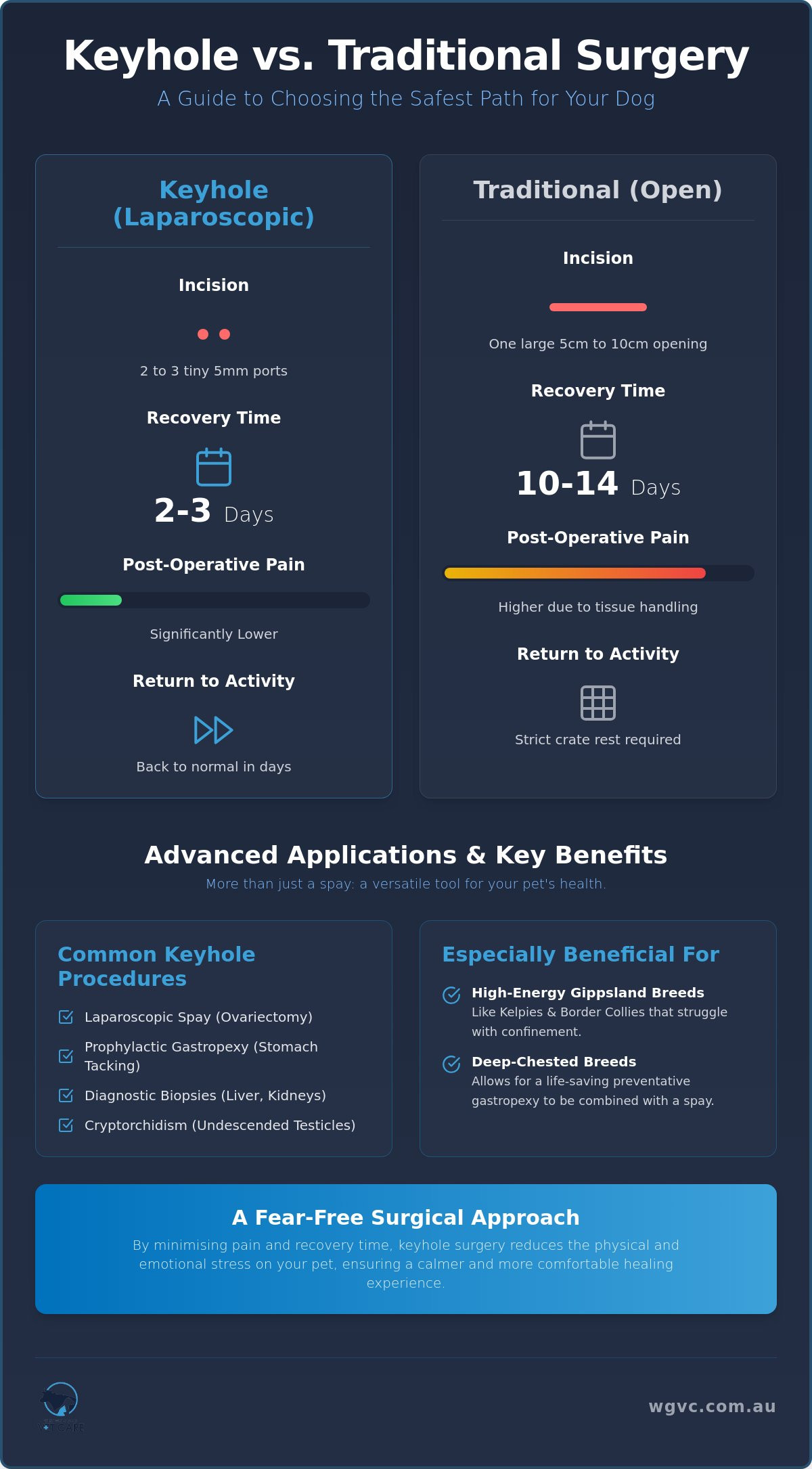
Traditional “open” surgery has been the gold standard for decades. It requires a larger abdominal incision, often between 5cm and 10cm depending on the size of the dog, to allow the vet to see and handle the organs directly. Keyhole surgery represents a major shift toward precision. Instead of a large opening, we use tiny ports and a high-definition camera to guide our movements. This move from “hands-in” surgery to video-guided procedures allows for incredible detail without the physical trauma of a large wound. It’s why many local vets now recommend this approach as the preferred option for routine desexing.
How Keyhole Surgery Works for Your Dog
During the procedure, your vet uses a specialised telescope to project a magnified view of your dog’s abdomen onto a high-definition monitor. We gently use CO2 gas to create a small “bubble” inside the belly. This provides a clear, safe workspace for the instruments to move without touching other organs. By using two or three tiny 5mm incisions instead of one large 10cm opening, we reduce the impact on the body significantly. It is all about working smarter and more gently with your pet’s delicate tissues to ensure a smoother wake-up.
Common Procedures Performed Laparoscopically
While many people think of keyhole surgery only for spaying, it is a versatile tool for several important health checks and treatments. These include:
- Laparoscopic spay: Also known as an ovariectomy, this involves removing the ovaries through tiny ports with minimal tension on the internal ligaments.
- Prophylactic gastropexy: A preventative step to stop the stomach from twisting, which is a life-saver for deep-chested Gippsland breeds.
- Diagnostic biopsies: Safely taking small tissue samples from organs like the liver or kidneys with very little disruption.
- Cryptorchidism: Locating and removing undescended testicles that are tucked away inside the abdomen.
For many local families, the choice between keyhole surgery for dogs vs traditional cost comes down to the quality of life during those first few days at home. It is about giving your mate the most comfortable experience possible.
The Clinical Difference: Pain, Recovery, and Fear-Free Healing
Seeing your dog groggy and in discomfort after an operation is heart-wrenching for any pet owner. While we have already explored the technical basics, the real value of the keyhole surgery for dogs vs traditional cost becomes clear during the first 48 hours at home. The biology of pain is quite straightforward. Traditional surgery requires manual stretching of the abdominal wall and internal ligaments to provide the surgeon with a clear view. This physical tension and tissue handling is what causes the majority of post-operative soreness. Because keyhole surgery uses tiny ports and a camera, that internal stretching is almost entirely eliminated.
Research, including a Cornell University study on castration, has shown that laparoscopic techniques often result in significantly lower pain scores and fewer complications than traditional methods. For your dog, this means a calmer wake-up and a much shorter stay in the clinic. This is a core part of our commitment to Fear-Free veterinary care, where we aim to reduce the emotional and physical stress of every visit.
A Faster Return to the Paddock
For families with high-energy Gippsland dogs, like Kelpies or Border Collies, managing a “quiet” recovery is often the hardest part of the process. With keyhole surgery, most dogs are back to their normal selves within 2 to 3 days. Compare this to the 10 to 14 days of strict crate rest and lead-only walks required after traditional surgery. This shorter window is a game-changer for working breeds that struggle with confinement. It also drastically reduces the risk of seromas, which are fluid-filled swellings that can occur when an active dog moves too much after a traditional procedure.
The Emotional Side of Surgery
Smaller wounds lead to a much more relaxed pet. Because the incisions are only about 5mm wide, there is far less itching and irritation as they heal. Most keyhole patients don’t even need the dreaded “cone of shame” because there isn’t a large, tempting incision site to lick. This means less anxiety for your dog and fewer sleepless nights for you. Reduced internal inflammation directly translates to a happier, tail-wagging pet on day one, making the entire experience feel like a minor blip in their routine rather than a major ordeal.
The Cost Breakdown: Why Keyhole Surgery Carries a Premium
When we talk about the difference between keyhole surgery for dogs vs traditional cost, it’s completely understandable that families want to know exactly what they’re paying for. The premium for laparoscopic surgery isn’t just about the procedure itself. It’s about the sophisticated technology and the advanced training required to perform it safely and gently. We view this as a commitment to providing our community with the same level of care you would expect in a modern human hospital.
Setting up for a keyhole procedure involves an investment in high-definition camera towers, precision optics, and specialised vessel-sealing devices. These tools allow us to operate with incredible accuracy, sealing blood vessels with heat rather than traditional sutures. Unlike standard surgery where the vet uses their hands, we’re navigating via a high-resolution screen. This requires a unique set of surgical skills and years of dedicated training for our veterinary team. These cases also often require more staff, including additional surgical nursing support to manage the complex equipment while ensuring your pet remains perfectly stable and comfortable throughout.
Upfront Costs vs. Long-term Value
While the initial invoice might be higher, many owners see this as a once-in-a-lifetime investment in their dog’s health. For those who share their lives with “heart dogs”, those special companions who are truly part of the family, the added safety margin is invaluable. Desexing is a procedure your dog will only ever have once. Choosing a less invasive path reduces the physical toll on your mate, which is a priority for many Gippsland pet owners who want to ensure the highest quality of life for their best friend.
Hidden Savings of Laparoscopy
It’s also helpful to look at the “hidden” savings that often come with a smoother, faster recovery. Because the incisions are so small, clinical data shows fewer postoperative complications such as infections, haematomas, or wound breakdowns. In traditional cases, these issues can lead to expensive “re-check” visits, additional courses of antibiotics, or even secondary surgeries to repair a damaged wound.
There’s also a practical saving for you at home. A traditional recovery often means taking time off work or organising constant supervision to ensure your dog doesn’t jump, play, or lick their stitches. With keyhole surgery, the recovery is so rapid that many of these logistical headaches and extra costs simply disappear. When you factor in the reduced need for follow-up appointments and post-op medications, the gap in the keyhole surgery for dogs vs traditional cost starts to feel much smaller. It’s about paying for a better experience and more peace of mind.
Spays and Gastropexy: Specific Benefits for Gippsland Breeds
In our local Gippsland community, we often see large, deep-chested breeds like Labradors, German Shepherds, and Great Danes. These dogs are more than just pets; they’re active companions that thrive in our rural environment. For these specific breeds, the discussion around keyhole surgery for dogs vs traditional cost takes on a new level of importance. It isn’t just about a faster recovery. It is about accessing life-saving preventative care in a way that is far less invasive than old-fashioned methods. When weighing up the investment, the “two-for-one” advantage of combining a spay with a gastropexy is a significant factor for many families.
The Laparoscopic Spay (LOVE Spay)
The Laparoscopic Ovariectomy, often called a “LOVE spay,” is the modern gold standard for female dogs. Unlike a traditional spay that removes both the ovaries and the uterus, this technique focuses solely on the ovaries. Because we have such clear visualisation of the suspensory ligaments through the camera, we can perform a much cleaner and more precise procedure. This approach typically leads to reduced surgical time. Less time on the table means less anaesthesia exposure for your mate, which is always a safer outcome for their long-term health.
Gastropexy: Preventing the Deadly ‘Bloat’
For many owners in Warragul and surrounding areas, Gastric Dilatation-Volvulus (GDV), or “bloat,” is a constant worry. This life-threatening condition occurs when the stomach fills with gas and twists, cutting off blood supply. In a rural setting where the nearest emergency clinic might be a long drive away, prevention is vital. A keyhole gastropexy allows us to “tack” the stomach to the body wall with minimal trauma. It provides permanent peace of mind without the need for the massive abdominal incision used in traditional preventative surgery.
Performing this procedure at the same time as a routine desexing is the most cost-effective strategy. It means your dog only needs one session of anaesthesia and one recovery period. Handling these complex soft-tissue cases requires a high level of surgical precision. Our team often draws on the same delicate techniques used by an orthopaedic vet gippsland families trust for bone and joint care. This ensures that even preventative procedures are performed with the utmost dedication to safety. If you are planning for your large breed’s future, we invite you to speak with our team about the benefits of a combined keyhole approach. It is a simple way to provide your best mate with a lifetime of protection.
Is Keyhole Surgery Right for Your Dog? Making the Choice
Deciding on the best surgical path for your mate is a personal journey that involves more than just comparing two different techniques. While the keyhole surgery for dogs vs traditional cost is a significant factor for many families, the right choice ultimately depends on your pet’s individual health profile. Every dog is unique. We take the time to consider their age, breed, weight, and even their temperament before making a recommendation. Our goal is to ensure you feel supported and informed as you make this important decision for your family.
For many Gippsland pets, the benefits of a minimally invasive approach are clear. A senior dog might benefit from the reduced anaesthesia time, while a high-energy working breed will surely appreciate the shorter recovery period. However, there are times when traditional “open” surgery remains the most appropriate choice. If a dog has a known anatomical abnormality, a large internal mass, or requires a broad exploratory procedure, the traditional approach provides the necessary access for our surgeons. When you sit down with our team to discuss the keyhole surgery for dogs vs traditional cost, we provide a clear, transparent breakdown so you can make a choice with confidence.
Questions to Ask Your Vet
We encourage open dialogue and want you to feel comfortable asking any questions on your mind. During your consultation, you might like to ask:
- Is my dog’s breed particularly prone to post-op complications that keyhole surgery could help avoid?
- What is the specific recovery protocol for my pet’s lifestyle, especially if we live on a larger property?
- Are there any specific anatomical reasons why my dog might be better suited to an open approach?
- How does the anaesthesia protocol differ between the two options for my dog’s age?
The West Gippsland Vet Care Difference
Our team in Warragul and Drouin is deeply committed to providing advanced surgical care that Gippsland families can trust. We believe in blending clinical excellence with a down-to-earth, nurturing approach that puts both you and your pet at ease. We view ourselves as an extension of your support system, here to guide you with honesty and kindness. We don’t just see a clinical case; we see a beloved member of your family who deserves the gentlest care available.
Booking a pre-surgical consultation is the first step toward a safer, more comfortable experience for your best friend. It gives us the chance to perform a thorough health check and discuss which path aligns best with your dog’s needs and your family’s expectations. We are here to listen, to explain, and to ensure your mate gets back to their happy, tail-wagging self as quickly as possible.
Choosing the Gentlest Path for Your Dog’s Recovery
Deciding on surgery for your best friend is never easy, but choosing a minimally invasive approach can make all the difference in their comfort. We have seen how keyhole techniques offer smaller incisions, significantly less pain, and a much faster return to the active Gippsland lifestyle they love. When you consider the keyhole surgery for dogs vs traditional cost, it is really about the quality of those first few days at home. Every dog deserves a gentle wake-up.
As trusted Gippsland locals for over 20 years, our team is dedicated to supporting your family with kindness and clinical excellence. With advanced laparoscopic equipment on-site and a team of Fear-Free Certified Professionals, we ensure your pet’s well-being is always our first priority. We are here to help. Our goal is to ensure you feel confident and informed every step of the way.
Ready to discuss the best care for your mate? Book a surgical consultation for your best mate at West Gippsland Vet Care today. We look forward to seeing those happy tails back in action soon.
Frequently Asked Questions
Is keyhole surgery for dogs safer than traditional surgery?
Keyhole surgery is considered safer in many respects because it involves significantly less tissue handling and much smaller incisions. By using a high-definition camera, our team gets a much clearer view of your dog’s internal organs than is possible with the naked eye. This precision reduces the risk of bleeding and internal trauma, helping your mate feel much more comfortable when they wake up from their procedure.
How much more does laparoscopic spaying cost in Australia?
The keyhole surgery for dogs vs traditional cost typically involves a premium to cover the specialised equipment and advanced surgical training required. While we don’t provide fixed industry averages, the investment reflects the use of high-tech camera towers and precision vessel-sealing tools. Most families find the value lies in the significantly reduced recovery time and the lower risk of post-operative complications for their pet.
Does my dog still need to wear a ‘cone of shame’ after keyhole surgery?
Most dogs do not need to wear a traditional “cone of shame” after a keyhole procedure. Because the incisions are only about 5mm wide, there is very little irritation or itching as the skin heals. This means your dog is much less likely to lick or chew at the site. It makes those first few nights at home much more relaxed for both you and your mate.
Can any vet perform keyhole surgery on my dog?
No, keyhole surgery requires specific advanced equipment and additional surgical training that isn’t available at every clinic. It is a specialised skill to operate while looking at a high-definition monitor rather than directly at the tissue. You should always look for a clinic that has invested in both the modern laparoscopic towers and the ongoing education needed to perform these procedures safely and effectively.
If you are located in the Surfcoast region and looking for similar expertise, you can read more about how established clinics in your local area approach surgical procedures and animal health.
What is the recovery time for a laparoscopic gastropexy?
Recovery from a laparoscopic gastropexy is usually much faster, with most dogs returning to normal activity within 5 to 7 days. In contrast, a traditional open gastropexy often requires 10 to 14 days of strict rest. This shorter recovery is a huge relief for owners of active Gippsland breeds who might struggle to keep their bouncy dog quiet and confined for two full weeks.
Is my dog too small for keyhole surgery?
Most dogs are great candidates for keyhole surgery, but very small pets may occasionally be better suited for a traditional approach. If a dog is particularly tiny, there might not be enough space in the abdomen to safely use the laparoscopic instruments and camera. We always perform a thorough pre-surgical check to ensure the chosen method is the safest and most effective option for your pet’s specific size.
What happens if the vet finds a complication during the keyhole procedure?
If a complication is discovered, our surgeons are fully trained to convert the procedure to a traditional open surgery immediately. This is a standard safety protocol used in both human and veterinary medicine. While it is rare, having this plan in place ensures that your dog’s safety is never compromised. We always discuss this possibility with you beforehand so you feel completely informed and at ease.
Does pet insurance cover the extra cost of laparoscopic surgery?
Whether pet insurance covers the additional cost depends entirely on your specific policy and the type of procedure being performed. Many standard policies don’t cover routine desexing, regardless of the method used. However, some premium wellness or routine care add-ons may provide a contribution toward the cost. It is always a good idea to give your insurance provider a quick ring to check your level of cover.