
You’ve spent weeks carefully lifting your dog into the car and hovering over them in the backyard, yet suddenly, they’re lifting that leg again. It’s a heart-sinking moment for any Gippsland pet owner. After the emotional and financial investment of an orthopaedic procedure, it’s natural to worry about the signs of failed cruciate surgery in dogs. Is this just a minor setback from a bit too much excitement, or is it a mechanical failure that needs urgent attention?
We understand that the road to recovery is rarely a straight line, and it’s completely normal to feel anxious when your best mate isn’t bouncing back as expected. While procedures like TPLO have a high success rate of up to 95 per cent, the small number of cases that face complications can be incredibly stressful for families. In this guide, we’ll help you distinguish between a standard recovery “blip” and genuine complications. You’ll learn exactly what to look for at home, when it’s time to bring them into our Warragul or Drouin clinics for a check-up, and how we can support you through the process of revision surgery if it becomes necessary.
Key Takeaways
- Understand the typical healing arc for cruciate procedures and why minor setbacks don’t always mean the surgery has failed.
- Learn to recognise the red flags and signs of failed cruciate surgery in dogs, including sudden lameness or unusual clicking sounds from the joint.
- Distinguish between mechanical implant issues and biological healing challenges to better understand the root cause of a complication.
- Discover the essential first steps to take at home to protect your mate’s leg while you prepare for a professional assessment in Warragul or Drouin.
- Gain confidence in the path forward with revision surgery and how a tailored plan can get your dog back to their happy, active self.
Understanding Cruciate Surgery Recovery: What is Normal for Your Mate?
Watching your dog recover from a major leg operation can feel like a full-time job that’s equal parts rewarding and nerve-wracking. It is vital to remember that recovery is rarely a straight line; it is a journey that typically spans about 12 weeks. During this time, the stifle joint, which is the canine equivalent of a human knee, undergoes a complex healing process. Whether your dog has had a lateral suture or a Tibial-plateau-leveling osteotomy (TPLO), their body is balancing two different types of progress. First, there is mechanical stability, which is the immediate support provided by the surgical implants. Second, there is biological healing, which is the slower process of bone and soft tissue actually knitting back together.
It is perfectly normal to see minor “blips” in your dog’s gait during these first few months. You might notice a slight increase in lameness after a longer-than-usual walk or a change in the weather. Generally, if your dog is just a bit stiff after a nap but “warms up” and uses the leg within a few steps, this is part of the standard healing arc. However, if they suddenly stop using the leg entirely, you might be seeing the signs of failed cruciate surgery in dogs. Distinguishing between a temporary flare-up and a genuine complication is the key to a stress-free recovery for both you and your mate.
The First 72 Hours vs. Week 6: The Timeline of Healing
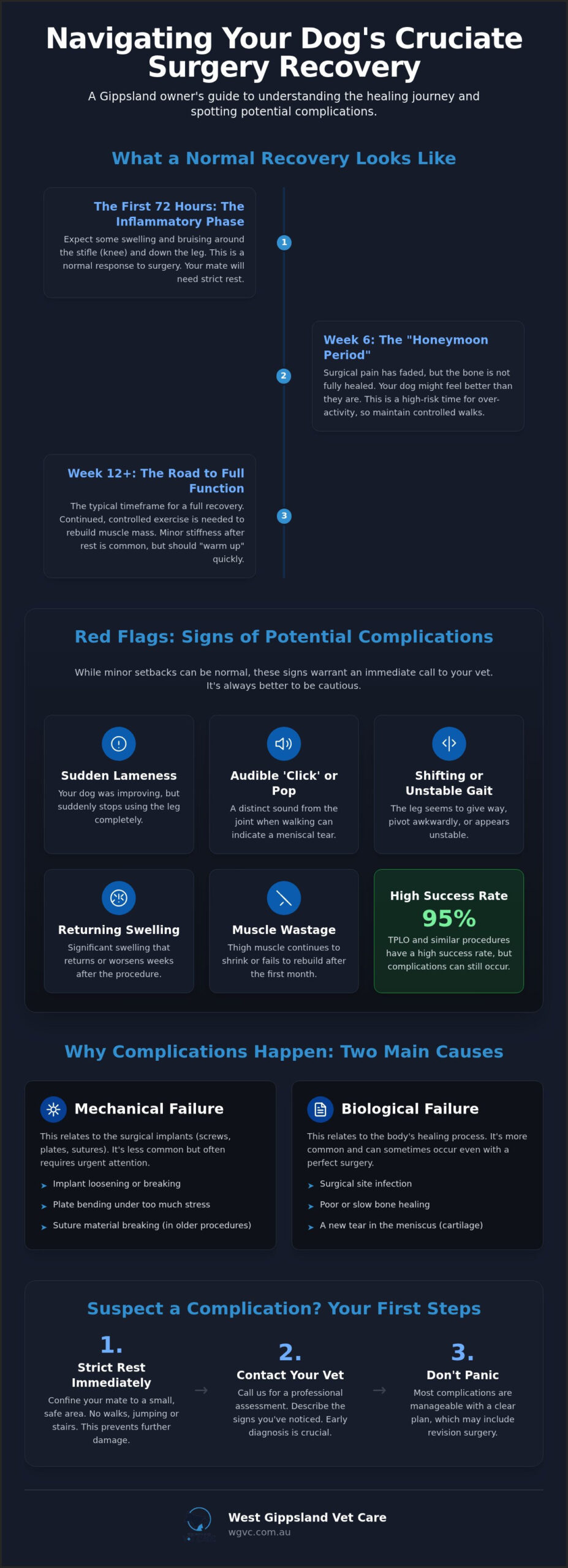
In the first few days following surgery, the stifle area will likely look quite angry. You should expect some swelling and even bruising that might travel down the leg toward the hock. This is a normal inflammatory response to the procedure. By week six, most dogs enter what we call the “honeymoon period.” They often feel remarkably good because the initial surgical pain has faded, but the bone hasn’t fully healed yet. This is a high-risk time because your dog might try to jump or zoom around the backyard, which can put undue stress on the repair before it’s ready to handle the load.
When ‘Slow Progress’ is Still Progress
Improvement isn’t always about how fast they can walk. We often look at weight distribution and muscle mass as better indicators of success. You might notice the muscles in their thigh look a bit thinner than the other side; rebuilding this takes time and consistent, controlled movement. In our West Gippsland region, the hilly terrain around Warragul and Drouin means you need to be extra cautious. Walking on flat surfaces is essential during the middle weeks of confinement. While the “boring” weeks of crate rest and short leash walks can feel endless, your patience is what allows the biological healing to catch up with the mechanical stability of the surgery.
Red Flags: The Primary Signs of Failed Cruciate Surgery
Recovery can feel like a delicate dance for both you and your dog. While small setbacks are often part of the natural healing process, certain indicators suggest the surgical repair may not be holding as intended. Identifying the signs of failed cruciate surgery in dogs early is essential for preventing further joint damage and ensuring your mate stays comfortable. It is always better to raise a concern early than to let a potential complication progress.
Watch for these specific warning signs during the recovery period:
- Sudden, non-weight-bearing lameness after your dog was previously showing steady improvement.
- An audible clicking or popping sound coming from the stifle when they walk or sit.
- A “shifting” gait where the leg seems to give way or pivot awkwardly when they attempt to stand.
- Swelling that returns or worsens significantly weeks after the initial procedure.
- Persistent muscle wastage in the thigh that doesn’t start to fill back out after the first month of rehabilitation.
The Tell-Tale ‘Click’: Identifying Meniscal Tears
The meniscus is a C-shaped piece of cartilage that acts as a vital shock absorber within the joint. According to the American College of Veterinary Surgeons, a meniscal tear is a common complication that can occur even after a successful cruciate repair. This often happens if the joint had significant instability before the surgery was performed. If you hear a distinct “click” when your dog moves, it usually means a piece of torn cartilage is flipping inside the joint like a loose pebble. Our team at West Gippsland Vet Care uses advanced diagnostic imaging to confirm these tears, as they typically require a quick “tidy up” procedure to resolve the persistent pain.
Infection and Implant Complications
While rare, infections can pose a significant risk to a successful recovery. A superficial skin infection around the stitches is usually manageable with a course of antibiotics. However, a deep “implant-associated” infection is more serious and can be one of the most concerning signs of failed cruciate surgery in dogs. Look for persistent heat, redness, or any unusual discharge from the wound site. If your dog seems lethargic, loses their appetite, or runs a fever, these are emergency signals that their body is struggling. In some cases, the body may even treat the surgical hardware as a foreign object. If you notice any of these worrying changes, our emergency care team is available to help existing clients in Warragul and Drouin assess the situation quickly.
Mechanical vs. Biological Failure: Why Do Surgeries Fail?
Even when a procedure is performed with absolute precision, the path to recovery can occasionally hit a snag. Understanding why this happens helps you stay vigilant for the signs of failed cruciate surgery in dogs. Generally, failures fall into two categories: mechanical and biological. Mechanical failure involves the surgical hardware itself. While the plates and screws used in modern orthopaedics are incredibly strong, they aren’t indestructible. If a screw loosens or a plate shifts before the bone has finished knitting together, the stability of the joint is compromised. This usually happens when the leg is subjected to a sudden, sharp force that exceeds what the metal can hold.
Biological failure is a bit different. In these cases, the implants might stay perfectly in place, but the dog’s body struggles to complete the healing process. This can manifest as a “non-union,” where the bone fails to grow across the surgical site. Research from the University of Florida Small Animal Hospital indicates that pre-existing conditions, such as severe osteoarthritis, can also influence how well a dog bounces back. Additionally, breed-specific anatomy plays a role. Some dogs have a naturally steep tibial plateau, which creates higher levels of “shear force” within the joint, putting more pressure on the repair than a dog with flatter anatomy.
Living in West Gippsland brings a unique set of challenges we call the “Gippsland Factor.” Many of our local patients are high-energy working breeds like Kelpies or Border Collies. These dogs have an incredible drive to work and run. They don’t understand the concept of “taking it easy” and will often try to bolt across a paddock the moment they feel a slight improvement. This natural exuberance is one of the most common reasons we see mechanical setbacks and signs of failed cruciate surgery in dogs in our region.
The Role of Post-Operative Activity Levels
A sudden case of the “zoomies” or a single leap onto the couch can be catastrophic during the first six weeks of healing. For families on acreage around Warragul or Drouin, managing a dog without a traditional suburban fence requires extra care. We suggest using secure indoor pens or very short, double-leashed walks to ensure your mate doesn’t catch a scent and try to sprint. Keeping your dog mentally occupied with “fear-free” enrichment, such as snuffle mats or food puzzles, is a great way to keep them calm and occupied while their body mends.
Underlying Health and Age Factors
A dog’s internal health is the engine that drives their recovery. Metabolic issues like Cushing’s disease or diabetes can significantly delay the healing of bone and soft tissue. Obesity is another major factor; carrying even a few extra kilograms puts a punishing, constant load on a fresh surgical site. It’s often a wise move to book Senior Pet Health Checks to screen for these conditions. Identifying and managing these health hurdles early reduces the risk of you ever having to spot the signs of failed cruciate surgery in dogs.
What to Do if You Suspect a Complication
Discovering that your dog’s recovery has taken a turn for the worse is understandably upsetting. If you notice any signs of failed cruciate surgery in dogs, taking swift, calm action is the best way to protect your mate’s long-term mobility. In a regional setting like West Gippsland, where our dogs often have access to large paddocks and uneven terrain, a minor slip can feel like a major disaster. However, having a clear plan of action helps reduce the stress for both you and your pet.
Follow these four essential steps if you are concerned about your dog’s progress:
- Step 1: Immediate Activity Restriction. Even if your dog was previously allowed short walks on the lead, you must return to strict crate rest or a very small indoor pen. No jumping, no stairs, and no “potty breaks” without a short lead.
- Step 2: Document the Symptoms. It is incredibly helpful to take a short video of your dog walking on a flat, non-slip surface. Dogs often hide their lameness due to adrenaline when they arrive at our clinic, so your home footage provides us with vital evidence.
- Step 3: Contact Your Vet. Don’t wait for your scheduled 8-week check-up. If you see a sudden setback, a phone call to our team can determine if an earlier assessment is needed.
- Step 4: Prepare for Diagnostics. Getting a clear picture of what is happening inside the stifle often requires your dog to be very still. We may need to use light sedation to ensure we get high-quality, diagnostic X-rays without causing your dog any distress.
Triage at Home: Assessing the Urgency
Not every setback requires an immediate midnight dash to the clinic, but some do. If your dog is suddenly completely non-weight-bearing, has a high fever, or if the surgical site is oozing, these are urgent concerns. You can gently feel the knee for excessive heat or a new, hard swelling, but stop immediately if your dog shows signs of pain. For our existing Gippsland clients, we provide 24-hour emergency care to ensure you always have support when things don’t go to plan.
The Diagnostic Process at West Gippsland Vet Care
When you bring your mate in, we perform a thorough physical exam to re-evaluate joint stability. We use specific manual tests, such as the “drawer test” and “tibial thrust,” to feel for any abnormal movement within the joint. While X-rays are essential for us to “see” how the bone is healing and check the position of the surgical hardware, it’s important to remember that they don’t show the ligaments or the meniscus directly. Instead, we look for secondary clues like joint fluid build-up or changes in the bone surface. If you are worried about your dog’s recovery, contact us today to discuss your concerns with our experienced orthopaedic team.
Revision Surgery and the Path Back to the Paddock
Finding out that a surgical repair hasn’t held is heartbreaking, but it’s not the end of the road for your dog’s active lifestyle. We’ve seen many Gippsland dogs bounce back from a setback to live happy, pain-free lives. While the signs of failed cruciate surgery in dogs can feel like a major defeat, a failed procedure simply means the joint needs a different approach to achieve stability. Our goal is to help you navigate this second chapter with a clear plan and the support your family needs.
The path back to the paddock involves more than just a second operation. It’s a holistic journey that combines surgical expertise with dedicated rehabilitation. We often use a combination of laser therapy to reduce inflammation and strictly controlled exercise to rebuild the supporting muscles. Transitioning your mate from the crate back to the rolling hills of Warragul or Drouin takes time, but with a methodical approach, they can get back to their favourite activities safely.
Revision Surgery: A Second Chance for Stability
Revision surgery is naturally more complex than the initial procedure. It often involves carefully removing the old hardware, addressing any new damage like meniscal tears, and stabilising the joint using a different technique or more robust implants. Because the bone and soft tissues have already been through one surgery, this process requires the steady hand of an experienced orthopaedic vet. It’s also vital to manage expectations; the recovery timeline is often longer the second time around as the body needs more time to knit together. Despite the complexity, success rates for revision procedures remain high when managed by a dedicated team that understands the nuances of bone healing.
Long-term Joint Support for Gippsland Dogs
Once your dog is back on their paws, long-term joint health becomes the priority. We often recommend high-quality joint supplements containing Glucosamine and Chondroitin, along with Omega-3 fatty acids, to support the cartilage and manage inflammation. It’s also important to keep a close eye on the “good” leg. Statistics show that between 40 and 60 per cent of dogs that rupture one cruciate ligament will unfortunately experience the same injury in the opposite knee within 18 months. By managing their weight and keeping up with regular, low-impact exercise, you can help protect both joints for the future.
We know this journey has its ups and downs, but you don’t have to walk it alone. Our team is here to listen to your concerns, answer your questions, and provide the gentle, professional care your best mate deserves. Whether it’s a quick phone call to check a symptom or a detailed revision plan, we’re committed to getting your dog back to their happy, wagging self.
Supporting Your Mate’s Journey Back to Full Health
Recovery is a marathon, not a sprint. While most dogs heal beautifully, being aware of the signs of failed cruciate surgery in dogs allows you to act quickly if something feels off. Whether it’s a mechanical implant issue or a biological healing delay, identifying the problem early is the first step toward a solution. Remember that a temporary setback doesn’t mean your dog won’t return to their happy, active self; it simply means we need to adjust the path forward.
As an independent, Gippsland-owned practice, we are deeply committed to the well-being of our local community’s pets. Our Warragul clinic features an advanced in-house orthopaedic surgical suite, and we pride ourselves on providing compassionate, fear-free post-operative support. We understand the worry that comes with a slow recovery, and we’re here to provide the clinical expertise and personal care needed to get your mate back on their paws safely.
With the right support and a bit of patience, your dog can return to enjoying the beautiful Gippsland landscape by your side. We’re here for you every step of the way.
Frequently Asked Questions
How can I tell if my dog’s TPLO plate has shifted or failed?
You will usually notice a sudden, sharp return of lameness or a change in the physical appearance of the knee joint. While you might feel a new, hard lump near the surgical site, the only definitive way to confirm a shift is through follow-up X-rays at our clinic. If the plate or screws have moved, your dog will likely be very reluctant to put any weight on the leg at all.
Is it normal for my dog to start limping again 3 months after cruciate surgery?
No, a new limp at the three-month mark is generally not typical. By this stage, your dog should be well into their rehabilitation and walking quite comfortably. A return of lameness this late in the piece could indicate a late-onset meniscal tear or issues with the bone healing process. It is best to have them assessed to ensure the progress they have made isn’t being undone.
What does a ‘meniscal click’ sound like in a dog’s knee?
A meniscal click is an audible sound that occurs when a torn piece of cartilage gets caught within the joint during movement. It often sounds like a sharp “snap” or “pop,” very similar to a person cracking their knuckles. You will usually hear it most clearly when your dog is walking on a hard floor or when they first stand up after a nap.
Can a dog’s body reject the metal implants used in cruciate surgery?
While modern medical-grade metals are very well tolerated, some dogs can develop what we call an implant-associated infection. This isn’t always a “rejection” in the traditional sense, but the body reacts to the metal as a site where bacteria can hide. This is one of the more complex signs of failed cruciate surgery in dogs that we monitor for during our post-operative check-ups.
What should I do if my dog jumps off the couch right after surgery?
Restrict their activity to a crate or small pen immediately and monitor their gait closely for the next 24 hours. Don’t panic, as a single jump doesn’t always cause failure, but it can put significant stress on the new repair. If they are suddenly limping more or if the knee looks swollen, contact your vet for advice as a “micro-shift” in the hardware may have occurred.
How do I know if my dog has an infection inside the surgical joint?
Look for systemic symptoms like fever or a loss of appetite alongside local signs like heat, redness, and swelling. If the joint is infected internally, your dog will often seem quite depressed and may refuse to put any weight on the limb. This is a serious situation that requires prompt veterinary attention to protect the joint and the surgical repair.
Will my dog need a second surgery if the first cruciate repair failed?
If the joint remains unstable or there is a persistent source of pain, a second procedure is often the best path forward. Revision surgery allows us to remove any problematic hardware and re-stabilise the stifle joint anew. We focus on creating a tailored plan for the second recovery to ensure your mate can finally get back to their happy life in Gippsland.
Does insurance cover revision surgery for a failed cruciate repair?
Most comprehensive pet insurance policies in Australia do cover complications from surgery, provided the initial condition wasn’t considered “pre-existing” before your policy started. However, every provider has different waiting periods and specific exclusions. It is always a wise move to check your Product Disclosure Statement or call your insurance company to confirm your coverage before proceeding with further surgery.