
Did you know that even a cat who never leaves your West Gippsland living room still faces risks from some of the most common feline illnesses? It’s a common misconception that indoor-only pets are naturally shielded from every threat. We know you want the very best for your companion, but it’s easy to feel overwhelmed when you start researching an f3 vaccination cat schedule. Between the different codes like F4 or F5 and the worry about potential side effects, many local owners feel a bit lost or even guilty if they’ve missed a booster date.
We believe that keeping your cat healthy should be a gentle, collaborative process rather than a source of stress. You’re not alone in wondering if your pet really needs yearly protection or how to manage their next check-up without the fuss. In this guide, we’ll explain exactly why the F3 vaccine is considered the vital core protection for every Gippsland feline. You’ll discover the three specific diseases it prevents and gain the confidence to organise a vaccination plan that fits your cat’s unique lifestyle. Let’s work together to ensure your feline friend stays happy, protected, and right by your side for years to come.
Key Takeaways
- Understand why the F3 vaccine is the essential foundation for every Australian cat’s health, regardless of whether they stay inside or roam the garden.
- Learn how an f3 vaccination cat owners choose protects against three resilient viruses that can survive in the environment for surprisingly long periods.
- Discover why West Gippsland’s local environment means even indoor cats require a tailored protection plan to stay safe from common feline illnesses.
- Get clarity on the ideal vaccination timeline for kittens and the critical role of the first-year booster in building lifelong immunity.
- Find out how a low-stress, gentle approach to vet visits in Warragul can make your cat’s health checks a calm and positive experience.
What is an F3 Vaccination? Understanding the ‘Core’ Protection
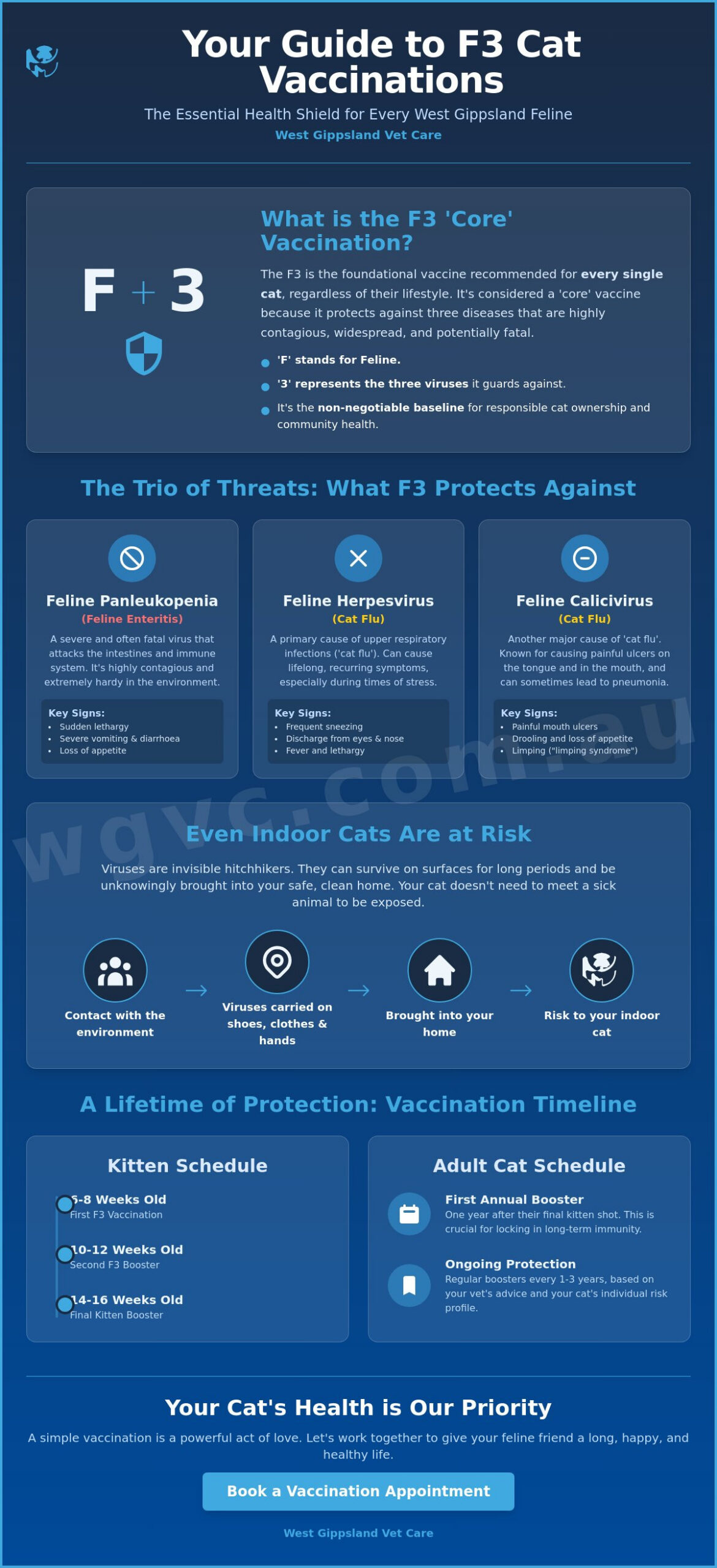
The term F3 might sound like technical jargon used in a lab, but it’s actually a simple code for your cat’s most important health shield. The ‘F’ stands for Feline, and the ‘3’ represents the three specific viruses this vaccine is designed to guard against. An f3 vaccination cat owners choose provides a foundational level of safety that we recommend for every single feline visitor we see. It isn’t just an optional extra; it’s the baseline of responsible pet ownership in our local community. Whether your companion is a rugged barn cat or a pampered indoor kitten, this vaccine forms the cornerstone of their long-term wellbeing.
Why ‘Core’ Vaccines are Non-Negotiable
Veterinary experts across Australia categorise vaccines into two groups: core and non-core. Core feline vaccines are considered essential because the diseases they prevent are either highly contagious, widespread, or often fatal. In West Gippsland, we prioritise these because viruses like Panleukopenia are incredibly hardy. They can survive in the soil or on surfaces for long periods. Even if your cat stays inside a home in Drouin or Warragul, you could accidentally bring these microscopic threats inside on your shoes or clothing after a walk through the park. By keeping up with boosters, you aren’t just protecting your own pet. You’re contributing to ‘herd immunity,’ which helps keep the entire Gippsland cat population safer from outbreaks.
F3 vs F4 and F5: What’s the Difference?
You might hear about F4 or F5 options and wonder if your pet is missing out on vital cover. An f3 vaccination cat protocol covers the ‘big three’ viral threats that every cat faces. F4 and F5 vaccines add protection against Chlamydia and Feline Leukaemia (FeLV). While these extra layers are important for some, they aren’t always necessary for every cat’s lifestyle. We believe in a tailored approach. If your cat spends time in high-density boarding or lives in a multi-cat household with frequent outdoor access, we might suggest moving beyond the F3 baseline. Our goal is to provide exactly what your companion needs to stay healthy. We work with you to ensure they receive the most appropriate care for their specific life in West Gippsland, without over-vaccinating.
The Three Diseases: What the F3 Vaccine Protects Against
Seeing your cat lose their spark is heartbreaking for any pet owner. While an f3 vaccination cat owners choose is technically a medical procedure, it’s truly about protecting the bond you share with your companion. These three diseases aren’t just minor bugs; they are resilient threats that can survive in the West Gippsland environment for months at a time. Treating an infected cat is often a long, emotionally draining, and expensive journey that no family wants to experience. For kittens whose immune systems are still developing and senior cats who might be slowing down, these risks are even more significant. Prevention isn’t just the easier path; it’s much kinder for your feline friend.
According to RSPCA Australia’s vaccination guidelines, the F3 vaccine targets three specific pathogens that are considered core risks. These viruses are remarkably tough. Unlike some germs that die quickly when exposed to the sun, these can linger on your porch, your car tyres, or even your favourite pair of boots. This resilience is why we often see cases in cats that never even leave their own backyard.
Feline Enteritis (Panleukopenia)
Think of this as the feline version of parvo. It is a highly contagious and often devastating disease that attacks a cat’s rapidly dividing cells, particularly in the intestines and bone marrow. It’s a frightening condition because it hits so fast. You might notice your cat becoming suddenly lethargic, refusing their dinner, or suffering from severe vomiting. Because the virus is so hardy, it’s often brought into Warragul homes indirectly. You don’t need to meet a sick cat for your pet to be at risk; the virus simply waits on a surface for a host to come along. Ensuring your f3 vaccination cat boosters are current is the only reliable way to keep this threat at bay.
Feline Herpesvirus & Calicivirus (Cat Flu)
These two viruses are the primary culprits behind what we commonly call ‘cat flu’. While the name might make it sound like a simple cold, it can be quite painful and debilitating for a cat. Infected pets often struggle with frequent sneezing, runny eyes, and painful ulcers on the tongue or inside the mouth. This can lead to a complete loss of interest in food because they simply can’t smell it. The real challenge with these viruses is their persistence. Even after a cat seems to recover, they often become lifelong carriers, meaning symptoms can flare up again during times of stress. If you’re unsure if your cat is protected, our team is always here to help you plan their next visit in a way that feels safe and supportive.
Lifestyle Risks in West Gippsland: Indoor vs. Outdoor Cats
Many owners in our community choose to keep their feline friends indoors, believing this is the ultimate shield against disease. While it’s true that staying inside reduces exposure to traffic and local wildlife, the need for an f3 vaccination cat owners provide remains just as vital. In West Gippsland, we share our beautiful landscape with a significant population of stray and semi-feral cats. These cats often carry the very viruses we’ve discussed, and those pathogens can linger in the environment long after the stray has moved on from your garden or porch.
We often talk about ‘fomite transmission’ with our clients. This is just a professional way of saying that you can accidentally act as a taxi for viruses. If you’ve been gardening or walking through a park where an infected cat has been, those hardy viruses can hitch a ride on your shoes or trousers right into your living room. Because these germs are so resilient, your indoor cat can be exposed without ever stepping paw outside. Local regulations, such as the cat curfews in Baw Baw Shire, are designed to keep pets safe and protect our native birds. However, even with these rules, the risk of a cat slipping out the front door in a town like Trafalgar or Bunyip is a reality we must prepare for.
The ‘Indoor Only’ Misconception
It’s easy to assume that ‘cat flu’ only spreads through direct nose-to-nose contact, but Herpesvirus and Calicivirus are remarkably persistent. They can be carried on the air over short distances or survive on shared surfaces for days. A single unplanned night out for an unvaccinated cat can lead to a lifetime of health issues. Additionally, if you ever plan to use local services like professional dog and cat grooming or a boarding cattery, you’ll need to show an up-to-date F3 certificate. These businesses require it to ensure every pet in their care stays safe, regardless of their usual lifestyle.
Outdoor Adventurers and Rural Risks
For cats living on farms or roaming gardens in rural parts of Gippsland, the risks multiply. Territorial disputes with stray cats are common, leading to bite wounds and the potential spread of more than just the core viruses. For these outdoor adventurers, an f3 vaccination cat protocol is the absolute minimum requirement. We often discuss adding protection against Feline Immunodeficiency Virus (FIV) for these cats, as fight wounds are the primary way it spreads. Keeping your cat healthy and contained also plays a huge role in protecting our local Gippsland wildlife, ensuring our native species thrive alongside our beloved pets.
The Vaccination Schedule: Timing for Kittens and Adults
Timing is everything when it comes to building a strong immune system for your feline friend. While the science behind vaccines is complex, the schedule itself is a straightforward roadmap designed to protect your pet at their most vulnerable stages. An f3 vaccination cat schedule ensures that your companion’s natural defences are ‘primed’ and ready to fight off the viruses we discussed earlier. We view these visits as more than just a quick needle; they are a vital opportunity for a top-to-tail health check to ensure every part of your cat’s wellbeing is on track.
Kitten Vaccination Milestones
Kittens receive temporary protection from their mother’s milk, but these maternal antibodies gradually fade. To bridge the gap, we follow a three-step primary course. This carefully timed approach ensures your kitten develops their own long-lasting immunity. The standard milestones include:
- Step 1: The first F3 dose is typically administered at 6 to 8 weeks of age.
- Step 2: A second booster follows at 10 to 12 weeks to strengthen the immune response.
- Step 3: The final kitten dose is given at 14 to 16 weeks to ensure full, robust coverage.
The first-year booster, given twelve months after the kitten course, is perhaps the most critical. It ‘sets’ the immune system for adulthood and provides the foundation for their ongoing protection.
Adult Boosters and Overdue Vaccinations
For adult cats, we generally recommend annual boosters to maintain high antibody levels. We understand that life in Drouin or Warragul can get busy, and sometimes a booster date slips past. If you’ve realised your cat is overdue, please don’t feel guilty. Our priority is simply getting your pet back on the path to safety. If a significant amount of time has passed since their last f3 vaccination cat update, their immunity may have waned. In these cases, we might suggest ‘restarting’ the course with two doses a few weeks apart to ensure they are fully shielded once again.
During these visits, we do more than just vaccinate. We check their teeth, listen to their heart, and discuss any subtle changes you’ve noticed at home. It’s a collaborative effort to keep your cat thriving. If your pet is due for a check-up, you can book your cat’s vaccination and health check with our caring team to ensure they stay protected and healthy.
The West Gippsland Vet Care Difference: Gentle, Local Support
At West Gippsland Vet Care, we don’t see ourselves as just a service provider. We’re partners in your cat’s long-term journey. We understand that for many owners in Warragul, the thought of a vet visit brings a bit of anxiety. Maybe your cat disappears the moment the carrier comes out, or perhaps they’re a ‘scaredy cat’ who finds new environments overwhelming. Our goal is to change that experience. When you come in for an f3 vaccination cat appointment, we prioritise a calm, nurturing atmosphere that puts both you and your feline friend at ease.
Making the Visit Stress-Free for Your Feline
A positive experience starts well before you reach our doors. We often suggest Gippsland owners leave the cat carrier out in the living room for a few days before the visit, perhaps with a favourite blanket or some treats inside. This helps your cat view the carrier as a safe space rather than a signal of an impending trip. During the car ride, a towel draped over the carrier can help reduce visual stress. Once you arrive, our team utilises quiet spaces and gentle handling techniques designed to keep heart rates low. We avoid the clinical, rushed feel of larger city practices, opting instead for a pace that respects your pet’s comfort levels.
Beyond the Needle: The Annual Health Check
While the f3 vaccination cat protocol provides the essential immunity your pet needs, the physical examination that accompanies it is where we often find the most valuable health insights. Cats are absolute masters at hiding discomfort, often masking pain until a condition is quite advanced. An annual visit is the perfect time for us to check their dental health, feel for any new lumps or bumps, and monitor their weight. These subtle checks can catch issues early, long before they become serious or costly problems.
We also use this time as a collaborative space to discuss nutrition and parasite prevention tailored to our local Gippsland environment. We’re a seasoned team of professionals who remain down-to-earth, and we’re always happy to have an open dialogue about your cat’s specific needs. Our commitment is to the West Gippsland community and the animals that call it home. If you have any questions about your pet’s lifestyle or their next booster, please feel free to give us a call or drop by the clinic for a chat. We’re here to ensure your companion stays happy, healthy, and by your side for as long as possible.
Securing a Healthy Future for Your Gippsland Companion
Protecting your cat shouldn’t be a source of worry or stress. As we’ve explored, ensuring your pet stays current with an f3 vaccination cat schedule is a simple yet profound way to show your love. This core protection shields your companion from resilient local viruses, whether they spend their days on a windowsill in Warragul or exploring a garden in Drouin. By pairing these boosters with a comprehensive physical exam, we can work together to monitor their dental health and overall wellbeing before small concerns become big problems.
Our experienced local Gippsland veterinary team is dedicated to providing a supportive, family-oriented environment for every pet. Beyond vaccinations, we offer professional grooming and dental services to keep your cat feeling its best, along with the security of 24-hour emergency care for our existing clients. We invite you to book your cat’s F3 vaccination and wellness check at our Warragul or Drouin clinics today. Let’s ensure your feline friend enjoys a long, happy, and healthy life right by your side.
Frequently Asked Questions
Does my cat really need an F3 vaccination if they never go outside?
Your indoor cat still requires protection because viruses are surprisingly hardy and can enter your home indirectly. You can accidentally carry pathogens like Feline Enteritis on your shoes or clothes after visiting public spaces in Warragul. Since these viruses survive for long periods in the environment, an f3 vaccination cat owners provide ensures their pet is shielded from these “hitchhiking” threats.
What are the common side effects of the F3 vaccine in cats?
Most cats experience only very mild symptoms after their visit, such as slight lethargy or a reduced appetite for a day or two. You might also notice a small, temporary lump at the injection site. These are normal signs that the immune system is responding to the vaccine. If you notice any unusual swelling or persistent distress, we encourage you to call our team for a reassuring chat.
How much does a cat vaccination cost in West Gippsland?
Vaccination costs vary based on your cat’s age and whether they need a primary course or a single booster. Because each f3 vaccination cat appointment includes a full physical health check, the total reflects both the preventative medicine and the professional exam. We recommend contacting our friendly reception team directly to discuss your cat’s specific needs and obtain current pricing for our local clinics.
Can a vaccinated cat still get cat flu?
While no vaccine offers 100% protection against every strain of cat flu, vaccinated cats typically experience much milder symptoms if they are exposed. The vaccine significantly reduces the severity of the illness and helps your cat recover much faster. It’s similar to how the human flu shot works. This provides a vital layer of defence that prevents the most life-threatening complications.
My cat is 10 years old; do they still need to be vaccinated?
Senior cats actually need consistent protection more than ever because their immune systems naturally weaken with age. A ten-year-old cat is more vulnerable to severe complications from diseases like Panleukopenia than a healthy young adult. Regular vaccinations also ensure your senior pet receives an annual health check. This is crucial for catching age-related issues like kidney disease or arthritis early.
What should I do if I’ve missed my cat’s annual booster by several months?
If you’ve missed a booster, the best step is to book an appointment as soon as possible to get your pet back on track. Your cat’s immunity may have dropped to unsafe levels depending on how much time has passed. In some cases, we might need to “restart” the protection with two doses a few weeks apart. This ensures their antibody levels are robust enough to fight off infection.
Is the F3 vaccine safe for pregnant or nursing cats?
We generally recommend that cats are fully vaccinated before they become pregnant so they can pass on strong antibodies to their kittens. While some modern vaccines are safe, we prefer to assess each nursing or pregnant mother on an individual basis. Please chat with one of our vets about your cat’s history. We can then determine the safest timing for their next booster.
Do I need an F3 certificate to board my cat in a Gippsland cattery?
Reputable boarding catteries across the Gippsland region almost always require proof of a current F3 vaccination before your cat can stay. This policy is in place to protect your pet and all the other feline guests from highly contagious diseases. We recommend checking your cat’s vaccination card well in advance of your holiday to ensure their boosters are up to date.