

Could a makeshift splint make your dog’s painful leg injury worse? If you’re searching for an “emergency splint for dog leg”, it’s understandable to want to act quickly, especially when you’re worried that movement could cause more harm.
A splint, bandage or brace isn’t right for every injury, and applying one at home can cause discomfort or make the situation harder to manage. The safest first steps are to limit movement, handle your dog gently and arrange veterinary advice. The right support depends on what is injured and where, so a veterinary assessment matters before deciding on treatment.
West Gippsland Vet Care provides diagnostic imaging and orthopaedic care to help assess suspected fractures and serious leg injuries. Existing clients have access to 24-hour emergency care. This guide explains how to keep your dog as settled as possible, why a DIY splint can be risky and how to plan transport.
Key Takeaways
- Severe pain, inability to bear weight, visible deformity or an open wound are reasons to seek urgent veterinary help.
- An emergency splint for dog leg injuries is temporary support, not a diagnosis or a substitute for veterinary assessment.
- Splints, braces and bandages have different purposes. The appropriate support depends on the injury and veterinary advice.
- Limit walking and jumping, handle your dog gently and ask a vet for guidance on transport.
- A veterinary assessment, which may include diagnostic imaging, helps guide decisions about care, including whether orthopaedic treatment is appropriate.
Emergency splint for a dog’s leg: what signs mean you need urgent help?
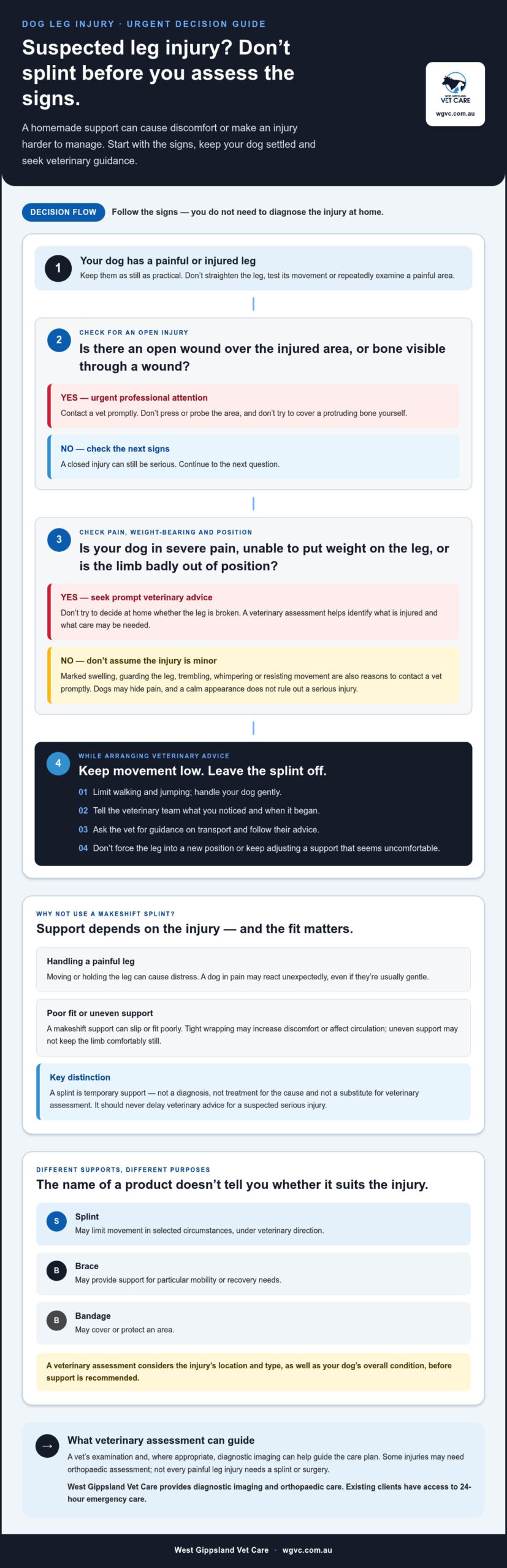
A painful leg is worrying, especially when your dog can’t tell you what’s wrong. You don’t need to diagnose the injury yourself. If your dog is in severe pain, can’t put weight on the leg, or the limb looks badly out of position, seek prompt veterinary advice instead of trying to work out at home whether it’s broken.
Urgent veterinary assessment helps identify what’s injured. Deciding whether a splint is suitable comes after that. An emergency splint for dog leg injuries isn’t automatically the safest first step. The injury’s location and nature matter, and a vet can advise you on what to do while you arrange care.
Which leg-injury signs should prompt urgent veterinary advice?
Contact a vet promptly if your dog has marked swelling, seems very painful, won’t use the leg or holds it at an unusual angle. An open wound over an injured area, or bone visible through a wound, needs urgent professional attention. Don’t press or probe the area, or try to cover a protruding bone yourself.
Dogs may hide pain or become unusually quiet when distressed, so a calm appearance doesn’t rule out a serious injury. Look for changes such as guarding the leg, trembling, whimpering or resisting movement. When you call, describe what you’ve noticed and when it began. Follow the veterinary team’s advice, even if your dog’s signs seem to change.
Why can’t I tell at home whether my dog has a fracture?
A fracture, sprain and other injuries can cause similar signs, including lameness, swelling and tenderness. The way a limb looks can’t reliably show what has happened beneath the surface. Don’t straighten the leg, test its movement or repeatedly examine a painful area. Handling may increase distress and discomfort.
A veterinary examination helps assess the injury and what care may be needed. Where appropriate, diagnostic imaging can help the vet understand the affected area and guide next steps. West Gippsland Vet Care provides diagnostic imaging and orthopaedic surgery for cases where they’re relevant. Not every painful leg injury needs a splint or surgery, so treatment decisions depend on the assessment.
Until you’ve received veterinary guidance, focus on keeping your dog settled and avoid encouraging them to walk. General First aid principles centre on taking safe, temporary steps while professional help is arranged. They don’t replace assessment of an animal’s injury. Existing West Gippsland Vet Care clients have access to 24-hour emergency care.
Why Home Splinting for a Dog’s Leg is Risky
An emergency splint is temporary support, not a way to diagnose an injury or treat its cause. It may seem like the quickest way to protect a sore leg, but the right approach depends on where the injury is, what may be damaged and how your dog is coping. A support that’s unsuitable for one injury could make another harder to manage.
A splint should never delay veterinary advice for a suspected serious injury. If you’re worried about your dog’s leg, seek guidance before trying to brace it. You can keep your dog as still as practical and explain what you’ve observed without trying to position or secure the limb yourself.
What can go wrong with a makeshift dog-leg splint?
Applying support may mean moving or holding a painful leg. That handling can cause distress, and a dog in pain may react unexpectedly, even if they’re usually gentle. A makeshift support can slip or fit poorly. Tight wrapping may increase discomfort or affect circulation, while uneven support may fail to keep the limb comfortably still. Ask a veterinarian for advice tailored to your dog’s situation.
These risks are one reason not to copy generic DIY instructions. Advice about First Aid for Fractures in Dogs and Cats can explain general precautions, but it can’t assess your dog’s particular injury. Don’t force the leg into a new position or keep adjusting a support that seems uncomfortable. Ask a vet what to do while arranging care.
When might a veterinarian use a splint or another support?
A vet can examine your dog and consider the injury’s location, type and your dog’s overall condition before recommending support. A splint may be used for temporary stabilisation in some cases. Another form of care may be more appropriate in others. The decision isn’t based simply on whether a dog is limping or whether a particular support is easy to obtain.
Temporary stabilisation is different from longer-term treatment. The vet may use examination findings and, where appropriate, diagnostic imaging to guide a care plan. Some injuries may need orthopaedic assessment, but that doesn’t mean every leg injury requires surgery or a splint. West Gippsland Vet Care provides diagnostic imaging and orthopaedic surgery for cases where they’re relevant.
If you’re an existing client and are concerned about a serious leg injury, West Gippsland Vet Care provides emergency and trauma care, including 24-hour emergency care for existing clients. Follow the clinic’s current emergency instructions rather than delaying advice to make a homemade splint.
Dog splint, brace or bandage: how their purposes differ
Splints, braces and bandages can all look like ways to support an injured leg, but they don’t do the same job. A product labelled for a particular condition doesn’t show that your dog has that condition or that the product suits their injury. The right support depends on veterinary advice, not just the name or appearance of an item.
| Type of support | General purpose |
|---|---|
| Splint | May limit movement in selected circumstances, under veterinary direction. |
| Brace | May provide support for particular mobility or recovery needs. |
| Bandage | May cover or protect an area, but doesn’t necessarily stabilise a limb. |
These supports aren’t interchangeable. A bandage won’t necessarily hold an injured limb still, and a brace intended for a particular mobility need shouldn’t be assumed to support an acute injury. Even a commercially available emergency splint for dog leg injuries may be unsuitable if it doesn’t match the injury’s location or your dog’s needs. Seek veterinary advice rather than choosing support by appearance or an online product description.
How does a splint differ from a dog brace?
A splint is intended to limit movement in selected circumstances, with its type and placement guided by a veterinarian. A brace is a broader term for support that may be used for particular mobility or recovery needs. Neither label confirms a diagnosis. A brace advertised for a condition doesn’t establish that your dog has it, or replace a vet’s assessment and treatment plan.
When is a bandage not the same as a splint?
A bandage may cover or protect an area, but that doesn’t mean it stabilises the bones or joints around an injury. Wrapping too tightly can cause problems, and covering an open injury without veterinary direction may not be appropriate. Don’t try to make a bandage function as a splint. If the injury looks serious or you can’t tell what support is needed, get veterinary guidance.
A vet’s recommendation takes account of the injury’s site and type, as well as your dog’s comfort and overall condition. A support considered in one case may not suit another, and some injuries need a different approach altogether. Choosing a support from a shop or online listing isn’t a substitute for an examination.
For general advice on staying calm and responding to an urgent injury, UC Davis offers Handling Pet Emergencies. Use general information as a guide, not a diagnosis. If your dog has a suspected serious leg injury, contact a veterinary team promptly and follow their advice on handling and transport. West Gippsland Vet Care’s diagnostic imaging and orthopaedic expertise can help guide assessment and care where appropriate.
Transporting a Dog with a Suspected Leg Injury
Getting your dog to veterinary care can feel daunting, especially if they’re sore or frightened. Keep the plan simple: reduce movement, get veterinary guidance, then arrange transport that suits your dog’s size and distress. Don’t straighten the leg, test how far it moves or apply an emergency splint for dog leg injuries unless a vet directs you to.
- Keep your dog still. Confine them in a small, quiet space and prevent walking, running or jumping. Stay close and speak calmly.
- Call for veterinary guidance. Explain what happened and describe what you can see. Ask how to handle and transport your dog safely.
- Plan calm transport. Prepare a secure vehicle and, if needed, ask another person to help with lifting. Follow the veterinary team’s instructions.
The safest immediate priority is to limit movement and seek veterinary advice.
How can I keep my dog comfortable and still?
Offer quiet reassurance and give your dog space to settle. Don’t coax them to walk. Pain can make even a gentle dog react defensively, so move slowly, avoid hugging them and keep your face away from their mouth and injured leg. Don’t attempt to muzzle a dog who is having trouble breathing, vomiting or may have a facial injury. Ask the vet for handling advice.
How should I prepare for the trip to the vet?
Call ahead for instructions suited to your dog’s condition. A small dog may be more secure in a carrier or box, while a larger dog may need help to move. If the vet advises it and you can do so without forcing movement, a firm board or blanket may help support a larger dog during lifting. Keep your dog confined and secure during the trip.
Share when the injury happened and any changes you’ve noticed, such as worsening discomfort or reluctance to stand. Don’t delay urgent care to collect a complete history or belongings. If your dog is distressed or difficult to move, pause and seek the veterinary team’s guidance rather than trying to manage the lift alone.
West Gippsland Vet Care provides emergency and trauma care, with 24-hour emergency care available to existing clients. If you’re an existing client and your dog has a suspected serious leg injury, contact West Gippsland Vet Care for current emergency instructions and advice about getting your dog to care.
Veterinary assessment for a dog’s leg injury in West Gippsland
A veterinary assessment helps replace guesswork with a clearer understanding of what may be causing your dog’s pain. A limp or unusual leg position can’t confirm the injury on its own. The vet can consider your dog’s history and signs, examine them as appropriate and decide whether further assessment is needed. This also helps determine whether a splint or another form of support is suitable, instead of relying on a homemade emergency splint for dog leg injuries.
What might happen during a veterinary leg-injury assessment?
The vet may ask how and when the injury occurred, then assess your dog and the affected leg in a way that suits their condition. Diagnostic imaging may be recommended if it could help clarify what’s happening. Not every dog needs imaging, and an examination doesn’t automatically mean a splint or surgery. The vet will explain their findings and discuss support or treatment options based on your dog’s individual needs.
West Gippsland Vet Care provides diagnostic imaging and orthopaedic surgery for cases where these services are relevant. If assessment suggests a more complex injury, orthopaedic expertise may help inform the next steps. Decisions should reflect the injury and your dog’s circumstances, not assumptions about what a particular support can do. Your vet can also advise how to care for your dog while the plan is put in place.
Where can West Gippsland dog owners find further guidance?
West Gippsland Vet Care serves communities including Warragul, Drouin, Bunyip, Yarragon, Trafalgar, Willow Grove, Hill End and Neerim South. Wherever you’re travelling from, describe the signs you’ve noticed and follow veterinary advice about assessment and transport. Existing clients have access to 24-hour emergency care. If you’re an existing client seeking urgent help, follow the clinic’s current emergency instructions.
For a suspected serious injury, timely veterinary assessment can help guide decisions about support and care. If you’d like to learn more about the clinic’s orthopaedic expertise, explore our orthopaedic veterinary care in Gippsland article. If your dog is injured now and you’re an existing client, use the clinic’s current emergency instructions rather than waiting to decide for yourself whether a splint is needed.
Choose a calm, supported next step
It’s natural to want to protect your dog straight away, but you don’t need to solve the injury yourself. If you’re weighing up an emergency splint for dog leg pain, make your next step a conversation with a veterinary team rather than a homemade fix. Your observations, including when the problem began and how your dog is behaving, can help guide that discussion.
As you arrange care, focus on what you can safely control: keep your dog settled, avoid unnecessary handling and follow the advice you’re given. Asking for help is a caring response, not an overreaction. You and your dog don’t have to work through the uncertainty alone.
Contact West Gippsland Vet Care for guidance about your dog’s injured leg. A clear next step can make a worrying moment feel more manageable and help you focus on being there for your mate.
Frequently Asked Questions
Should I splint my dog’s leg before going to the vet?
Usually, don’t apply a makeshift splint unless a vet directs you to. The wrong support or pressure can add discomfort, and your dog may need to be moved for assessment. Keep them settled in a small, comfortable space and phone the clinic for advice before handling the leg. If you’re searching for an emergency splint for dog leg injuries, professional guidance should come first.
How can I tell if my dog’s leg is broken?
You can’t confirm a fracture from signs alone. Severe pain, swelling, an unusual limb position or reluctance to bear weight can also occur with other injuries. Don’t squeeze the leg or try to check whether it moves. Tell the vet what you’ve observed and whether the signs are changing. They can examine your dog and decide whether diagnostic imaging may help clarify the injury.
Can I use a human splint or bandage on my dog?
Don’t assume a human splint or bandage will fit your dog or support the injury safely. A bandage, for example, may cover an area without keeping the limb stable, and pressure from a poor fit can cause discomfort. Keep your dog from walking on the sore leg and seek veterinary advice before applying anything, particularly if there’s a wound or the limb looks out of position.
What should I do if my dog will not put weight on a leg?
Prevent walking, running and jumping, then seek prompt veterinary advice. Not bearing weight can have several causes, and the way your dog holds the leg can’t identify the injury. Don’t encourage them to stand for a better look. If they’re reluctant to move, keep them somewhere secure and quiet while you call the clinic for advice on getting them to care.
Is it safe to move a dog with a suspected leg fracture?
Your dog may need careful help to reach veterinary care, but don’t make them walk to the car. Call ahead and describe their size, behaviour and how much they can move, so the clinic can advise on handling. Keep the vehicle secure and ask someone to assist if lifting is needed. If moving them seems difficult, pause and get guidance rather than improvising a splint.
Does West Gippsland Vet Care provide 24-hour emergency care for an injured dog?
Yes, West Gippsland Vet Care provides 24-hour emergency care for existing clients. If you’re an existing client, follow the clinic’s current emergency instructions and call ahead where directed. Don’t delay seeking advice while trying to support the leg yourself. The clinic serves West Gippsland communities including Warragul, Drouin, Bunyip, Yarragon, Trafalgar, Willow Grove, Hill End and Neerim South.