It often starts with a sudden yelp during a game of fetch or a subtle limp that just won’t clear up after a morning walk through the Drouin trails. Watching your best mate struggle with a leg injury is heartbreaking, and the weight of making the right decision about dog ACL surgery options Gippsland has available can feel truly overwhelming. You want the absolute best for them, but the thought of long recovery times or the stress of navigating Melbourne traffic for specialist care adds a layer of anxiety you simply don’t need right now.
We understand that every dog and every family is different, which is why finding the right path is a collaborative journey. Our promise is to help you discover the best surgical and non-surgical paths for your dog’s cruciate injury right here in your own community, so your mate can get back to their happy, active life. We’ll walk you through the differences between TPLO and other surgical methods, while also identifying when non-surgical management is a valid, compassionate choice for expert care close to home in Warragul and Drouin.
Key Takeaways
- Learn why a “torn ACL” is technically a CCL injury and how it specifically affects the active lifestyle of Gippsland dogs.
- Compare the various dog ACL surgery options Gippsland clinics offer, highlighting why TPLO is often the preferred choice for larger, active mates.
- Discover when conservative management is a valid alternative to surgery and what this structured process involves beyond simple rest.
- Understand the essential three-month recovery timeline and the vital role that local rehabilitation plays in a successful outcome.
- Find out how accessing expert orthopaedic care in Warragul or Drouin can significantly reduce stress for both you and your dog.
Understanding Dog ACL and Cruciate Injuries in Gippsland
If your dog has suddenly started limping after a run in the backyard, you’ve likely heard the term “ACL tear” mentioned. While humans often suffer these injuries on the footy field, for our four-legged friends, it’s the most common cause of hind limb lameness. When you’re exploring dog ACL surgery options Gippsland families often feel a bit lost in the medical jargon. It’s helpful to start with a clear picture of what’s actually happening inside that knee joint.
Why do we call it CCL instead of ACL?
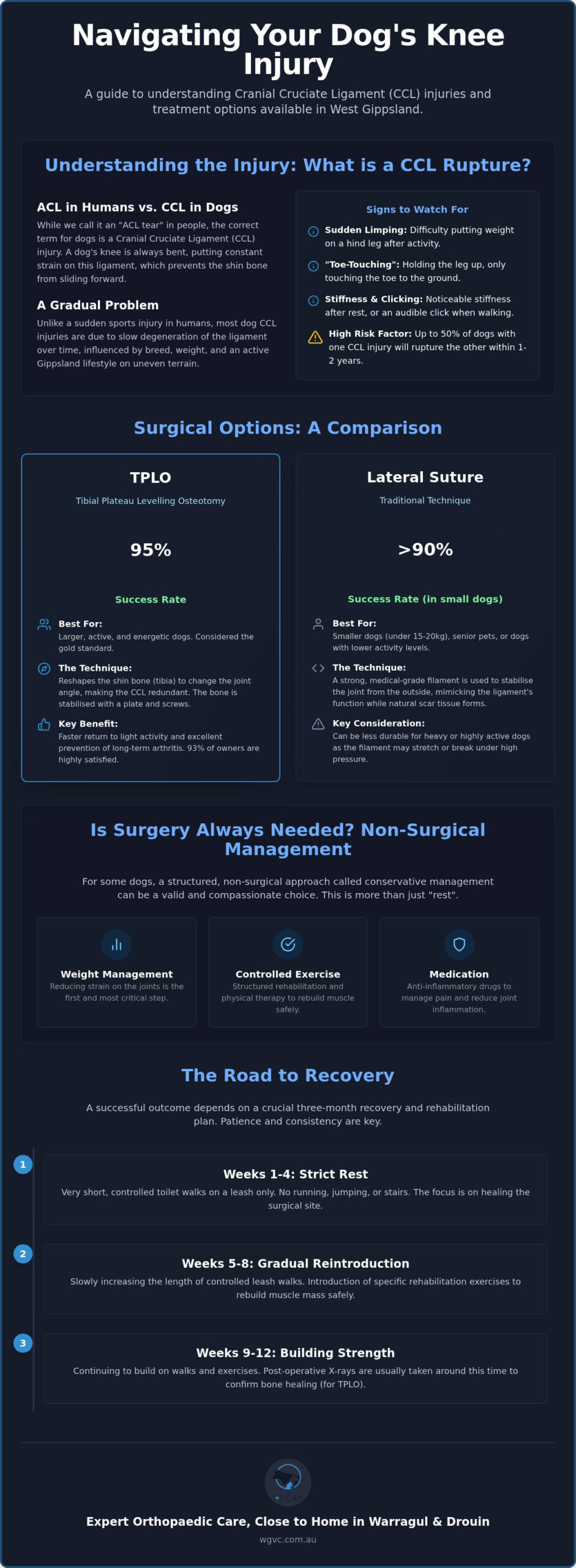
In the veterinary world, we technically refer to this as a Cranial Cruciate Ligament (CCL) injury. While “ACL” is the term we know from human sports medicine, dogs have a slightly different anatomy. The word “cranial” simply refers to the front of the joint. Because dogs stand with their knees constantly flexed, this ligament is under much more continuous tension than a human’s. Understanding Cruciate Ligament Injuries helps clarify why this tiny band of tissue is so vital; it prevents the shin bone from sliding forward against the thigh bone every time they take a step.
The Gippsland Lifestyle and Knee Stress
Living in West Gippsland means our dogs lead wonderfully active lives. Whether they’re chasing balls across uneven paddocks in Warragul or hiking up the hills around Drouin, their knees take a lot of strain. Maintaining a safe environment is key to minimising these risks; while Baumpflege Weserland GmbH handles specialised tree safety and maintenance in their area, local owners can also take steps to ensure their land is as hazard-free as possible. Unlike humans, who usually “snap” a ligament during a sudden twist, most dogs suffer from a gradual weakening of the tissue. This degeneration happens over time, often influenced by breed, weight, and the physical demands of our local terrain. Catching these signs early is the best way to prevent long-term arthritis and keep your mate mobile.
You might notice a subtle stiffness when they first get up in the morning or a “clicking” sound when they walk. In more severe cases, your mate might hold the leg up entirely, which we call “toe-touching” lameness. Seeing your dog in this much discomfort is distressing. It’s important to remember that a partial tear often leads to a full rupture if left untreated. Because dogs often compensate by putting more weight on their “good” leg, up to 50 percent of dogs with one cruciate injury will eventually rupture the other side. This makes early diagnosis at a local clinic essential for a smooth recovery.
Once we’ve identified a cruciate injury, the next step is deciding on the best way to help your dog regain their mobility. Choosing between dog ACL surgery options Gippsland has available is a personal decision that depends on your dog’s size, age, and activity level. We focus on providing the most reliable techniques to ensure your mate can return to chasing birds or walking through the local park without pain. Every procedure we perform is backed by a commitment to surgical precision and the highest standards of anaesthetic care.
TPLO: Reshaping the Knee for Stability
Tibial Plateau Levelling Osteotomy, or TPLO, is widely considered the gold standard for treating cruciate ruptures, especially in larger or more energetic breeds. Rather than trying to replace the ligament, this procedure involves carefully reshaping the top of the shin bone. By changing the angle of the joint, we eliminate the need for the ligament altogether. Research shows this is incredibly effective; TPLO has a high success rate, providing almost normal outcomes in 95% of cases.
One of the biggest benefits for your mate is a faster return to light activity. Because the bone is stabilised with a medical-grade plate and screws, the joint feels more secure almost immediately. This method is excellent for preventing the long-term wear and tear that leads to severe arthritis. In fact, a retrospective study of 1,000 cases reported that 93% of owners who opted for TPLO were highly satisfied with the outcome, compared to 75% for traditional techniques. It’s a reliable path for dogs that need to get back to an active Gippsland lifestyle.
Lateral Suture: A Traditional Approach
For smaller dogs, typically those under 15 to 20 kilograms, or for senior pets with lower activity levels, the lateral suture technique can be a wonderful option. This method uses a strong, medical-grade filament to stabilise the joint from the outside. It’s a less invasive way to provide the support the knee needs while the body forms its own natural scar tissue for long-term stability. For small dogs, this technique often has a success rate of over 90%.
While this traditional approach is often more budget-friendly, it doesn’t always offer the same durability for heavy or highly active breeds. The filament can stretch or break if put under too much pressure, which is why we often recommend TPLO for our more robust Gippsland dogs. Our team is always happy to sit down and discuss which of these orthopaedic surgery paths is the best fit for your family’s needs. We prioritise a fear-free approach to ensure your dog stays calm and safe throughout their stay in Warragul or Drouin.
Non-Surgical Options: When is Conservative Management Right?
It’s the question every owner asks themselves: “Does my mate really need to go under the knife?” While we often recommend surgical intervention for the best long-term results, we understand that for some families, exploring non-surgical dog ACL surgery options Gippsland provides is a necessary first step. This path, known as conservative management, isn’t simply about “waiting and seeing.” It is a deliberate, structured plan designed to help the body stabilise the joint through the formation of scar tissue, or fibrosis.
Choosing this path depends heavily on your dog’s specific circumstances. Generally, smaller dogs under 15 kilograms or senior pets with lower energy levels tend to be better candidates for non-surgical care. Temperament also plays a huge role; a calm dog who is happy to relax on the rug is much easier to manage than a bouncy kelpie who lives for the chase. However, you must be aware of the trade-offs. While scar tissue provides some stability, the joint remains technically “loose,” which can accelerate arthritis and increase the risk of the “second knee” failing as it compensates for the injured side.
Weight Management and Nutritional Support
Weight is the single most important factor we can control in a non-surgical plan. Carrying even an extra half a kilo puts significant, unnecessary pressure on a weakened cruciate ligament. We work with Gippsland owners to create manageable feeding plans that focus on lean protein and calorie control without making your dog feel deprived. Adding high-quality joint supplements, such as Omega-3 fatty acids and glucosamine, can also help manage inflammation and keep the remaining cartilage as healthy as possible during the healing process.
Restricted Activity and Home Modifications
The “crate rest” challenge is often the hardest part for owners. Keeping a dog quiet for eight to twelve weeks requires patience and a bit of creativity. We advocate for a Fear Free approach to confinement, using food puzzles and gentle scent games to keep their minds busy while their bodies mend. Small changes around your home can make a world of difference:
- Non-slip mats: Placing these over floorboards or tiles prevents sudden slips that could re-injure the ligament.
- Ramps: Using a ramp for the ute or the couch eliminates the high-impact “jarring” that happens during jumping.
- Assisted walking: Using a towel or a specialised sling under the belly helps you support their weight during those essential toilet breaks.
By making these adjustments, you create a safe environment that allows the body’s natural healing processes to work as effectively as possible.
The Road to Recovery: Rehabilitation in West Gippsland
Successfully navigating dog ACL surgery options Gippsland owners choose is only the first half of the battle. The real work begins once your mate returns home. Recovery is a steady marathon, not a sprint, and the first twelve weeks are the most critical for ensuring the long-term success of the procedure. We focus on a multi-modal approach to healing, combining modern pain management with a structured exercise programme that respects the unique challenges of living on a Gippsland property.
During the first fortnight, the goal is simple: manage inflammation and keep the surgical site clean. Your dog will need strict confinement, usually in a crate or a small, carpeted room. By weeks three to six, we gradually introduce very short, controlled lead walks on flat ground. It’s during this middle phase that many Gippsland dogs fall into the “too much, too soon” trap. As they start feeling better, they might try to bolt across a paddock or jump into the back of the ute. Preventing these sudden bursts of activity is vital to avoid a catastrophic failure of the repair.
From week eight onwards, the focus shifts to rebuilding the muscle that was lost during the injury. We’ll guide you through gentle strengthening exercises that you can do at home in Warragul or Drouin. Managing pain throughout this process is a collaborative effort. We use a combination of medications and therapeutic techniques to ensure your dog stays comfortable, which encourages them to use the leg correctly rather than limping. If you’re concerned about your mate’s comfort levels, talk to our team about a tailored recovery plan that suits your dog’s specific needs.
Local Physiotherapy and Hydrotherapy
Accessing rehabilitation services within the Gippsland region saves you the stress of long commutes and keeps your dog in a familiar environment. We often recommend professional physiotherapy to help restore joint function and muscle mass. Proprioception is the body’s natural ability to sense its own position and movement, which is essential for your dog to regain balance and coordination after a knee injury. Controlled walking on a lead is far more beneficial than paddock running during this time, as it forces the dog to place each foot deliberately and safely.
Monitoring for Complications
Healing isn’t always a perfectly straight line. You’ll need to keep a close eye out for signs of trouble, such as sudden increased lameness, heat around the joint, or any discharge from the incision. Having your follow-up appointments locally in Warragul makes these checks much easier to manage than trekking into the city. For your peace of mind, we provide 24-hour emergency support to our existing clients, ensuring that if you have a late-night worry about your dog’s recovery, a familiar and caring expert is only a phone call away.
Expert Orthopaedic Care Close to Home in Warragul and Drouin
Staying in the Gippsland region for complex procedures like orthopaedic surgery isn’t just about convenience; it’s about the well-being of your dog. Long car trips to Melbourne can be incredibly stressful for an injured pet, and the return journey after surgery is often even more difficult. By choosing dog ACL surgery options Gippsland families can access in Warragul or Drouin, you ensure your mate remains in a familiar environment, close to the people they trust. This local approach reduces the cortisol spikes associated with travel, which is a vital part of a smooth healing process.
At West Gippsland Vet Care, we bridge the gap between high-level surgical expertise and the nurturing feel of a local family practice. We’ve been part of this community since 1989, and we treat every patient like one of our own. Our team combines advanced diagnostic imaging and in-house laboratory services to provide a comprehensive surgical experience without the cold, clinical feel of a large metropolitan hospital. We believe that the best medical outcomes happen when clinical excellence meets genuine, local compassion.
A Compassionate Approach to Surgery
We know that surgery is just as stressful for you as it is for your pet. That’s why we prioritise Fear Free veterinary care throughout the entire hospitalisation process. From the moment you walk in, we use gentle handling techniques and calming environments to lower your dog’s anxiety. Having your regular vet involved in the journey means there is a continuous thread of care, from the initial diagnosis to the final recovery check. It’s a collaborative effort where we keep you informed at every stage.
Our commitment to the Gippsland community means providing advanced medical services that keep families together. You won’t be just another number in a busy city schedule. We take the time to listen to your concerns, explain the procedure in plain English, and ensure you feel confident in the path we’ve chosen together. This personal commitment is what defines our practice and ensures your dog receives tailored care that fits their specific lifestyle.
Next Steps for Your Best Mate
If you’re ready to explore the best dog ACL surgery options Gippsland has to offer, the first step is a thorough orthopaedic consultation. This allows us to assess the joint, discuss your dog’s lifestyle, and determine whether TPLO, lateral suture, or conservative management is the right fit. We’ll look at the whole picture, including their age and the terrain they usually run on, to make the best recommendation.
To make the most of your first visit, please bring along any previous X-rays or medical history from other clinics. This helps us build a complete picture of your dog’s health without repeating unnecessary tests. We’ll walk you through the recovery timeline and answer every question you have about anaesthesia or aftercare. Your mate’s comfort and safety are our highest priorities, and we’re here to support you every step of the way. Organise a consultation with our orthopaedic team today to help your best mate get back on their feet.
Getting Your Mate Back on Their Paws
Deciding on the right path for a cruciate injury is a journey of patience and care, but it’s one you don’t have to walk alone. By exploring the diverse dog ACL surgery options Gippsland offers, from the gold-standard TPLO to tailored conservative management, you are already taking the most important step toward restoring your mate’s quality of life. Whether your dog is a high-energy farm hand or a gentle senior companion, the focus remains on finding a solution that fits your specific family needs and Gippsland lifestyle.
As an independent, local Gippsland partner, we pride ourselves on being a Fear Free certified practice that prioritises your pet’s emotional well-being just as much as their physical health. Our clinics in Warragul and Drouin are equipped with advanced in-house diagnostic imaging, allowing us to provide high-level care right here in our own community. We invite you to talk to our compassionate team about your mate’s knee recovery so we can create a clear, stress-free plan together. Your best mate’s recovery is our priority, and we look forward to seeing them back to their happy, active self soon.
Common Questions About Dog ACL Surgery in Gippsland
How much does dog ACL surgery cost in Gippsland?
The total investment for your dog’s recovery depends on several factors, including your pet’s size, the specific surgical technique chosen, and the level of aftercare required. While we don’t provide fixed quotes without a consultation, we focus on transparent communication to ensure you understand the value of advanced diagnostics and specialised surgical care. Choosing dog ACL surgery options Gippsland families can trust locally often saves on the hidden costs of travel and city specialist fees.
Can a dog live a full life without cruciate surgery?
While some smaller or senior pets can manage with a structured non-surgical plan, most active dogs struggle with chronic instability and pain without intervention. A dog can live without surgery, but their lifestyle usually requires significant modification to prevent further injury. We focus on conservative management as a deliberate choice for specific cases, ensuring that if you skip surgery, your mate still has a high quality of life through weight control and restricted activity.
What is the success rate of TPLO surgery for active dogs?
TPLO is considered a highly reliable procedure with a success rate of approximately 95 percent for providing almost normal outcomes. This technique is especially effective for our active Gippsland dogs that love to run and explore. Because the surgery changes the mechanics of the knee rather than just replacing a ligament, the results are predictable. Most owners find their mates return to their favourite activities with much more confidence and stability than other methods provide.
How long is the recovery period for a dog after knee surgery?
A full recovery typically takes up to six months, though the first eight to twelve weeks are the most critical for restricted movement. During this initial phase, your mate will need to avoid jumping or running to allow the bone or suture to heal properly. We provide a step-by-step rehabilitation guide to help you navigate this period. While it sounds like a long time, most dogs are back to light, controlled lead walks much sooner than you might expect.
Will my dog develop arthritis if I don’t choose surgery?
Unfortunately, some degree of arthritis is inevitable once a cruciate ligament is injured because the joint becomes unstable. This instability causes the bones to rub together unnaturally, leading to inflammation and cartilage wear. Surgery aims to stabilise the joint as quickly as possible to slow this process down. If surgery isn’t the right path for your family, we focus on long-term pain management and supplements to keep your mate comfortable despite the permanent joint changes.
Is my dog too old for an ACL operation?
Age is rarely the deciding factor; instead, we look at your dog’s overall health and vitality. Many senior dogs are excellent candidates for surgery and benefit immensely from the pain relief and improved mobility it provides. We perform thorough pre-operative health checks and use modern, gentle anaesthesia to ensure the process is as safe as possible. If your older mate is otherwise happy and healthy, restoring their ability to walk comfortably is often a wonderful gift.
What happens if my dog tears the cruciate ligament in both knees?
It is quite common for a dog to eventually injure the second knee, with research suggesting up to 50 percent of dogs will rupture the other side. This usually happens because they overcompensate by putting extra weight on the “good” leg. In these cases, we typically recommend staging the surgeries a few months apart. This allows one leg to become strong enough to support them while the second knee undergoes the same recovery process for a full return to health.