
Did you know that roughly one in ten bulls is actually subfertile? It’s a quiet drain on your bottom line that often goes unnoticed until the scanning gate shuts and the “empty” count starts to climb. For any Gippsland producer, the sight of a dry cow represents more than just a missed opportunity; it’s the high cost of a sire that didn’t do his job during the joining season. That’s why a professional bull semen evaluation is such a vital part of your seasonal preparation. It’s not just a clinical check, it’s a way to ensure your investment in genetics actually translates into calves on the ground.
We understand how much you care about the future of your herd and the long-term success of your farm. We’re here to help you move toward joining with total confidence by explaining how these evaluations protect your calf crop and ensure your bulls are truly fit for work. In this guide, we’ll explore the Australian standards for breeding soundness, the importance of sperm morphology, and how the early detection of fertility issues can help you maximise pregnancy rates within those critical first two cycles.
Key Takeaways
- Understand why a bull’s physical appearance doesn’t always match his breeding potential and how to avoid the “lucky dip” of using unproven sires.
- Discover how a professional bull semen evaluation provides a clear picture of sperm motility and morphology to protect your next calf crop.
- Learn about the comprehensive VBBSE process, which goes beyond the laboratory to include vital structural and physical health checks.
- Master the “60-day rule” for testing to ensure your bulls are at peak performance exactly when the Gippsland joining season begins.
- Identify sub-fertile sires early to maximise your pregnancy rates and secure the long-term profitability of your beef or dairy enterprise.
Beyond the Visible: Why Bull Semen Evaluation Drives Gippsland Farm Profit
A bull that looks the part in the paddock isn’t always a high performer when it’s time to work. Relying solely on a visual appraisal is essentially a lucky dip for your herd’s future. While a bull might have the right muscle, a shiny coat, and a strong frame, these physical traits don’t guarantee his reproductive success. In fact, relying on looks alone can be a costly gamble for any business. Professional bull semen evaluation is the only way to peek under the bonnet and ensure everything is working as it should.
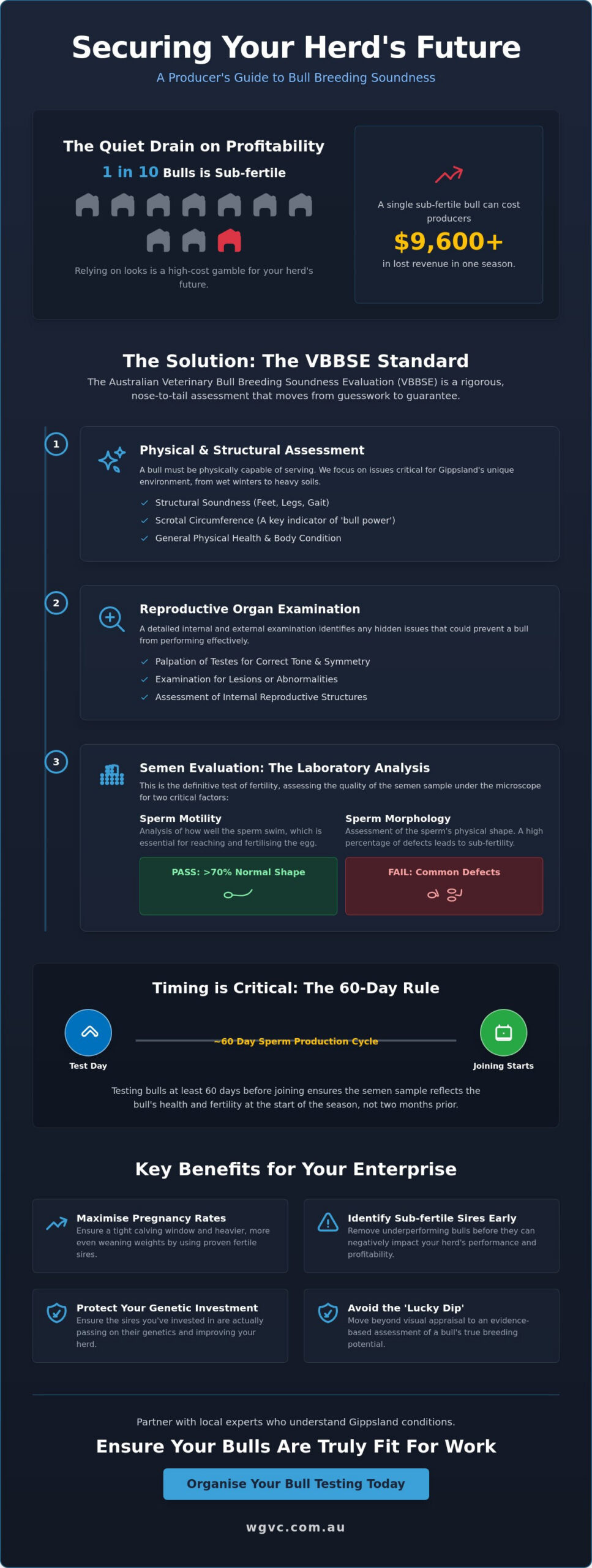
One industry estimate suggests that a sub-fertile bull can cost a producer upwards of $9,600 in lost revenue in a single season. This isn’t just about the current year’s profit; it’s about the genetic legacy of your farm. Your herd sires dictate the future of your replacement heifers. A sire with poor reproductive traits can inadvertently pass those struggles on to the next generation, impacting your herd’s productivity for years to come. In Australia, we follow the Veterinary Bull Breeding Soundness Evaluation (VBBSE) standard. This is a rigorous, evidence-based assessment that provides a reliable measure of a bull’s potential. It moves the conversation from “he looks alright” to “he is biologically fit to perform.”
The Hidden Risk of Sub-fertility
It’s easy to spot a completely infertile bull when the cows don’t get pregnant at all, but sub-fertile bulls are far more dangerous to your bottom line. These bulls are capable of getting some cows in calf, but they take much longer to do it. This drags out your calving bridge and leads to lighter, uneven weaning weights. Often, a sub-fertile bull’s poor performance is masked by social dominance. He might be the boss bull in the paddock, preventing younger, more fertile sires from working, while he himself is failing to deliver at a high level.
Why West Gippsland Farmers Prioritise Testing
Our local climate plays a significant role in herd health. Cold, wet Gippsland winters can place immense stress on a bull’s body condition. If a bull spends his winter just trying to stay warm and maintain weight, his nutrition and subsequent semen quality can suffer. This is why many producers in Warragul and Drouin are prioritising bull semen evaluation well before the spring joining begins.
Working with a trusted livestock vet West Gippsland allows you to integrate these checks into your broader herd strategy. It’s about building a relationship with a local expert who understands our soil, our seasons, and the unique challenges of farming in the valley. We view this as a partnership. Our goal is to ensure your breeding season is as smooth and successful as possible.
The Veterinary Bull Breeding Soundness Evaluation (VBBSE) Process
A Veterinary Bull Breeding Soundness Evaluation (VBBSE) is much more than a simple health check. It’s a comprehensive, nose-to-tail examination designed to give you peace of mind before the season starts. Think of it as a thorough pre-work assessment that ensures your sire is ready for the physical demands of the Gippsland hills. This standardised approach, developed by the Australian Cattle Veterinarians, looks at the whole animal to identify any hidden issues that might prevent him from doing his job effectively. We see your bulls as more than just assets; they’re the heart of your herd’s future, and they deserve a thorough check-over.
Physical and Structural Assessment
We always begin with a close look at the bull’s structural soundness. If a bull can’t walk comfortably, he simply can’t serve. In our local Gippsland environment, where heavy soils and wet winters are common, we pay particular attention to feet, legs, and gait. Issues like foot abscesses or early arthritic changes can quickly turn a promising sire into a liability once he’s out in the paddock. We also measure scrotal circumference, as this is a reliable proxy for sperm production capacity. A bull with a larger scrotal size generally has more “bull power” and often produces daughters that reach puberty earlier, adding long-term value to your breeding program.
Reproductive Organ Examination
The next step involves a detailed look at the reproductive organs. We palpate the testes to ensure they have the right tone and symmetry, checking for any lesions or abnormalities that could hinder performance. We also examine the penis and prepuce for injuries that might have occurred in previous seasons. An essential part of our process is the internal palpation of the accessory sex glands. This allows us to spot infections like vesiculitis, which can significantly impact fertility but are impossible to see from the outside. It’s these hidden details that often make the difference between a successful joining and a disappointing scanning result.
Collecting a sample for bull semen evaluation is done using modern electroejaculation technology. This method is safe, humane, and allows us to gather a high-quality sample for analysis right at the crush-side. It’s a gentle process that prioritises the animal’s welfare while providing the data we need to help you make informed decisions. If you’re planning your next joining, it’s a great time to chat with our team about how a VBBSE can support your herd’s performance. Understanding the technical side of the semen evaluation process helps you see why every step of this examination is vital for your farm’s success.
Understanding Sperm Motility and Morphology: What the Lab Results Mean
Once we’ve confirmed your bull is physically sound, we move to the microscopic level. This is where we look at the actual cells to see if they have the power and the structure to create a pregnancy. We generally group these results into two categories: motility and morphology. Think of motility as the engine that gets the sperm to the egg, while morphology is the blueprints that ensure the sperm can actually do its job once it arrives. A comprehensive bull semen evaluation isn’t complete without looking at both.
Crush-side Motility Assessment
While we are still with you at the crush, we use a microscope to check for progressive motility. This means we are looking for “swimmers” that are moving forward in a straight line rather than just spinning in circles. For a bull to receive a “pass” grade under the Australian Cattle Veterinarians standards, he needs more than 60% progressively motile sperm. If a sample shows between 30% and 60%, he might receive a “qualify” grade; this could be acceptable for a paddock with multiple bulls but is quite risky for a single sire situation.
It’s helpful to remember that motility can be sensitive. Temporary factors like a sudden Gippsland cold snap, recent transport stress, or even a minor fever can cause a dip in results. Because we care about the long-term success of your breeding program, we always look at these results in context. If a bull’s motility is lower than expected, we can discuss whether a re-test in a few weeks is the best path forward for your peace of mind.
Advanced Morphology Testing
While motility tells us if the sperm can travel, morphology tells us if they are “normal” enough to fertilise the egg. Morphology is the study of sperm structure to ensure successful egg penetration. A bull can have incredibly fast-moving sperm, but if those cells have structural defects, they won’t be able to penetrate the egg membrane. This is why morphology is often considered the most critical part of the Bull Breeding Soundness Examination (VBBSE).
We send these samples to specialised laboratories where technicians use high-power phase-contrast microscopy to identify specific defects:
- Head abnormalities: Issues here can prevent the sperm from attaching to the egg or carrying the correct genetic material.
- Mid-piece issues: This is the sperm’s power plant; defects here can lead to a lack of energy or even early embryo loss.
- Tail detachments: These prevent the sperm from reaching the destination at all, regardless of how healthy the head might be.
For single sire mating or AI, we look for a threshold of more than 70% normal sperm. If you are running multiple sires, the benchmark is generally more than 50%. By understanding these numbers, we can work together to ensure your joining season is built on a foundation of proven fertility and reliable performance.
Timing and Strategy: When to Organise Your Bull Testing in Victoria
Timing is everything when it comes to reproductive success. In Victoria, where our seasonal windows are so defined by the spring flush, getting your bull semen evaluation organised at the right moment is essential. We generally recommend the “60-day rule”. This means testing your sires roughly eight weeks before they are due to go out with the cows. This buffer is vital for your peace of mind and your farm’s productivity.
This specific timeframe isn’t arbitrary. It’s based on the 61-day sperm production cycle, known as spermatogenesis. If a bull has suffered a fever, a foot injury, or severe stress recently, it takes about two months for those issues to clear his system and for new, healthy sperm to be produced. By testing early, you give yourself a safety net. If a bull receives a “deferred” result, you have time to decide whether to re-test him after a rest period or to source a replacement before joining begins. It’s about being proactive rather than reactive.
Preparing for the Joining Window
Integrating your bull checks into your existing farm routine makes the process much smoother. We often suggest aligning these evaluations with your annual vaccination and drenching programs. It’s also the perfect time to assess your bulls’ Body Condition Score (BCS). On our lush Gippsland pastures, it’s easy for bulls to become either too heavy or to lose too much condition during a tough winter. We want them in a “fit, not fat” state, ideally a BCS of 3.0 to 3.5. This ensures they have the physical stamina to cover the ground and stay active throughout the entire joining period.
The Bull-to-Cow Ratio
The results of a VBBSE don’t just tell you if a bull is sound; they help you plan your stocking rates. A bull with exceptional morphology and high “bull power” might comfortably handle a ratio of 1:50. Conversely, a younger yearling or a bull with a “qualify” grade might be better suited to a 1:30 or 1:40 ratio. Managing these ratios is a form of risk insurance. For single-sire joining groups, the stakes are much higher, making a “pass” result non-negotiable. Younger bulls require a different approach altogether. They are still growing and often lack the social experience of seasoned sires, meaning they can tire more easily if over-worked.
Don’t leave your herd’s fertility to chance this season. You can book your bull fertility testing with our livestock team today to ensure your sires are ready to perform when it counts.
Partnering with West Gippsland Vet Care for Superior Herd Performance
At West Gippsland Vet Care, our commitment to the local farming community stretches from Bunyip right through to Trafalgar. We’re more than just a clinical service; we’re a team of people who live and work in your neighbourhood. Our livestock team understands that while the science behind a bull semen evaluation is complex, the advice you receive should be practical and down-to-earth. We aim to be an extension of your support system, helping you navigate the challenges of each season with a friendly, expert hand.
Building a long-term relationship with a vet who knows your herd history is one of the best investments you can make. When we visit for a VBBSE, we’re also thinking about how those results fit into your broader farm goals. We can easily link your bull fertility checks with other essential services like livestock pregnancy testing or even canine artificial insemination for your working dog team. This integrated approach ensures that every reproductive aspect of your farm is managed with the same high level of care and professional dedication.
Our Compassionate Approach to Livestock Care
We believe that every animal deserves to be treated with kindness. During our evaluations, we use low-stress handling techniques to keep your bulls calm and safe. It’s a collaborative effort between our team and yours. When the results come back, we sit down and talk through them without the heavy medical jargon. Whether we’re discussing your sires or supporting responsible dog breeding on your property, our focus remains on animal welfare and your peace of mind. We take the time to listen to your concerns and provide guidance that respects the deep bond you have with your livestock.
Booking Your Evaluation
Organising a farm visit for multiple bulls is the most efficient way to get your herd ready for the season. To help us provide the best care, we ask that you have your yards and crush in good working order before we arrive. A safe, stable environment allows us to focus entirely on the bull semen evaluation and the health of your animals without unnecessary distractions. It’s about creating a space where we can work together smoothly to achieve the best results for your business.
Ready to secure your next calf crop? Contact West Gippsland Vet Care to book your bull breeding soundness evaluation today.
Securing Your Herd’s Future with Confidence
Ensuring your sires are fit for work is one of the most effective ways to protect your farm’s productivity and your family’s legacy. By looking beyond a bull’s physical appearance and committing to a professional bull semen evaluation, you’re removing the guesswork from your joining season. A comprehensive VBBSE covers everything from structural soundness to the microscopic details of sperm morphology, providing a clear path toward high pregnancy rates and a tighter calving window. Remember that timing is your greatest ally; starting your checks eight weeks before joining gives you the space to make informed decisions without the stress of a looming deadline.
Our team at West Gippsland Vet Care has been serving the local community for decades. Our BULLCHECK™ accredited veterinarians arrive on your farm with comprehensive diagnostic equipment, ready to provide the expert care your livestock deserve. We’re here to listen, to help, and to ensure your breeding season is a success from the very first cycle. When you’re ready to get started, you can Book your Bull Semen Evaluation with West Gippsland Vet Care. We look forward to working alongside you to help your herd thrive.
Frequently Asked Questions
How often should I have my bulls evaluated?
Bulls should be evaluated every year, ideally about eight weeks before your joining season begins. Fertility can change quickly due to illness, injury, or environmental stress; a pass result from last year doesn’t guarantee he’s fit for work today. Regular checks ensure you catch any issues before they impact your pregnancy rates.
Can a bull pass a physical check but fail a semen test?
Yes, it’s very common for a bull to look structurally perfect and have great physical presence but still fail a bull semen evaluation. Morphology issues, such as head or tail defects, are completely invisible to the naked eye. These microscopic problems can prevent fertilisation even if the bull is active and serving cows regularly.
What is the minimum scrotal circumference for a fertile bull?
Minimum scrotal circumference varies depending on the bull’s age and breed; however, a mature bull should generally measure at least 32 to 34 centimetres. This measurement is a key indicator of his sperm production capacity. We use the latest Australian Cattle Veterinarians standards to ensure your sires meet the requirements for their specific age group and developmental stage.
How much does a bull semen evaluation cost in Gippsland?
The investment for a bull semen evaluation depends on several factors, including the number of bulls being tested and the travel required to reach your property. While we don’t provide fixed prices here, we’re always happy to have a chat about your specific needs. Most producers find the cost is a small price to pay compared to the thousands of dollars lost from “empty” cows at scanning time.
What happens if my bull receives a “deferred” status?
If a bull receives a “deferred” status, it means he hasn’t passed today but may improve with time. This often happens if the bull has recently recovered from a fever, a minor injury, or extreme weather stress. We usually recommend a re-test in six to eight weeks to allow for a full cycle of new sperm production to occur before making a final decision.
Can I test my own bulls, or do I need a veterinarian?
A formal Veterinary Bull Breeding Soundness Evaluation (VBBSE) must be performed by a qualified veterinarian to meet recognised industry standards. Vets have the specialised training and high-powered laboratory equipment needed to assess sperm morphology accurately. Having a professional certificate also adds significant value if you’re planning to sell the bull or need to meet specific insurance requirements.
Does a semen test evaluate a bull’s libido (sex drive)?
A standard semen test assesses the quality and health of the sperm, but it doesn’t measure a bull’s actual desire to mate. While we check the reproductive organs for physical health during the exam, a serving assessment is a separate observation used to evaluate libido. We can discuss your bull’s paddock behaviour with you to get a fuller picture of his reproductive performance.
Is electroejaculation painful or harmful for the bull?
Modern electroejaculation is a safe and humane method for collecting samples when performed by an experienced veterinarian. We use low-voltage equipment designed to be as gentle as possible, prioritising the bull’s welfare throughout the process. Most bulls tolerate the procedure very well and return to their normal paddock activities immediately afterward.