Anti-inflammatory medication can ease pain from a dog’s ACL injury, but it can’t repair the ligament or stabilise an unstable knee. Non-surgical options for a dog’s ACL injury may suit some partial tears, particularly when the knee is less unstable. Surgery generally offers a more predictable outcome when the tear is complete.
It’s understandable to hope that rest, medication or supplements will help your dog feel comfortable again. Conservative care can play an important role, but it depends on carefully restricted activity and a plan tailored to the injury, not simply waiting for the knee to heal.
Here, you’ll learn how veterinarian-prescribed anti-inflammatory medication fits into non-surgical treatment, what activity changes may involve, and how joint supplements may support comfort. These approaches can help manage signs, but may not replace surgery when the knee needs mechanical stabilisation.
Key Takeaways
- Non-surgical care is more likely to suit smaller dogs and partial injuries; the degree of knee instability matters when weighing treatment options.
- Plan for closely restricted activity early on, followed by a gradual return to low-impact movement guided by your dog’s progress.
- Weight management can reduce extra strain on the knee, while supplements may offer joint support as part of a broader care plan.
- Use anti-inflammatory medication only as prescribed, and keep your vet informed about other medicines your dog is taking.
When is non-surgical management off CCL disease recommended?
Conservative care may suit some partial injuries, but complete ruptures often leave the knee unstable, making surgery an important option to consider.
Choosing conservative management
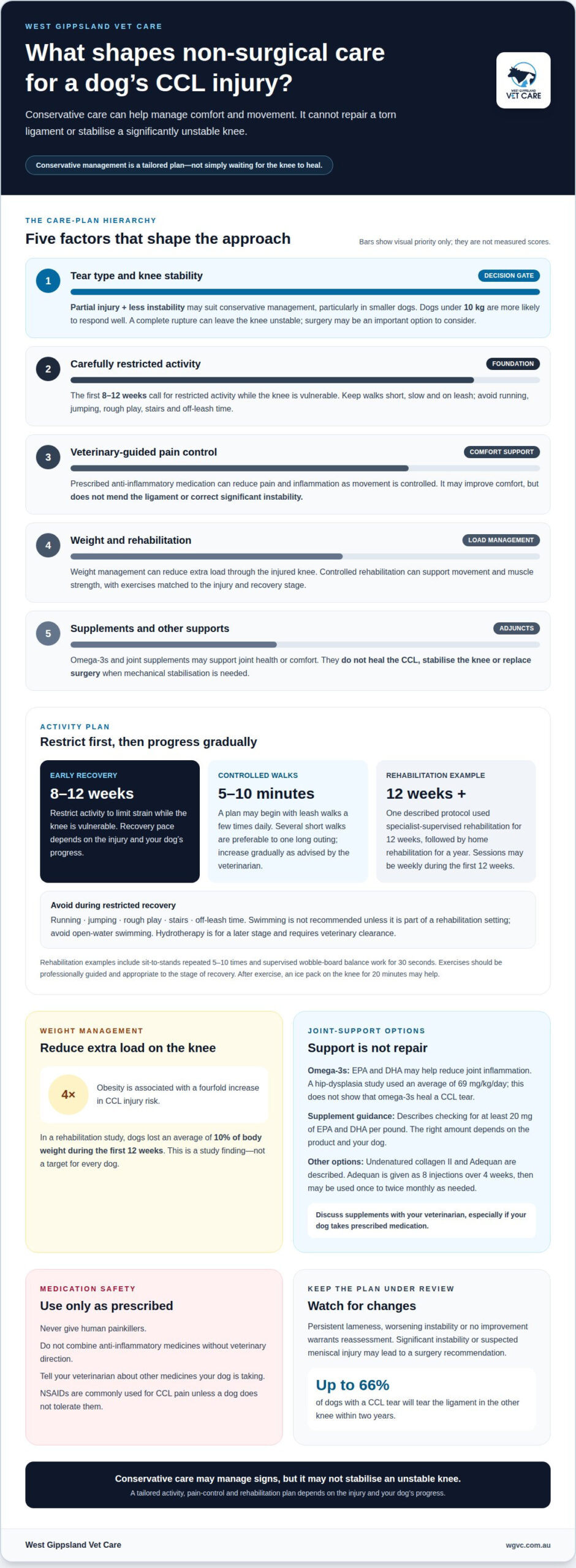
Conservative management combines restricted activity, pain control and rehabilitation without surgery. It may be considered for a partial rupture, especially in a smaller dog with less knee instability. Dogs under 10 kg are more likely to respond well, while a complete rupture can let the shinbone move forward and make the knee difficult to manage without stabilisation. In Australia, cost depends on the case, including assessment, medications and follow-up; a price is provided after a quote request.
Managing pain and inflammation
Pain management may involve veterinarian-prescribed medication to reduce discomfort and inflammation while movement is controlled. Non-steroidal anti-inflammatory drugs (NSAIDs) are commonly used for cranial cruciate ligament pain, unless a dog doesn’t tolerate them. Never give human painkillers or combine anti-inflammatory medicines without veterinary direction. Medication can improve comfort, but it doesn’t mend a torn ligament or correct significant instability. Persistent lameness, worsening instability or no improvement with conservative care warrants reassessment. Significant joint instability or a suspected meniscal injury may lead to a surgery recommendation.
Weight management and recovery supports
Weight management reduces extra load through an injured knee, making it a practical part of conservative treatment. Obesity is associated with a fourfold increase in CCL injury risk. In a rehabilitation study, dogs lost an average of 10% of their body weight during its first 12 weeks; this is a study finding, not a target for every dog. Omega-3 fatty acids and joint supplements may support joint health, but they don’t heal the CCL. Hydrotherapy may support recovery later, after veterinary clearance.
Risks of conservative management
Conservative care can leave ongoing instability, pain and arthritis, particularly when a complete rupture is present. A dog may improve yet still need long-term activity changes to reduce arthritis flare-ups. The other knee also matters: up to 66% of dogs with a CCL tear will tear the ligament in their other knee within two years. A complete rupture, worsening instability or lack of improvement can change the treatment decision, so follow-up helps identify when the plan needs reassessment.
Activity restriction and gradual return to low-impact exercise
During the first 8 to 12 weeks after a CCL injury, restricted activity helps limit strain while the knee is vulnerable. The exact pace of recovery depends on the injury and your dog’s progress.
Keep walks short, slow and on leash. Avoid running, jumping, rough play, stairs and off-leash time, even if your dog seems keen to move. Several short walks are preferable to one long outing. A conservative plan may begin with controlled leash walks of 5-10 minutes a few times daily, then increase gradually as the veterinarian advises.
Rehabilitation adds controlled exercise to support movement and muscle strength. For example, supervised programmes can work the quadriceps and hamstrings, which provide secondary support around the knee. In one described protocol, dogs had 12 weeks of specialist-supervised physical rehabilitation, followed by home rehabilitation for a year. Rehabilitation sessions may be weekly during the first 12 weeks.
Exercises should match your dog’s injury and stage of recovery. A rehabilitation plan may include sit-to-stands, repeated 5-10 times, or supervised balance work on a wobble board for 30 seconds. Controlled stretching can help limit stiffness. These activities aren’t a substitute for surgery when the knee needs stabilisation, and advanced exercises shouldn’t begin without professional guidance.
After walks or exercise, an ice pack on the knee for 20 minutes may help. Swimming isn’t recommended unless it’s part of a rehabilitation setting; avoid open-water swimming. Hydrotherapy belongs at a later recovery stage and requires veterinary clearance. After the initial recovery period, low-impact activity can return gradually, while high-impact play such as fetch and running remains unsuitable for many dogs.
A veterinary assessment can help shape safe activity and rehabilitation around your dog’s injury. Find veterinary assessment and care when your dog needs a tailored plan.
Omega-3 fatty acids and joint supplements
Joint supplements may support comfort and joint health during recovery, but they don’t repair a torn cruciate ligament. Treat them as one part of a broader plan, not as a way to stabilise the knee or prevent further injury.
Omega-3 fatty acids, including EPA and DHA, may help reduce inflammation in dogs’ joints. One study found improved clinical outcome measures in dogs with hip dysplasia given an average of 69 mg of EPA and DHA per kg per day. That finding relates to hip dysplasia, not a canine CCL tear, so it doesn’t show that omega-3s heal a ligament. Supplement guidance describes checking for at least 20 mg of EPA and DHA per pound; the right amount depends on the product and your dog.
Undenatured collagen II and Adequan are other joint-support options described for dogs with CCL tears. Adequan is administered as a series of 8 injections over 4 weeks, then may be used once to twice monthly as needed. These products may support joint health, but they don’t replace surgery when the knee needs mechanical stabilisation. Discuss any supplement with your veterinarian, especially if your dog takes prescribed medications.
A canine knee brace also doesn’t stabilise the joint or replace the cruciate ligament’s function. In one study, nearly 40% of dogs fitted with a custom stifle orthotic experienced skin-related complications within the first 3 months. This makes skin monitoring an important consideration if a brace forms part of a treatment plan. A brace shouldn’t be treated as a shortcut to an unrestricted return to activity.
Supplements and braces have limits: they may support joint care, but neither restores a ruptured ligament. Your dog’s comfort, knee stability and recovery progress help determine whether these options have a role alongside controlled care.
Veterinary-prescribed anti-inflammatory medication
Veterinarians commonly prescribe non-steroidal anti-inflammatory drugs (NSAIDs) early in conservative treatment for a cranial cruciate ligament injury. These medicines reduce pain and inflammation, helping a dog move more comfortably while activity remains restricted. They manage symptoms, but don’t reconnect torn tissue or stabilise the knee. With a partial tear, less pain doesn’t necessarily mean the ligament has healed.
Give only the medication and dose prescribed for your dog’s condition. Don’t add human pain relief, ibuprofen, corticosteroids such as prednisone, or another anti-inflammatory without veterinary direction. Combining NSAIDs with corticosteroids or other anti-inflammatories increases the risk of complications. Tell the veterinarian about every medicine and supplement your dog receives, so the plan can account for possible interactions.
Medication is one part of a broader plan, not a reason to increase exercise. A dog that seems more comfortable may still have an unstable knee, particularly after a complete cruciate ligament rupture. Follow the prescribed activity limits and note any changes in lameness, willingness to stand or comfort during controlled walks. Worsening signs or no improvement with conservative care call for veterinary reassessment.
For dogs taking daily medication, a veterinarian may recommend blood work every 6 to 12 months. This helps guide ongoing treatment and monitoring. Keep a record of the medication schedule and any changes you notice, such as reduced appetite or new signs of discomfort, and share these observations during reviews. Never stop or alter a prescribed course without discussing it with the veterinarian.
Choosing pain relief involves weighing your dog’s symptoms, other medications and overall health. For a veterinary assessment and guidance on prescribed pain management, arrange a veterinary assessment.
West Gippsland Vet Care
West Gippsland Vet Care can assess your dog’s knee injury and discuss whether conservative care or orthopaedic surgery may be appropriate. Considering the injury, your dog’s comfort and knee stability can help clarify the options and what to do next.
Bring details of the signs you’ve noticed, changes in your dog’s activity, and any medicines or supplements they’re taking. This context helps the veterinary team understand your concerns and discuss treatment choices with you. If your dog’s lameness worsens or they become less comfortable, seek veterinary advice rather than changing medication or exercise on your own.
Contact West Gippsland Vet Care to discuss your dog’s knee injury and possible next steps.
Make a considered plan for your dog
Choosing non-surgical options for a dog’s ACL injury isn’t simply a decision to avoid an operation. It means agreeing on what you hope your dog will regain and how you’ll recognise progress. Consider everyday goals, such as getting up comfortably, moving around home or joining calm family routines. These details are a useful starting point for discussing care.
Bring your observations and questions to a veterinary appointment, including changes you’ve noticed and any parts of the plan that feel difficult to manage. Your veterinarian can discuss how each treatment path fits your dog’s needs and explain what might prompt a change in approach. There isn’t one plan for every dog, so keep the conversation open as your dog’s comfort and function change.
For a thoughtful discussion about your dog’s next steps, contact West Gippsland Vet Care. A calm, informed decision can help you support your companion with confidence.
Frequently Asked Questions
How does non-surgical treatment compare to surgery?
The comparison also involves the commitment each treatment plan asks of you and your dog. Before deciding, discuss expected check-ins, home-care demands and what changes would prompt a revised plan. For non-surgical options for a dog’s ACL injury, ask how progress will be assessed and what happens if comfort or mobility stalls. Clear expectations can help you make a practical, informed choice.
What is the cranial cruciate ligament (CCL) in a dog?
CCL is the veterinary term for a ligament within a dog’s knee, while ACL is the familiar term for the corresponding ligament in people. The terms describe the same general structure in different species, not two separate ligaments in a dog. Knowing this distinction can make discussions about your dog’s knee injury and treatment easier to follow.
Considering a brace instead of surgery?
A brace shouldn’t be treated as an automatic substitute for surgery; its possible role depends on your dog’s examination findings. Ask what the brace is intended to achieve in your dog’s plan, how its use will be reviewed and what signs would mean it isn’t helping. This keeps the decision focused on your dog’s needs, not the device alone.
What is a knee ligament tear?
A knee ligament tear damages fibres within a ligament around the knee. It can occur alongside other problems in the joint, so a limp alone can’t identify exactly which tissues are affected. A veterinary examination helps distinguish a suspected ligament injury from other causes of hindlimb lameness and determine whether further assessment is needed before choosing treatment.
What about a brace?
If a brace is part of your dog’s care plan, keep a simple record of when it’s worn and how your dog moves afterwards. Note any reluctance to walk, changes to their usual routine or difficulty settling at home. Sharing these observations at a review can help the veterinarian decide whether the brace remains useful within the broader plan.
What causes CCL injuries in dogs?
The cause can’t always be traced to one clear event. Help the veterinarian understand your dog’s situation by noting when the limp first appeared, what your dog was doing and whether it changed over time. Mention any earlier episodes or changes in everyday activity too. This history can guide the assessment without assuming a dramatic accident caused the injury.