

A high or low flag is a prompt to interpret a result, not a diagnosis on its own. Understanding vet pathology reports means considering each result alongside your pet’s signs, history and other test findings, because an out-of-range value may not be clinically significant by itself. The result can help guide what to investigate, monitor or discuss next.
It’s understandable to feel worried when a report marks a result as abnormal, especially when the numbers and medical terms are unfamiliar. A flag shows that a result falls outside the laboratory’s reference interval; it doesn’t explain the cause or tell you, by itself, how unwell your pet is.
This guide explains what high, low and slightly abnormal results may mean, why reference intervals and changes over time matter, and which questions can help you have a clear conversation with your veterinarian. You’ll also learn how blood and urine tests, biopsies and other investigations contribute to a fuller picture of your pet’s health.
Key Takeaways
- Read a high or low flag as a signal to consider, not a diagnosis on its own.
- Compare results with the reference interval on the report, as laboratories can use different ranges.
- Look at trends across tests and your pet’s signs to understand whether an out-of-range result may matter.
- Ask your veterinarian what the result means for your pet, whether further tests are useful, and what to monitor.
- Use the report to guide a conversation, rather than trying to diagnose your pet from individual values.
Communicating with the doctor about results
Your veterinarian requested the test and is best placed to interpret the findings alongside your pet’s history and examination. A pathology report records laboratory results; it doesn’t replace the clinical picture. For example, an unusual blood result may mean something different for a lively pet than for one showing weakness or poor appetite.
The laboratory produces the report, and its pathologist-in-charge is responsible for it. Scientists and pathologists can discuss findings with the requesting veterinarian, who can relate them to your pet’s symptoms, medicines and previous results. This context helps show whether a result may indicate a condition, support monitoring or prompt another test before treatment is considered.
Veterinary pathology costs in Australia depend on the test type, sample number and analysis required; the cost is provided after a quote request. Turnaround depends on the test, sample handling, laboratory processing and whether specialist review is needed. A blood panel and a biopsy follow different laboratory processes, so their results may take different amounts of time.
To make the conversation useful, have the report and your observations ready. Ask focused questions such as:
- Which result matters most for my pet, and what does it indicate alongside their signs?
- Could a medicine, recent meal or activity help explain this finding?
- Does this result change the treatment plan, or is monitoring appropriate?
- Would another test clarify the finding, and what would it help establish?
These questions can clarify the difference between a confirmed diagnosis and a possibility. Pathologists may communicate uncertainty in the report’s comments or contact the veterinarian directly. The wording matters: cited human-medicine studies examined unclear final diagnoses. Clinicians linked such wording to miscommunication more than 70 % of the time. In veterinary care, ask your veterinarian to explain any phrase that feels unclear, including what is known and what remains uncertain.
A clear explanation should connect the result to a decision. If a biopsy identifies abnormal tissue, for example, ask how the finding relates to the lump and whether it changes the next step. If repeat blood tests are being compared, ask whether the pattern is improving, staying similar or changing. A cumulative report brings results together over time, helping your veterinarian assess a trend rather than focus on one isolated value.
Before you finish the discussion, check that you understand the plan: what the result means, whether further investigation is needed and which changes at home should prompt follow-up. Writing down the answers can help you remember them and share accurate details with everyone caring for your pet.
When discussing a result, ask how it fits with the other information available and how certain the findings are. The veterinarian who requested the tests should weigh that context. A sufficient level of diagnostic certainty is needed before starting expensive, invasive and potentially harmful treatment. If the report comments or veterinarian convey uncertainty, ask what it means for the next decision.
Flags for high and low results
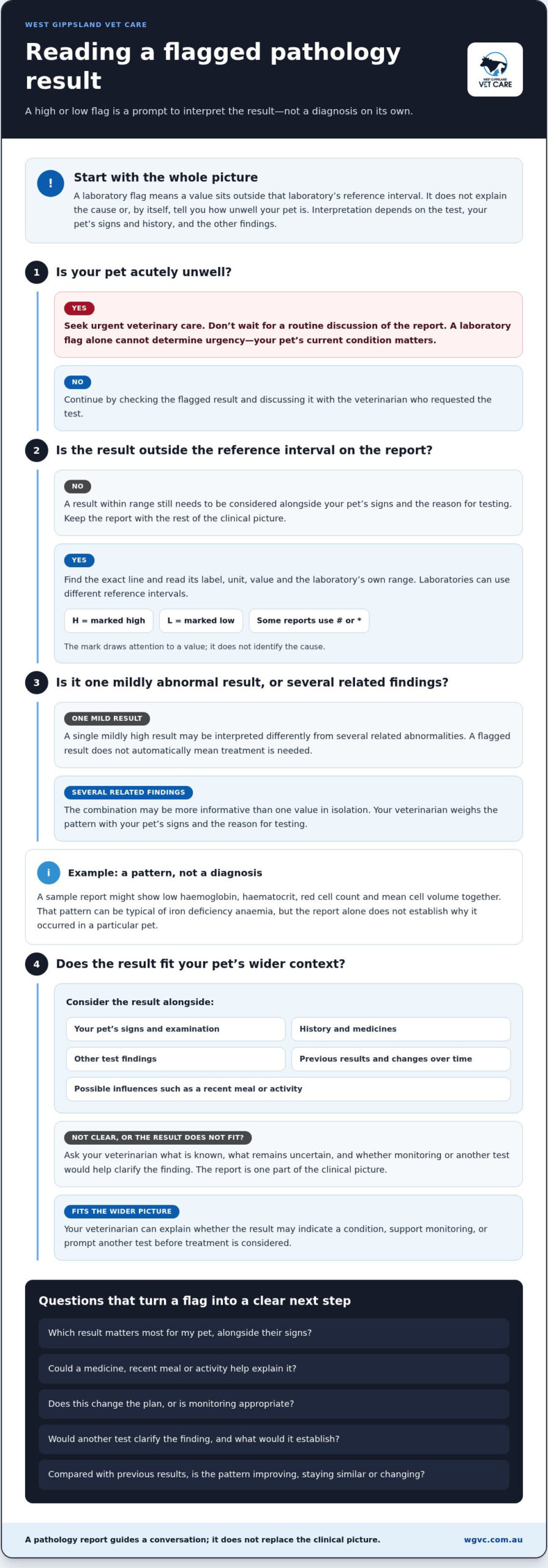
A flag shows that a result falls above or below the laboratory’s reference interval. For dogs and cats, its meaning depends on the test and why it was ordered.
Blood results and reference ranges
A blood result is a measured value, while its reference range is the interval the laboratory uses for comparison. The range helps show whether a dog’s or cat’s result sits within or outside that interval. Read the unit and test name beside each value; a number without its label, such as a red blood cell measure, can be easy to misread.
Understanding high and low flags
A high or low flag identifies a result outside the stated range, often with H or L. Some laboratories mark these results in red or use symbols such as # or *. The mark draws attention to a value but doesn’t explain its cause. Check which result carries the flag and whether the report labels it high or low.
For example, a sample report may show low haemoglobin, haematocrit, red cell count and mean cell volume together. That pattern can be typical of iron deficiency anaemia, but the report alone doesn’t establish why it occurred in a particular pet. Your veterinarian considers the combination of findings, your pet’s signs and the reason for testing.
Seek urgent veterinary care if your pet is acutely unwell; don’t wait for a routine discussion of the report. A laboratory flag alone can’t determine urgency. Your pet’s current condition matters, so tell the veterinary team about any sudden or severe change and share the report if it’s available.
Use the report to focus your questions. For each flagged line, note the test name, whether it is marked H or L, and the value beside the laboratory’s range. Then ask:
- What does this specific result indicate for my dog or cat?
- Do other results support the same interpretation?
- Does this finding change the next step or treatment plan?
If the symbols or values feel difficult to follow, talk through your pet’s test results with your veterinary team. A clear explanation can help you understand what the report says and what the next step means for your pet.
Out-of-range results that may not be clinically significant
An out-of-range value is a finding to interpret, not proof of disease. For a useful clinical reading, compare the result with the laboratory’s own reference interval, then consider patterns across related results and tests.
Several factors can affect veterinary pathology results, including the laboratory’s reference interval, the test performed, your pet’s clinical signs and history, and how the result compares with earlier tests. These details help distinguish a meaningful pattern from an isolated result just outside the stated range.
Reference intervals can differ between laboratories, even for the same test. Compare a value with the interval printed on the report from the laboratory that analysed the sample. Using a range from another laboratory can give a misleading impression because the stated boundaries may not match.
A slightly high result at one laboratory might sit within another laboratory’s interval. This doesn’t prove that either result is wrong; it shows why the report’s own range matters. If your pet has results from different laboratories, tell your veterinarian which laboratory performed each test. They can interpret each value against the correct interval and consider the wider clinical picture.
One sample full blood count report shows why a single flag needs context. Slightly out-of-range monocyte and lymphocyte results were normal on the other two occasions tested. In that example, the results were considered almost certainly not clinically significant. The pattern across the tests mattered more than either isolated flag.
For your pet, a useful comparison includes the test name, result, laboratory range and previous results for the same test. Note whether the value remains outside the range, returns within it or changes alongside other findings. A repeated result provides different context from a one-off finding, but still needs to be interpreted alongside your pet’s signs and history.
Bring earlier reports to the discussion, especially if the tests came from more than one laboratory. Ask your veterinarian to explain:
- Which reference interval applies to each result?
- Has this same result changed across previous tests?
- Do related results support a clinical concern?
- What would repeating the test help clarify?
A flagged value may be less meaningful when it sits just outside the range and other results or repeat tests give a different picture. A broader pattern, several related findings or a change in your pet’s condition may carry more weight. The aim is to understand what the combined evidence indicates, rather than treat every out-of-range number as a diagnosis.
What slightly abnormal results may mean
A slight abnormality may be acceptable in light of your pet’s current situation, rather than evidence of disease. The wording and type of sample help determine what the result can show.
Interpreting slightly abnormal results
A slightly abnormal result sits outside the laboratory’s range but may not establish a diagnosis by itself. Its meaning depends on the finding and the clinical picture. For example, a small change in one blood value may mean something different from several related abnormalities that point in the same direction.
Pathology language can describe different levels of certainty, but clinicians and pathologists may interpret a phrase differently. One proposed guide gives an unmodified morphologic diagnosis 95-100% certainty, “Diagnostic of” 75-95%, “Compatible with” 50-75%, and “Suspicious for” less than 50%. These expressions are guides, not a substitute for discussing what the report means for your pet.
If a mild change needs watching, a repeat laboratory panel after 3-6 months can help reassess the result. The comparison can show whether the value has moved, stayed similar or returned within range. Ask which result the repeat panel will track and how its direction would affect the next decision.
Cytology and histopathology results
Cytology examines cells from a sample, while histopathology examines a tissue sample under a microscope. The distinction matters because each report describes different material, so the findings answer different questions about an abnormal area.
A cytology report describes the cells collected, while a histopathology report assesses tissue. A report may describe what the sample shows, qualify the diagnosis or express uncertainty in its comments. If the wording says “compatible with” or “suspicious for”, ask what that level of certainty means for your pet and whether the sample supports a firm conclusion.
Biopsy findings in veterinary reports
A biopsy is a tissue sample examined under a microscope to help determine whether a lump or abnormal tissue is benign or malignant. The findings can guide the diagnosis and the discussion about what should happen next.
The sample’s location and size affect how a biopsy is performed. A pet may have a biopsy under local or general anaesthesia, depending on those factors. When reading the result, focus on the diagnosis and comments explaining uncertainty. Ask whether the findings answer the question that prompted the biopsy and what the result means for your pet’s care.
These reports describe evidence from the sample, not the whole story in isolation. The veterinarian considers the findings alongside your pet’s signs and other available information. If a result is slightly abnormal or its wording is unclear, ask which part matters most, whether further assessment is needed and what changes to monitor. That conversation helps turn unfamiliar terms into a clearer understanding of the next step.
Whether owners can interpret reports themselves
You can read the test names, values and comments in a veterinary pathology report, but it needs to be understood alongside your pet’s health information. Focus on what each part records, then discuss its meaning with the veterinarian who requested the test.
Information in a pathology report
A pathology report presents the laboratory’s findings from a sample and may include comments that explain them or express diagnostic uncertainty. The laboratory produces the report, and its pathologist-in-charge is responsible for it. Knowing who prepared the interpretation helps explain why the report is a technical record, rather than a complete account of your pet’s health.
Start by identifying the test and sample described. A blood test report, urinalysis and biopsy report each relate to different material and questions. The findings section records what the laboratory observed or measured; comments add context about the interpretation. For example, a biopsy report examines tissue under a microscope to help assess whether a lump or abnormal tissue is benign or malignant.
Reports can also show results collected over time. A cumulative pathology report brings repeated results together, allowing a veterinarian to see whether a condition is improving. Check the dates and test names before comparing entries, then note any changes you want explained. This helps keep the discussion anchored to the correct results.
Common report terminology
Common terms describe whether a finding is within a reference interval, outside it or interpreted with uncertainty. “High” and “low” indicate a result’s position against the laboratory’s range, while comments explain how the pathologist interprets the finding. These labels describe test results; they don’t name a diagnosis by themselves.
Words in a tissue report can signal different degrees of certainty. “Diagnostic of” expresses a stronger conclusion than “compatible with”, while “suspicious for” signals a less certain interpretation. Pathologists and clinicians may interpret these terms differently, so ask the requesting veterinarian to explain the exact phrase in your pet’s report.
Use these steps to prepare for that conversation:
- Underline an unfamiliar term, such as “compatible with”, and ask what it means in plain language.
- Match each flagged value to its test name and the laboratory’s reference interval.
- Ask how the finding relates to your pet’s signs and other available information.
- Write down the diagnosis, next step and what to monitor at home.
Scientists and pathologists can discuss results with the requesting veterinarian, who interprets them alongside other information. If a report’s wording is unclear, arrange a conversation about your pet’s results so you can understand what the findings mean and what happens next.
West Gippsland Vet Care: Pet Vaccinations
West Gippsland Vet Care offers pet vaccinations to help you plan preventive care around your animal’s needs. If a pathology result raises questions about vaccination or what care to discuss next, bring the report and your questions to your veterinary appointment.
Share relevant findings and your pet’s health history so the discussion can take both into account. A report’s flags don’t automatically determine vaccination decisions; the veterinarian can explain how the results relate to your pet’s care. Clear answers can help you feel more prepared to make decisions for your companion.
Contact West Gippsland Vet Care to discuss pet vaccinations and your questions about your pet’s care.
Take the next step with confidence
Understanding vet pathology reports can help you feel more prepared, but the next step is deciding what information matters for your pet’s care. A clearer understanding of vet pathology reports can help you bring focused questions to an appointment and discuss options such as pet vaccinations, desexing procedures or microchipping.
West Gippsland Vet Care can support you as you consider your companion’s care. Bring your questions and share what you’ve noticed at home, so the conversation can focus on your pet’s needs and the decisions ahead.
Contact West Gippsland Vet Care to discuss your pet’s care. With clear information and a supportive conversation, you can move forward feeling more prepared.
Frequently Asked Questions
Why does this matter?
Pathology matters because it can reveal clues that a physical examination alone may not show, helping guide diagnosis or treatment monitoring. For example, a urine test can provide information about kidney health, the urinary tract and hydration, and may identify crystals or infection. Knowing why a test was ordered helps connect its findings with the concern being investigated, rather than viewing a result as an isolated number.
What does an abnormal or borderline result mean for my pet?
An abnormal or borderline result needs to be considered in light of why the test was done and how your pet is acting. A finding from routine screening may lead to a different discussion from one found while investigating a new problem. Tell your veterinarian about changes you’ve noticed, such as altered appetite, drinking or energy, and ask whether the result affects care now or should be monitored.
What should I ask my vet after receiving a pathology report?
Ask what the finding means for your pet’s care today, what would change the plan and which signs at home deserve attention. You can also ask how the result relates to the original reason for testing and whether earlier records would help guide decisions. If you’re in Warragul, Drouin, Bunyip, Yarragon, Trafalgar, Willow Grove, Hill End or Neerim South, keep the report nearby when discussing your pet’s results.