

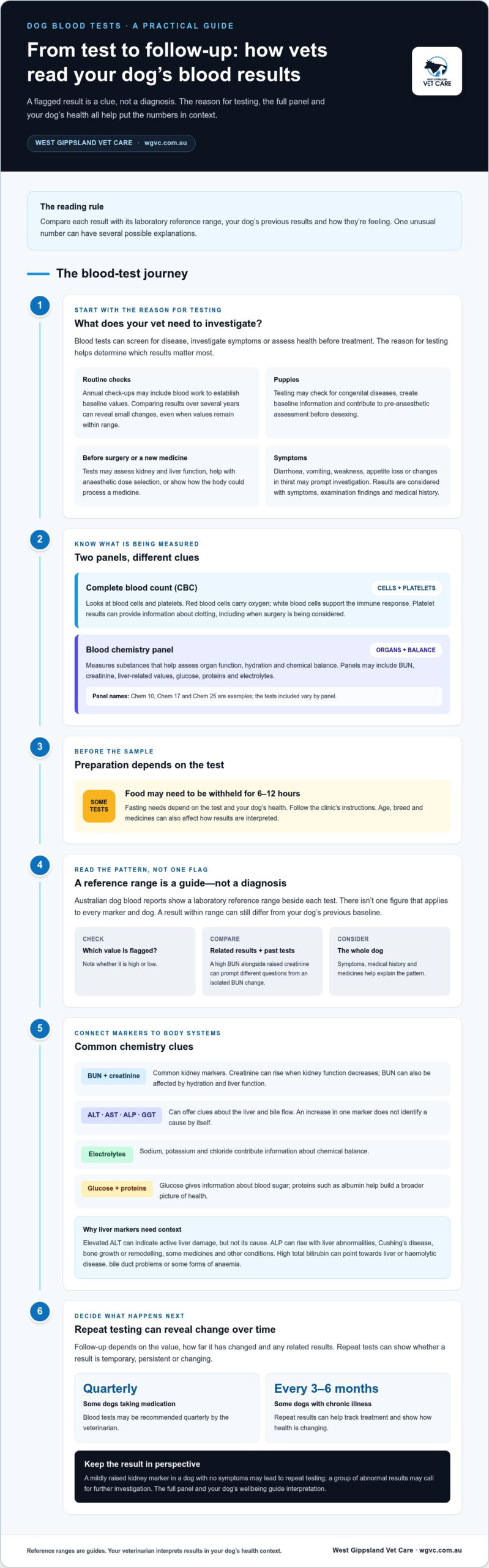
A flagged result is a clue, not a diagnosis. Interpreting my dog’s blood test results means comparing each value with the laboratory’s reference range, your dog’s previous results and how they’re feeling. A veterinarian assesses the pattern across the full panel, because one unusual number can have several possible explanations.
It’s understandable to feel concerned when a result is marked high or low, especially when the report uses unfamiliar terms. That flag doesn’t automatically mean your dog has a serious illness, but it can help guide what to investigate next.
This guide explains why vets recommend blood tests, what a complete blood count and blood chemistry panel measure, and what common abnormal results may indicate. You’ll also learn how repeat testing can show changes over time, and why your dog’s symptoms and medical history matter when interpreting the results.
Key Takeaways
- Blood tests can support routine health checks and help assess a dog before surgery or a new medication.
- A CBC looks at blood cells and platelets, while a chemistry panel gives clues about organ function and electrolyte balance.
- A result outside its reference range is a clue to interpret, not a diagnosis on its own.
- Your dog’s symptoms, medical history and previous results help make sense of flagged values and guide follow-up testing.
- Platelet results can provide useful information about clotting, particularly when surgery is being considered.
When Will A Veterinarian Recommend Dog Blood Tests?
Veterinarians recommend blood tests to screen for disease, investigate symptoms and assess a dog’s health before treatment. A blood sample provides information that a physical examination alone can’t. Results help assess organ function, blood cells and electrolyte balance, and, when relevant, hormone levels. The reason for testing determines which results matter most.
For a healthy dog, annual check-ups can include routine blood work to establish baseline values. Comparing results across several years can reveal small changes, even when individual values remain within the laboratory’s reference ranges. Routine blood tests may be considered as part of a dog’s regular health checks. For puppies, tests can check for congenital diseases, create baseline information and contribute to pre-anaesthetic assessment before desexing.
Before surgery or anaesthesia, a veterinarian may recommend blood tests to assess kidney and liver function and help select an anaesthetic dose. A complete blood count can also reveal some hidden abnormalities, including potential bleeding concerns. Before a dog starts a new medication, testing may help assess how the body could process it, particularly if the medicine is metabolised by the liver or kidneys. The medication, health history and planned procedure all help determine which tests are appropriate.
Symptoms can prompt testing at any age. For example, blood tests for a dog with diarrhoea can help investigate infection, inflammation or organ dysfunction. Vomiting, weakness, appetite loss or changes in thirst may also lead a veterinarian to investigate. Blood tests provide clues, not a diagnosis on their own, so the veterinarian considers results alongside symptoms, examination findings and medical history.
Age, breed, fasting and medications can all affect how results are interpreted: age and breed inform the dog’s health context, while medicines can influence some values. For some tests, the veterinarian may recommend withholding food for six to 12 hours; follow the clinic’s instructions because fasting needs depend on the test and your dog’s health.
When a result falls outside its reference range, the next step depends on the value, how far it has changed and any related results. A mildly raised kidney marker in a dog with no symptoms may lead to repeat testing, while a group of abnormal results may call for further investigation. Results are complex and interconnected, so interpreting my dog’s blood test results means considering the whole panel and the dog, not just one flagged figure.
Follow-up testing can show whether a result is temporary, persistent or changing. Dogs taking medication may need blood tests quarterly when their veterinarian recommends it. Dogs with chronic illness may need testing every 3-6 months. These repeat results help track treatment and give the veterinary team a clearer view of how the dog’s health is changing.
What is Covered on the Blood Chemistry Panel for Dogs?
A chemistry panel measures substances in the blood to help assess organ function, hydration and chemical balance. Vets may interpret it alongside a complete blood count (CBC), which examines blood cells and platelets.
Common blood chemistry markers
Common markers are substances measured to provide clues about how a dog’s organs and body systems are working. Chemistry panels can include BUN, creatinine, liver-related values, glucose, proteins and electrolytes.
Some panels are grouped as Chem 10, Chem 17 or Chem 25, with the tests included varying by panel. BUN and creatinine are common kidney markers, while sodium, potassium and chloride are electrolytes. Glucose gives information about blood sugar, and proteins such as albumin help build a broader picture of health. A result becomes more useful when read with related markers and the reason for the blood work.
Blood chemistry and organ function
A chemistry panel helps assess major organ systems by measuring several values together. BUN and creatinine provide information about kidney function, while ALT, AST, ALP, GGT and bilirubin can offer clues about the liver and bile flow.
These markers don’t all mean the same thing. Creatinine can rise when kidney function decreases, while BUN can also be affected by hydration and liver function. Blood chemistry and electrolytes can help assess the liver, kidneys and pancreas. A CBC provides different information: red blood cells carry oxygen, and white blood cells support the immune response. Reading both panels together can help connect a possible illness with the pattern of results.
Interpreting chemistry results and ranges
Interpreting chemistry results means comparing each value with the reference range on the laboratory report, then considering related results and the dog’s health. The range is a guide, not a diagnosis, and a result within range can still differ from the dog’s previous baseline.
Australian dog blood reports show a laboratory reference range beside each test, because there isn’t one figure that applies to every marker and dog. To read common CBC and biochemistry results, identify which value is flagged, note whether it is high or low, and consider the related values. A high BUN alongside raised creatinine may prompt different questions from an isolated BUN change. The dog’s symptoms, medicines and previous blood work also help explain the pattern.
Elevated liver enzymes and bilirubin
ALT, ALP and bilirubin are different markers, so an increase in one doesn’t identify a cause by itself. Elevated ALT can indicate active liver damage, but it doesn’t show what caused it. ALP can rise with liver abnormalities, Cushing’s disease, bone growth or remodelling, some medicines and other conditions.
High total bilirubin can indicate that the liver isn’t functioning normally, and may point towards liver or haemolytic disease, bile duct problems or some forms of anaemia. Vets interpret these results alongside other chemistry values, the CBC, symptoms and medication history. If your dog seems seriously unwell, 24-hour emergency care for existing clients is available.
Complete blood count (CBC)
A complete blood count (CBC) measures red blood cells, white blood cells and platelets in a dog’s blood. It can help detect anaemia, inflammation or infection, and provide clues about hydration and immune response. A CBC offers a different view from chemistry testing: it doesn’t directly measure kidney function, which requires other tests.
Red blood cells carry oxygen around the body, so low red cell count, haematocrit or haemoglobin can mean reduced oxygen-carrying capacity. Haematocrit, also called packed cell volume, shows the proportion of blood made up of red cells. A low result may fit anaemia, while a high result can be associated with dehydration. The pattern and your dog’s signs help explain what the result means.
Other red cell markers describe cell size and the body’s response. Mean cell volume measures the size of an individual red blood cell. MCH and MCHC help distinguish some types of anaemia. Reticulocytes are young red blood cells: a high count can indicate the body is rebuilding red cell numbers, while a low count may show it isn’t responding adequately to demand. These results help characterise an abnormal red cell count.
White blood cells support the immune response. Changes in their total count or in types such as neutrophils, lymphocytes and monocytes can accompany infection, inflammation, stress or other conditions. Eosinophils may provide clues about allergic or parasitic conditions. A high or low white cell count doesn’t identify a cause on its own; the veterinarian considers it alongside symptoms and other CBC findings.
Platelets help form blood clots, and a CBC includes a platelet count. This information can matter before surgery, when the veterinary team assesses clotting. Blood is collected through a minimally invasive draw. If your dog has a known bleeding problem or takes medication, share that history before collection so it can be considered alongside the result.
Blood collection and the laboratory report are separate parts of testing. A CBC describes what is measured in the blood sample; it can’t explain every concern during or after a blood draw. If you notice bleeding at the collection site or your dog seems unwell afterwards, contact the veterinary team for guidance. The report usually gives a reference range, and values outside it may be highlighted. A flagged result needs interpretation, not an automatic diagnosis.
Finally, compare the CBC with your dog’s previous results, if available. A value inside the laboratory’s reference range can still have changed from that dog’s baseline, while an out-of-range result may need further testing to find its cause. The veterinarian considers the full blood count, hydration, examination findings and relevant chemistry results before deciding what the pattern suggests.
Platelets and blood clotting
A complete blood count measures three main groups of blood cells: red blood cells, white blood cells and platelets. Each has a different role. Red blood cells carry oxygen, white blood cells help the immune system respond to infection and other disturbances, and platelets help form blood clots. A platelet result therefore adds information that red and white cell counts can’t provide.
Platelets gather at a damaged blood vessel and help form a clot that limits bleeding. On a CBC report, the platelet count shows how many of these clot-forming cells are present in the sample. A low count can raise concern about the blood’s ability to form clots, while the dog’s signs and other results help explain the finding. The number alone doesn’t establish why it changed.
Before surgery, platelet assessment can help the veterinary team consider clotting alongside other findings. For example, if a pre-surgical CBC shows an unusual platelet count, the veterinarian may interpret it with the dog’s history and examination before deciding whether further assessment is useful. This is one reason a CBC can contribute to pre-operative checks rather than relying on a single chemistry result.
Red and white blood cell results provide separate context for a platelet finding. A low red blood cell count, haematocrit or haemoglobin can indicate anaemia and reduced oxygen-carrying capacity. White blood cell changes can occur with infection, inflammation, stress or other conditions. If several cell groups are abnormal together, the veterinarian considers the overall pattern instead of treating the platelet count as an isolated answer.
A platelet count isn’t a complete assessment of every part of clotting. If a dog has unexplained bleeding, bruising or other concerning signs, the CBC is considered alongside those observations and the medical history. Further testing may help investigate the cause of an abnormal result. A normal platelet count also needs context: it describes the count in the sample, not every aspect of the dog’s health.
Blood chemistry provides different information. Chemistry results can help assess organ function and electrolyte balance, while a CBC focuses on blood cells and platelets. A veterinarian may review both panels when investigating illness or preparing for surgery. For instance, platelet findings alongside kidney-related chemistry results may inform a broader assessment, but neither should be read without the dog’s clinical picture.
When reviewing a report, note whether the platelet value is flagged, whether red or white cell results also differ, and what prompted testing. Share details such as visible bleeding, bruising, recent illness or medicines, as these help the veterinary team interpret the CBC. The laboratory’s reference range guides the reading, while the veterinarian connects the result with the dog’s history and other findings.
Common abnormal blood test results
A flagged result can indicate a change, but it doesn’t identify the cause on its own. The pattern of abnormalities, your dog’s symptoms and related tests all help shape the interpretation.
Abnormal glucose and electrolyte levels
Glucose measures blood sugar, while electrolytes such as sodium and potassium help assess fluid and chemical balance. High glucose can indicate diabetes mellitus, but the result needs to be considered alongside other findings and symptoms.
Low glucose can cause collapse, seizures or coma, so those signs call for urgent veterinary attention. Sodium may rise with dehydration or fall with vomiting, diarrhoea, Addison’s disease or kidney disease. Increased potassium can occur with kidney failure, Addison’s disease, dehydration or urethral obstruction, and high levels can affect the heart. These results help indicate which body systems need further assessment; they don’t provide a diagnosis on their own.
Abnormal protein and cholesterol levels
Blood proteins include albumin and globulin, and changes in either can add clues about a dog’s health. Low albumin may be associated with decreased liver function, blood loss, gastrointestinal disease or kidney disease. Elevated globulin can indicate inflammation or infection, and may also occur with dehydration or cancer.
Cholesterol results need to be interpreted alongside the rest of the panel, the dog’s symptoms and medical history. A flagged value alone doesn’t establish a diagnosis. For both protein and cholesterol findings, the overall pattern and accompanying abnormalities matter more than any single number.
Abnormalities needing urgent attention
Some results need urgent attention because they can accompany serious symptoms or affect vital body functions. Low glucose can cause collapse, seizures or coma, while high potassium can lead to a heart attack. If your dog collapses, has a seizure or appears severely unwell, seek veterinary attention promptly rather than waiting to interpret the report at home.
Other flagged results need timely follow-up, depending on the result and your dog’s condition. For example, raised BUN can relate to kidney, liver or heart disease, urethral obstruction, shock or dehydration. An elevated result alone doesn’t show which cause applies. The veterinarian considers symptoms, examination findings and related blood measures to determine what further assessment is appropriate.
For urgent concerns, existing clients can access 24 hours emergency and trauma care. Bring the blood report and details of your dog’s current symptoms and medicines, so the veterinary team has relevant context.
West Gippsland Vet Care: Pet Vaccinations
West Gippsland Vet Care provides pet vaccinations as part of ongoing preventive care. If a blood test has raised questions, our veterinary team can help you understand the results and discuss what care may be relevant for your dog.
Preventive care also includes desexing procedures and microchipping, while orthopaedic surgery may be relevant for dogs with certain bone or joint conditions. Each supports a different aspect of wellbeing, so the right conversation depends on your pet’s needs and health history.
For a calm discussion about your dog’s care, contact West Gippsland Vet Care.
Take the next step with confidence
If you’re interpreting my dog’s blood test results, keep the report alongside a short note of changes you’ve noticed, such as shifts in appetite, energy or behaviour. This gives you a clear starting point for discussing what the findings mean for your dog and whether follow-up care is appropriate. You don’t need to work out the diagnosis from the report alone.
That conversation can also help you consider your dog’s wider care. West Gippsland Vet Care offers pet vaccinations, desexing procedures and microchipping to support different aspects of preventive care. Your dog’s health history and current needs can guide which topics are useful to discuss.
Bring your questions and your dog’s test report into the conversation. Contact West Gippsland Vet Care to discuss your dog’s care, and take the next step with support.
Frequently Asked Questions
What do blood tests for dogs reveal?
Blood tests reveal measurable clues about a dog’s blood cells, organ function and chemical balance. A CBC can show changes in red cells, white cells or platelets, while chemistry tests examine values such as glucose, proteins and kidney markers. Results can help investigate symptoms or monitor a known condition. A report is most useful when considered with your dog’s examination, medical history and earlier test results.
Why is blood work important for your dog’s health?
Blood work can identify changes that aren’t obvious from behaviour or a physical examination alone. For example, a dog might still seem well while routine results show a change from its previous baseline. Comparing results over time helps the veterinary team assess whether a value is stable or changing. Blood tests can also help monitor a dog’s response to treatment, giving the team information to guide ongoing care.
What do “high” or “low” results really mean?
“High” and “low” describe how a result compares with the laboratory’s reference range; they don’t name a disease. The size of the change, related test values and your dog’s symptoms all affect how the result is understood. A single flagged value can have several possible explanations. Look at the full report and your dog’s previous results, rather than treating one bold or highlighted number as a diagnosis.
Why would a dog or cat need a blood test?
A dog or cat may need blood tests to investigate symptoms, check health before an operation or assess the effects of medication. For instance, a veterinarian might request tests when a pet is vomiting, losing appetite or becoming weak. Testing can also help monitor an existing illness. The panels chosen depend on the pet’s signs, history and the question the veterinary team needs to investigate.
Do dogs really need annual blood work?
Routine blood tests may provide a baseline for future comparisons, but whether they’re appropriate depends on the dog’s health and circumstances. The value is not just a pass-or-fail result: a gradual change across several years can help reveal a developing health concern. For owners in Warragul, Drouin, Bunyip, Yarragon, Trafalgar, Willow Grove, Hill End and Neerim South, keeping previous reports together can help with comparisons at check-ups.
Why and when does a pet need blood testing?
Blood testing helps answer a clinical question, such as whether diarrhoea could involve infection, inflammation or organ dysfunction. It can also provide a starting point before a procedure or help track a pet’s response to treatment. Repeat tests are useful when the veterinary team needs to see whether a value is improving, persisting or changing. The reason for testing determines which measures are most relevant to your pet.
What do high or low red blood cells, white blood cells and platelets mean in dogs?
Low red blood cell count, haematocrit or haemoglobin can indicate anaemia, which may be associated with tiredness, weakness or pale gums. White blood cell changes can occur with infection, inflammation, stress or other conditions. Platelets help blood clot, so their count is considered alongside bleeding concerns and planned surgery. None of these results identifies a cause alone; the pattern and your dog’s signs matter.
What do abnormal kidney values creatinine, urea and SDMA mean in dogs?
Creatinine and urea are kidney-related measures, but hydration and other health factors can affect their interpretation. Creatinine can rise as kidney function decreases and isn’t affected by a recent high-protein meal in the same way as urea. SDMA is another kidney marker: it has been shown to increase after 40% of kidney function is lost, compared with 75% for creatinine. Trends and related findings help put these values in context.