
What if a herd that looks healthy still carries a Johne’s disease risk? For beef producers, uncertainty about infection status can complicate decisions about testing, replacements and culling. Managing Johne’s disease in a beef herd means weighing the limits of testing alongside practical steps to reduce exposure, particularly for vulnerable calves.
Infected animals can shed bacteria in manure, which may contaminate feed, water and calving areas. Signs can take years to appear, and no single test provides a complete picture, so results need to be considered in context.
This guide explains how Johne’s disease can spread, compares testing and management approaches, and outlines ways to build a risk-reduction plan around your operation. It also covers replacement and culling decisions, and how veterinary advice can help you review your approach. In Victoria, management is voluntary and risk-based. For producers across Warragul, Drouin, Bunyip, Yarragon, Trafalgar, Willow Grove, Hill End and Neerim South, local herd-health advice can help shape practical steps for your cattle, property and market needs.
Key Takeaways
- Understand how Johne’s disease can reach calves through manure-contaminated feed and water, and exposure from infected dams.
- Compare blood ELISA and faecal PCR, including what each test can and can’t tell you about herd risk.
- Managing Johne’s disease in a beef herd starts with reviewing herd history and identifying where cattle may be exposed.
- Check calving areas, calf contact, feed, water and cattle grouping to identify practical risk-reduction steps.
- Work with a veterinarian to shape a plan around your operation, then set dates to review how it’s working.
What managing Johne’s disease in a beef herd involves
Johne’s disease is a chronic cattle disease associated with Mycobacterium avium subspecies paratuberculosis (MAP). Infection may develop slowly, and an animal can carry MAP before showing obvious signs. The Paratuberculosis (Johne’s disease) overview describes the disease, its cause and possible effects in cattle.
Infection means MAP is present in an animal; clinical disease means infection has progressed to visible illness. Ongoing weight loss and diarrhoea may raise concern, but these signs can have other causes and don’t confirm Johne’s disease. A veterinary assessment and appropriate testing are needed to interpret the signs.
Why one affected animal can matter to the whole herd
Because infection may be present before signs appear, a visibly unwell animal can prompt questions about earlier exposure and contact with other cattle. One suspected case doesn’t prove the whole herd is infected. However, the animal’s history, groups and movements may be relevant when deciding what to investigate next.
Without a broader view, decisions about testing, keeping replacements or separating cattle may be made with only part of the picture. Herd-level planning connects an individual animal’s history with potential exposure across the property, without making assumptions about every animal’s status.
What producers should expect from disease management
Managing Johne’s disease in a beef herd is an ongoing process, not a one-off treatment or a quick test that settles every question. The practical aim is to understand risk, reduce opportunities for exposure and review decisions as new information becomes available. In Victoria, management is voluntary and risk-based, so the approach can be shaped around the farm and its cattle operation.
For a beef producer in Warragul, a useful starting point is to record relevant herd history and identify where more information would help. This could include tracing the origin of a concerning animal, reviewing which cattle have mixed, or considering how calf-rearing and replacement decisions affect risk. A veterinarian can help weigh these factors alongside testing options and the realities of the operation.
- Build a picture: Record clinical concerns, cattle movements and relevant herd history.
- Reduce exposure: Identify practical changes that may limit contact with sources of infection.
- Review the plan: Set a time to revisit risks, test results and herd decisions with veterinary support.
Progress may involve several rounds of observation and adjustment. Control programmes described overseas can provide context, but their timelines shouldn’t be treated as a prediction for a Victorian beef herd. The right measures and pace depend on the herd’s circumstances, the evidence available and the producer’s goals.
How Johne’s disease spreads through beef herds
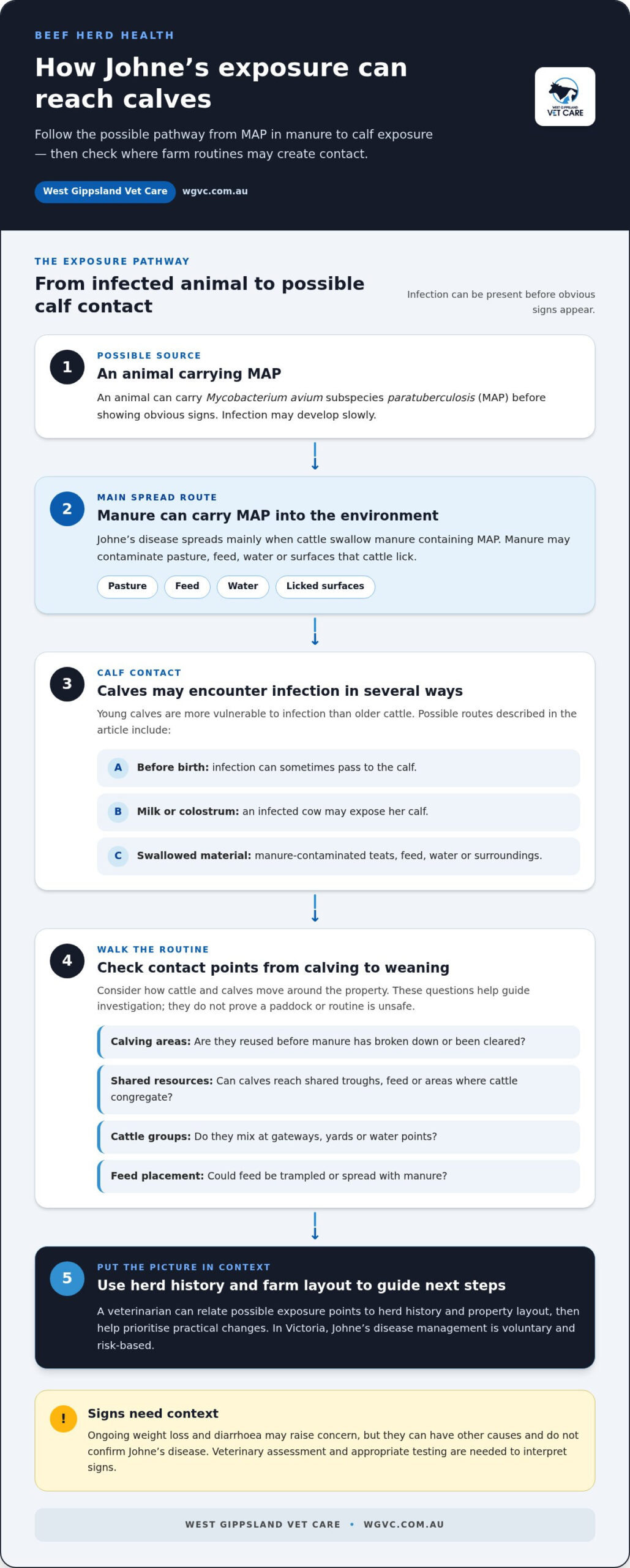
Johne’s disease spreads mainly when cattle swallow manure containing Mycobacterium avium subspecies paratuberculosis (MAP). Manure can contaminate pasture, feed, water or surfaces that cattle lick. An infected cow may also expose her calf through milk or colostrum, and infection can sometimes pass to the calf before birth. These routes make calf contact and everyday farm routines important parts of a herd risk assessment.
Calves may encounter MAP before birth, through milk or colostrum, or by swallowing manure-contaminated material from teats, feed, water or their surroundings.
Where calves may encounter infection
Young calves need particular attention because they’re more vulnerable to infection than older cattle. On a beef property, possible exposure points include a calving area used by many cows, a dirty udder or teat, pooled water contaminated by manure, or feed placed where cattle can foul it. The relevant risks depend on how cows and calves move around the farm.
For example, a set calving paddock may concentrate cows and newborn calves in one area, while a spread-out grazing system may create different challenges if groups share water points or feeding sites. Neither setup tells you on its own whether infection is present. Consider where a calf might suckle, drink, feed and rest, and whether manure could contaminate those places.
How farm routines can shape exposure risk
Consider the connections between cattle groups and farm facilities. If cows move between paddocks near calving, calves may encounter different ground and water sources. If feed is placed where multiple groups have access, manure contamination may be harder to avoid. Seasonal conditions, paddock layout and the timing of cattle movements can all change which contact points deserve attention.
When managing Johne’s disease in a beef herd, walk through the routine from calving to weaning and note where calves may encounter manure from other cattle. Ask:
- Are calving areas reused before manure has broken down or been cleared?
- Can calves reach shared troughs, feed or areas where cattle congregate?
- Do cattle groups mix at gateways, yards or water points?
- Could feeding practices place feed where manure can be trampled or spread?
These questions help guide investigation; they don’t prove that a particular paddock or routine is unsafe. A veterinarian can relate possible exposure points to your herd history and farm layout, then help prioritise practical changes. Local on-farm herd health advice can support that farm-specific discussion and help you consider next steps.
Comparing Johne’s testing and herd-management approaches
Testing can add useful evidence, but it isn’t a stand-alone answer. Blood ELISA and faecal PCR are both used in Australian Johne’s disease investigations, and they detect different things. The right option depends on what you’re trying to find out, the herd’s history and how a result would influence decisions about cattle or management.
What ELISA and faecal PCR can tell you
Blood ELISA looks for antibodies produced in response to MAP. Faecal PCR looks for MAP genetic material in a manure sample. Because they detect different signals, the tests may be useful for different questions or at different stages. Neither method detects every infected animal in every circumstance. Interpret a result in light of the animal’s history and the wider herd picture.
| Approach | What it can contribute | What to keep in mind |
|---|---|---|
| Blood ELISA | Evidence of an antibody response to MAP. | An animal may not yet have developed a detectable response; a result alone doesn’t establish the herd’s status. |
| Faecal PCR | Detection of MAP genetic material in the manure sample. | A sample reflects what is detected in that sample at that time, so a negative result can’t rule out infection across the herd. |
A positive result also needs context. It doesn’t, by itself, describe the extent of infection in the herd or confirm that every animal has clinical disease. Your veterinarian can consider the result alongside signs, movements, previous findings and the purpose of testing. No single result guarantees that a herd is free from Johne’s disease.
Choosing a management approach for your operation
There’s no universal testing schedule for every beef herd. A targeted approach may focus on particular animals, such as those with concerning signs or relevant herd history. Broader testing may be considered when the question relates to breeding stock or herd-level risk. A management-first approach focuses on practical exposure reduction while testing is considered in light of the farm’s circumstances.
When managing Johne’s disease in a beef herd, match the approach to the decision you need to make rather than testing without a clear purpose. Consider the herd’s history, replacement plans, possible exposure points and resources available for follow-up. For example, a result could affect how you manage a potential replacement, but it shouldn’t trigger an automatic culling decision.
Test-and-remove strategies are significant herd decisions, not simple rules. Discuss the implications with your veterinarian, including how a test result would be interpreted and what follow-up may be useful. Testing can inform a plan, but works best alongside considered herd management and ongoing review.
Building a practical Johne’s risk-reduction plan on a Victorian beef farm
A useful plan turns herd concerns into manageable steps instead of trying to change everything at once. Start with what you know, identify where cattle could be exposed, then agree which actions and information will guide your next decisions. Keep the plan realistic for the way your property is laid out and run, whether you farm near Warragul, Drouin, Bunyip, Yarragon, Trafalgar, Willow Grove, Hill End or Neerim South.
A practical Johne’s plan must fit your farm’s herd history, layout, calving system, cattle movements and management resources.
- Review herd history. Record animals with ongoing health concerns, relevant test results, cattle purchases and movements, and previous management decisions. Note what’s known and what remains uncertain.
- Map possible exposure points. Walk the property and consider calving areas, calf contact with manure, shared water points, feed placement and where cattle groups mix. Note seasonal changes that might alter these contacts.
- Discuss testing and options. Take the history and risk map to your veterinarian. Together, consider whether testing could answer a specific management question and how results might influence decisions about replacements or cattle grouping.
- Set review dates. Choose a time to revisit observations, results and actions taken. Agree who will keep records and what changes, such as a new clinical concern or cattle movement, should prompt an earlier review.
Reviewing calving, calf and replacement management
Look at calving areas from a newborn calf’s perspective. Could it encounter manure on the ground, dirty surfaces or a contaminated teat while seeking milk? Consider how cows and calves move through the area, and whether feed or water is accessible to different groups. Discuss colostrum and milk management with your veterinarian in light of the herd’s circumstances, rather than applying a blanket rule.
Include replacement cattle in the same risk picture. Record where they come from and how they’ll be grouped with the existing herd. Their introduction may affect contact between animals, but the right precautions depend on herd history, sourcing information and your operation’s plans. A considered approach helps balance risk reduction with the need to maintain suitable replacements.
Setting review points and using local guidance
Keep a dated record of test results, clinical observations, cattle purchases and movements, and changes to calving, feeding or grouping practices. A farm notebook or digital record can help you see what changed and when. Bring it to review discussions so decisions are based on the same timeline, not recollection alone.
Agree with your veterinarian who will review the plan and when. Revisit it after relevant results, new clinical concerns or changes in cattle movements. For current Victorian requirements and guidance, check Agriculture Victoria and Animal Health Australia resources; overseas examples may offer context but shouldn’t be treated as Victorian rules. Veterinary advice can help adapt options to local conditions and the way your farm operates.
West Gippsland Vet Care provides herd health advice and on-farm veterinary care in the region. Arrange a farm-specific herd-health discussion to work through your herd history, exposure map and practical next steps.
Working with a West Gippsland livestock vet on your herd plan
Herd-health decisions are easier to weigh when you can discuss them with a veterinarian who understands cattle and the practical demands of your operation. Managing Johne’s disease in a beef herd involves more than choosing a test. Your herd’s history, calving and replacement practices, exposure risks and future plans all help shape which management options make sense.
West Gippsland Vet Care provides herd health advice and farm animal veterinary services, including on-farm care in the region. A discussion with a local livestock vet can help organise the information you have, identify unanswered questions and consider practical next steps. The aim is a plan that fits your cattle operation, not a one-size-fits-all checklist.
What to bring to a herd-health discussion
A few clear notes can make the conversation more useful. Bring previous test results and a short herd history, including relevant cattle movements and changes in groups. Describe how calving, calf care and replacement selection work on your farm, as these routines can help put possible exposure risks in context.
Record observations such as ongoing weight loss, diarrhoea or other changes in an animal’s condition. These signs don’t diagnose Johne’s disease, but dates, affected cattle and changes over time may help guide a veterinary assessment. Write down upcoming decisions, too, such as selecting replacements or changing how cattle groups are managed.
- Previous test results and relevant cattle movement records
- Calving, calf-rearing and replacement practices
- Dated observations of health changes and which animals were affected
- Questions about testing, risk reduction or upcoming herd decisions
Turning advice into ongoing on-farm support
A herd-health discussion can connect the assessment with changes that fit everyday farm routines. You might work through where cattle groups meet, how calving areas are used, or which records would make future reviews clearer. The next steps depend on your farm’s circumstances and should be considered alongside veterinary advice, rather than assumed from another producer’s plan.
West Gippsland Vet Care’s farm animal services include herd health programs and farm animal medicine and surgery. The team can work with you to consider herd history, risks and practical management options, without treating any one observation or test result as a complete picture. Explore livestock vet services in West Gippsland as part of planning support for your cattle operation.
Bring your notes and questions to a herd-health discussion, and work through the options with a local veterinarian. If you’d like to talk about herd-health support for your operation, speak with the West Gippsland Vet Care team.
Take the next step with a plan that fits your herd
You don’t need to have every answer before starting a conversation. Bring together the information you already have, note the decisions coming up for your cattle, and identify the questions that matter most for your farm. This gives you a clear place to begin, even if infection status remains uncertain.
Managing Johne’s disease in a beef herd is an ongoing process, and your approach can be reviewed as new observations or test information emerge. West Gippsland Vet Care’s Farm Animal Services include herd health programs and on-farm veterinary care, with advice shaped around your operation.
Talk with our West Gippsland farm animal team about herd health and take a considered first step towards a practical plan for your cattle.
Frequently Asked Questions
Can Johne’s disease be cured in cattle?
No. There isn’t a cure that clears MAP infection from an affected animal. Veterinary care can help assess an animal’s condition and guide decisions about welfare and herd management, but it shouldn’t be mistaken for a cure. For managing Johne’s disease in a beef herd, the focus is on informed decisions and reducing opportunities for further exposure, with steps tailored to the herd rather than relying on treatment to remove infection.
Is Johne’s disease a notifiable disease in Victoria?
Victoria uses a voluntary, risk-based approach to managing bovine Johne’s disease, rather than the clinical-case reporting rule that applies in Queensland. Reporting requirements differ across Australian states. If you’re dealing with a suspected clinical case or a cattle movement decision, check current Agriculture Victoria guidance for the requirements relevant to your situation, and discuss the animal’s signs and history with your veterinarian.
Can I keep a calf born to a cow that tests positive?
Possibly, but a calf born to a test-positive cow may have been exposed before birth or through milk and colostrum. A positive result in the dam doesn’t confirm that the calf is infected, and keeping or selling the calf shouldn’t be decided on that result alone. Discuss the cow’s history, the test used, calf management and your herd goals with your veterinarian before making a plan for the calf.
Does one positive Johne’s test mean the whole beef herd is infected?
No. One positive test is evidence about the animal or sample tested, not proof that every animal in the herd is infected. Its significance depends on the test, the animal’s history and the circumstances behind testing. A veterinarian can help decide whether further investigation is useful, which animals or groups are relevant, and how to interpret results alongside herd records. Avoid making whole-herd culling or replacement decisions from one result alone.
How long can Johne’s disease take to become noticeable in cattle?
Visible signs may take years to develop after infection, so an animal can appear well for a long time. If illness emerges, ongoing weight loss and diarrhoea can be among the signs, but they also occur with other conditions. Keep dated notes about changes in body condition, appetite and manure, particularly if they persist. Those details can help your veterinarian assess the animal and decide what investigation is appropriate.
Can beef cattle spread Johne’s disease before showing signs?
Yes. Cattle may be infected and contribute to exposure before they look unwell. A healthy appearance alone can’t establish an animal’s infection status, particularly when reviewing herd introductions or contact with calves. If an animal has a relevant history or a test result raises concern, consider its movements and contact with other cattle as part of a veterinary discussion. This helps guide proportionate precautions without assuming the entire herd is infected.