
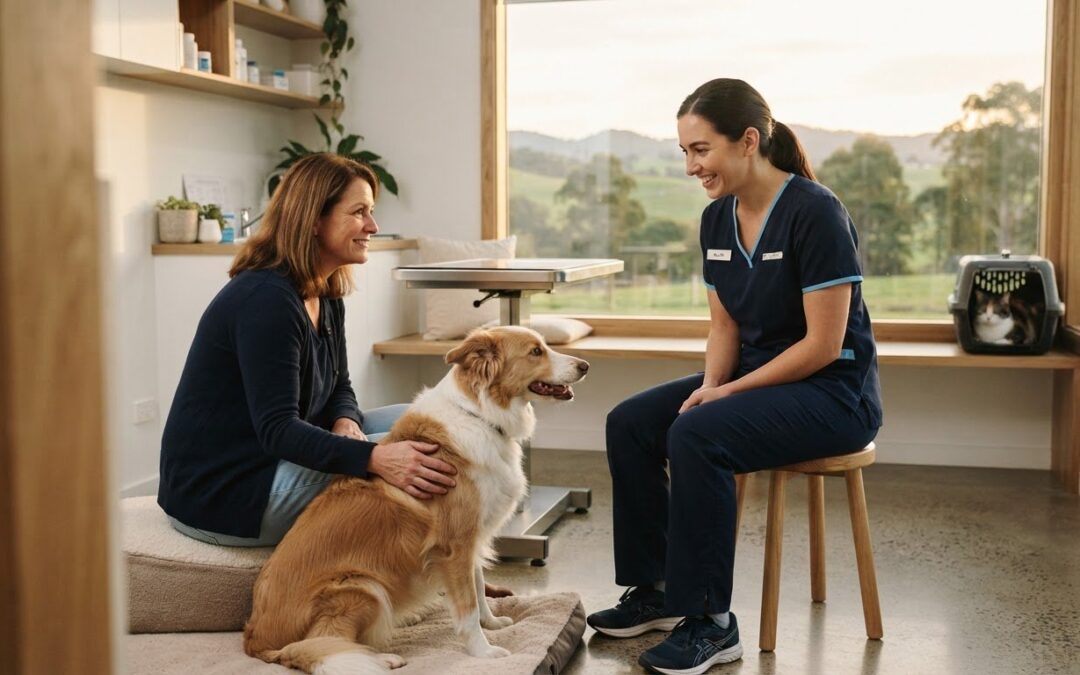
What if a change in your pet’s behaviour is more than a training challenge? A vet consultation for pet behaviour problems Yarragon pet owners can access through West Gippsland Vet Care can explore whether health, discomfort, stress, routine or learning may be contributing.
It’s understandable to feel unsure about what’s behind barking, hiding, toileting changes or a sudden shift in temperament. You may also worry about being judged for behaviour that’s difficult to manage. A behaviour consultation is a calm, supportive conversation focused on your pet’s welfare, not blame.
This guide explains when a behaviour change may deserve veterinary attention, which details can help you describe the pattern and what to expect from a consultation. Note when the behaviour began, what tends to happen beforehand and how your pet responds. These observations can help the vet understand the concern in context. West Gippsland Vet Care offers behaviour consultations and fear-free veterinary care for pets and their people in Yarragon, Warragul, Drouin, Bunyip, Trafalgar, Willow Grove, Hill End and Neerim South.
Key Takeaways
- New hiding, vocalising, reactivity or toileting indoors can be a reason to talk with a vet.
- A behaviour consultation can consider how health, discomfort, routine, surroundings and learning may relate to what you’re seeing.
- Noting when behaviour happens, what comes before it and any recent changes can help you describe the pattern clearly.
- Short videos may help if they’re safe to take, but never stage or provoke behaviour or delay seeking help to record it.
- A vet consultation for pet behaviour problems Yarragon pet owners can access at West Gippsland Vet Care provides a collaborative way to discuss concerns and consider next steps.
Pet behaviour problems in Yarragon: when is a vet consultation worth considering?
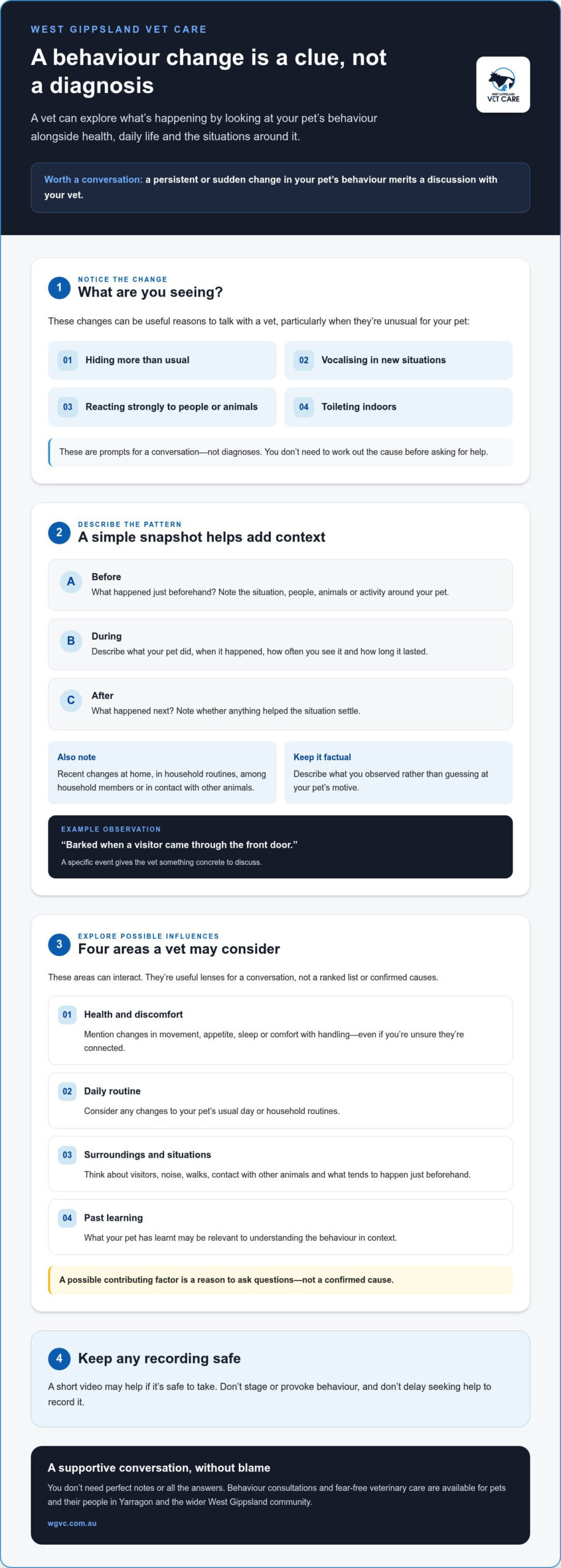
You don’t need to work out what’s causing a behaviour change before asking for help. If your pet has started hiding more than usual, vocalising in new situations, reacting strongly to people or other animals, or toileting indoors, discuss the change with a vet, particularly if it’s unusual for them.
One behaviour can have several possible explanations. Hiding might occur after a change at home, while new vocalising or reactivity may happen in particular situations. Toileting indoors can also have different possible causes. These examples are prompts for a conversation, not diagnoses. A vet can consider the behaviour alongside your pet’s health, welfare and circumstances.
Animal behaviour is shaped by many interacting influences. For a broad introduction to animal behavior, this overview offers useful background, but it can’t explain what’s driving a particular pet’s actions. Sharing what you’ve noticed with a vet lets you discuss the pattern in context, without needing to label or interpret it yourself.
A persistent or sudden change in your pet’s behaviour merits a conversation with your vet.
Which changes in behaviour should you write down?
A few factual notes can make it easier to explain what’s happening. Record what your pet does, when it occurs, how often you see it and how long it lasts. Include recent changes at home, in daily routines, among household members or in your pet’s contact with other animals. Describe what you observed rather than guessing at your pet’s motive.
- What happened immediately before the behaviour?
- What did your pet do, and for how long?
- What happened afterwards, and did anything help the situation settle?
- Has anything changed in the household or your pet’s routine?
For example, “barked when a visitor came through the front door” gives the vet a specific event to discuss. It’s more useful than deciding your dog was being difficult. You don’t need perfect notes. A few remembered examples are a helpful starting point.
When should you arrange a non-emergency consultation?
Consider arranging a conversation if a behaviour keeps recurring, is becoming more intense or is making ordinary activities at home harder. It’s sensible to discuss a change that appears suddenly or feels out of character for your pet. If you’re unsure whether it matters, describe it to your veterinary team and talk it through.
Try to avoid calling your pet bad, stubborn or deliberate. Those labels don’t explain what’s happening and can distract from welfare and context. A vet consultation for pet behaviour problems Yarragon owners are considering can help organise observations and discuss appropriate next steps. You’re not expected to arrive with all the answers.
How a vet consultation explores possible causes of pet behaviour problems
A veterinary behaviour consultation is a conversation about what your pet is doing, the situations around it, their welfare and possible next steps. You can share what you’ve noticed and what concerns you most. The vet can use those observations to explore relevant questions rather than treating one behaviour as a complete explanation.
Health and discomfort, daily routine, surroundings and past learning may all be relevant. A vet may ask when the behaviour began, whether it varies between situations and what else has changed. Your account helps build a fuller picture. The next steps depend on your pet and the information available.
Behaviour guidance is an area of ongoing veterinary discussion. The American Veterinary Society of Animal Behavior publishes position statements on aspects of animal behaviour, offering wider context for owners and professionals. Your pet’s circumstances still matter: general information can’t establish the cause of an individual animal’s behaviour.
A possible contributing factor is a reason to ask questions, not a confirmed cause. A vet consultation for pet behaviour problems Yarragon owners seek can help organise those questions and consider behaviour alongside health and everyday life.
Why health and behaviour are worth discussing together
A change in comfort or health may occur alongside a change in behaviour, so mention both. Tell the vet if your pet’s movement, appetite or sleep has changed, or if they’re less comfortable being handled than before. These details don’t point to one diagnosis by themselves, but give the vet more context to consider.
Describe what you’ve observed across the same period, even if you’re unsure whether the changes are connected. Raising them together gives the vet a clearer account and helps focus the discussion.
How routine and surroundings add useful context
Behaviour may look different depending on what is happening around your pet. Think about household routines, visitors, noise, walks, contact with other animals and any recent changes. The aim is to describe the circumstances clearly, not to blame a person, place or event.
For instance, note whether the behaviour happens only during a particular part of a walk or when visitors arrive, and what tends to happen just beforehand. That context can guide the discussion, but it doesn’t prove that one trigger is the cause. West Gippsland Vet Care offers behaviour consultations with a fear-free approach for pets and their people in Yarragon and the wider West Gippsland community.
What a behaviour consultation can help clarify for you and your pet
When a behaviour is worrying, it can be hard to know which details matter or what to do first. A consultation can help turn a jumble of concerns into a clearer account of what’s happening, what questions remain and which next steps may suit your pet. It’s a chance to talk things through with a vet, rather than a promise that one appointment will resolve the behaviour.
Noticing a behaviour and keeping a useful record of its pattern are different things. Both are valuable, but structured observations can make it easier to discuss the concern and its impact on your household.
- Observing alone: You may remember that your pet “gets worked up”, but be unsure when it happens, how often or what tends to come before it.
- Sharing structured observations: You can describe a particular situation, how your pet responded and what happened next, giving the vet details to explore with you.
You don’t need to arrive with a complete explanation. The discussion can help separate what you’ve directly observed from what you’re worried it might mean. For broader background on animal behaviour, the Texas A&M University College of Veterinary Medicine provides an educational resource, but general information can’t determine what’s happening for your individual pet.
What useful next steps might come from the discussion?
Depending on your pet and the details you share, the conversation may help identify whether further assessment, changes to how a situation is managed or follow-up discussion would be appropriate. These are possibilities to talk through, not a set pathway. Recommendations depend on the individual circumstances, and the consultation may help clarify what to monitor or which questions to revisit.
There’s no need to have a particular outcome in mind. Explain what feels most difficult day to day, then work with the vet to consider options that support your pet’s health and welfare. A vet consultation for pet behaviour problems Yarragon owners are considering can provide a thoughtful starting point, without guaranteeing a diagnosis or a particular result.
Veterinary guidance and training support: different roles
Veterinary guidance considers behaviour alongside health and welfare. Training support can help you teach skills and practise responses you’d like your pet to learn. These roles can complement each other: discussing a concern with a vet doesn’t make training irrelevant, and training alone may not answer questions about health or comfort.
The right balance depends on what’s going on for your pet. West Gippsland Vet Care offers behaviour consultations and fear-free veterinary care for pets and their people in Yarragon and the wider West Gippsland community. To explore the clinic’s local veterinary support, Explore West Gippsland Vet Care.
How to prepare for a pet behaviour consultation near Yarragon
You don’t need a perfect record or a polished explanation to make a behaviour consultation worthwhile. A few notes can help you recall useful details and make space to discuss what matters most to you and your pet. Keep them simple and factual. Your observations are a starting point for a shared conversation, not a test you need to pass.
Use this short preparation plan to gather the essentials:
- Describe the pattern. Note what your pet does, where and when it happens, how often you notice it and roughly how long it lasts. Include what happens immediately before and afterwards.
- Record what’s changed. Jot down any recent changes to routines, the home, household members or contact with other animals. Also note changes in eating, sleeping, movement, toileting or social interactions.
- Bring relevant history. Think about your pet’s health and behaviour history, current routines and anything else that may help explain the situation. You can bring notes or use them as prompts; you don’t need a special form.
- Choose your main goal. Write down the questions you want to ask and what change would make daily life easier for your household. For example, you might want to understand a recurring situation or help your pet feel more settled during a particular part of the day.
Useful appointment notes include the behaviour, its timing and setting, what happened before and after, recent changes, other health observations and your main question.
What observations and examples should you bring?
Approximate dates are fine if you can’t remember the exact day. A note such as “three times this week, mostly when the house is busy” can be more helpful than trying to reconstruct every detail. Add where it happened and how the situation unfolded, along with changes in appetite, sleep, movement, toileting or interactions. If a safe opportunity arises, a short video may help show what you mean. Don’t stage or provoke the behaviour, and never delay seeking help to record it.
How to make a vet visit feel more manageable
If your pet may feel worried or reactive, mention this when booking so the clinic knows what concerns you. Follow the clinic’s appointment guidance and avoid forcing stressful interactions before the visit. West Gippsland Vet Care offers fear-free veterinary care that takes your pet’s experience seriously. Sharing what tends to help or unsettle your pet is useful too.
Preparing this information can make a vet consultation for pet behaviour problems Yarragon owners are considering feel more focused, while leaving room for questions and discussion. If you’re ready to talk through your pet’s behaviour with a local team, arrange a behaviour consultation with West Gippsland Vet Care.
Arrange a vet consultation for pet behaviour problems in Yarragon
Taking the next step can be straightforward: notice a pattern, share what you’ve observed, discuss your concern with a vet, then consider appropriate next steps together. You don’t need to know what’s causing the behaviour before starting that conversation. A clear example or a few brief notes can help you explain what’s worrying you and how it affects your pet and household.
West Gippsland Vet Care provides behaviour consultations and fear-free veterinary care for Yarragon and the wider West Gippsland community, including Warragul, Drouin, Bunyip, Trafalgar, Willow Grove, Hill End and Neerim South. The consultation makes room for an open, non-judgemental discussion focused on your pet’s needs. You don’t need to have all the answers before you begin.
What to include when you get in touch
A short description is enough to begin. Mention what kind of pet you have, the main behaviour concern and when you first noticed it. If it happens in a particular situation, such as during walks or when visitors arrive, share that too. You don’t need to give a complete history in your first message or conversation.
If you have an immediate concern about your pet’s welfare or someone’s safety, say so clearly when you make contact. You can also mention if your pet is worried or reactive in unfamiliar situations, so this context is part of the discussion. There’s no need to delay getting in touch until your notes are perfectly organised.
A supportive first step for Yarragon pet owners
Raising a behaviour concern is a responsible part of caring for your pet. Changes can be difficult to understand, especially when you’re managing their effects at home. You deserve to be listened to, and talking with a vet can bring the behaviour, your observations and your questions into one conversation.
For local pet owners, a vet consultation for pet behaviour problems Yarragon offers a way to begin exploring a concern with a veterinary team. West Gippsland Vet Care’s fear-free approach takes each pet’s experience into account, while recognising that every animal and situation is different. Start by explaining what you’ve noticed and what you hope to make easier.
When you’re ready, arrange a conversation with West Gippsland Vet Care and take a calm first step towards understanding your pet’s behaviour and discussing suitable next steps.
Take the next step towards understanding your pet
You don’t have to understand the reason for a behaviour change before asking for help. Starting a conversation gives you space to talk through what you’ve noticed and what feels challenging, without needing a perfect explanation.
If you’re considering a vet consultation for pet behaviour problems Yarragon, West Gippsland Vet Care offers behaviour consultations and fear-free veterinary care for local pets and their people. Your observations and concerns are welcome, and the discussion can focus on understanding your pet’s needs and considering suitable next steps together.
Reach out when you’re ready to talk. Arrange a conversation with West Gippsland Vet Care and take a thoughtful first step towards supporting your pet.
Frequently Asked Questions
Is growling always a sign that a dog is aggressive?
No. A growl on its own isn’t enough to determine what a dog is communicating. It may signal discomfort, uncertainty or a wish for more space, and the situation around it matters. Don’t punish your dog or try to test what will make them growl. Note what was happening beforehand and discuss the pattern with your vet, particularly if the growling is new, increasing or creating safety concerns.
Can a vet help if my dog barks or lunges at other dogs?
Yes. A vet can help you discuss when the barking or lunging happens and what factors may be relevant to your dog’s health and welfare. Note the setting, how close the other dog was and what happened just before your dog reacted. Keep a safe distance rather than arranging an encounter to demonstrate the behaviour. Your vet can talk through suitable next steps for your individual dog.
Can cats have consultations for behaviour problems?
Yes. You can discuss changes in a cat’s behaviour with a vet, including hiding, toileting outside the litter tray or interacting differently with people or other animals. Along with when the change began, mention anything different at home and whether your cat’s appetite or comfort seems altered. Avoid assuming your cat is acting deliberately. A clear account can help you and your vet decide what may need further attention.
Should I punish my pet for unwanted behaviour?
No. Punishment may increase fear or stress, and it won’t tell you what is contributing to the behaviour. If your pet is doing something difficult to manage, focus first on keeping people and animals safe. Avoid provoking the situation and write down what you observe instead. A vet can help you consider the pattern and appropriate next steps. If there’s an immediate safety concern, seek veterinary guidance promptly.
Can separation-related behaviour be discussed with a vet?
Yes. Describe what your pet does when left alone, how soon it starts and what you notice before leaving or after you return. For example, note whether the behaviour begins as you prepare to go out or only after you’ve left. A video of an ordinary departure may add context if it’s safe to record, but don’t leave your pet distressed just to film them. Discuss your concerns with your vet.
Is it worth discussing behaviour changes in an older pet?
Yes. Tell your vet about behaviour changes in an older pet, especially if you’ve also noticed differences in their usual routine, such as taking longer to settle or choosing different places to rest. Note when you first saw the change and whether it happens consistently or in particular situations. These observations don’t identify a cause, but they can help your vet understand what’s different for your pet.
What should I do if my pet’s behaviour changes suddenly?
Contact your vet to discuss the change and how soon your pet should be assessed, especially if it’s severe or your pet seems unwell or uncomfortable. Note when it began and any other differences you’ve observed. Don’t wait to capture a video or recreate the situation before seeking advice. If you’re in Yarragon, Warragul, Drouin, Bunyip, Yarragon, Trafalgar, Willow Grove, Hill End or Neerim South, share your concerns with your veterinary team.