
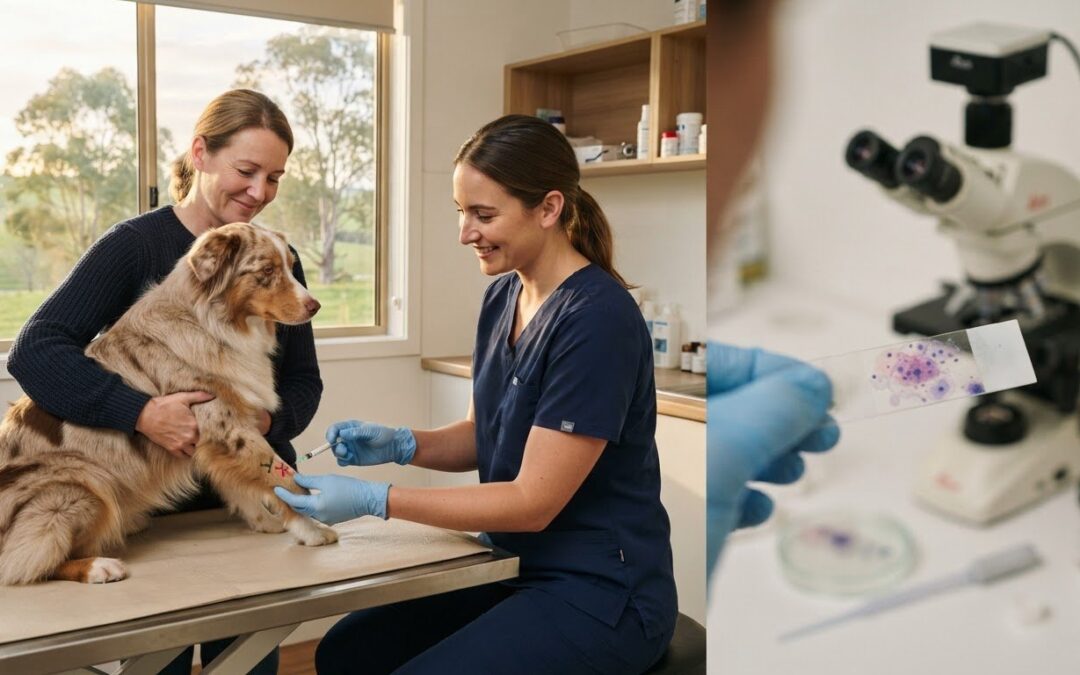
Could a needle test tell you whether your dog’s lump is cancer, or only offer part of the picture? If you’re wondering about fine needle aspirate for dog lump accuracy, it’s understandable to want a clear answer, especially when a result isn’t definite. An aspirate collects cells from a lump for examination. It may identify some types of lumps and provide useful clues, but the sample may not contain enough cells, and some masses are harder to assess. That means the result isn’t always conclusive.
An uncertain result doesn’t automatically mean bad news or that your dog needs surgery. Your vet can interpret the findings alongside the lump’s location and feel, and your dog’s health, then discuss suitable next steps. This article explains what an aspirate can and can’t show, why a sample may be inconclusive, and what follow-up your vet might discuss, such as another sample, imaging or a biopsy. You’ll also find practical questions to help you prepare for that conversation and decide on a plan together.
Key Takeaways
- Understand what a fine needle aspirate samples and the kinds of clues it may provide about a lump.
- Learn why fine needle aspirate for dog lump accuracy depends on the mass, sample quality and interpretation, rather than one universal figure.
- See how aspiration and biopsy differ, and why your vet may consider one or the other based on your dog’s situation.
- Use your vet’s examination and your dog’s history to help make sense of a clear or inconclusive result and discuss possible next steps.
- Find out how West Gippsland Vet Care’s in-house laboratory and diagnostic imaging fit into a conversation about suitable diagnostic options.
What can a fine needle aspirate tell you about a dog lump?
Finding a lump on your dog can be worrying, but touch alone can’t tell you what it is. A fine needle aspirate is one way a vet can gather more information before discussing what, if anything, should happen next. The procedure collects cells from the lump using a fine needle so they can be examined under a microscope.
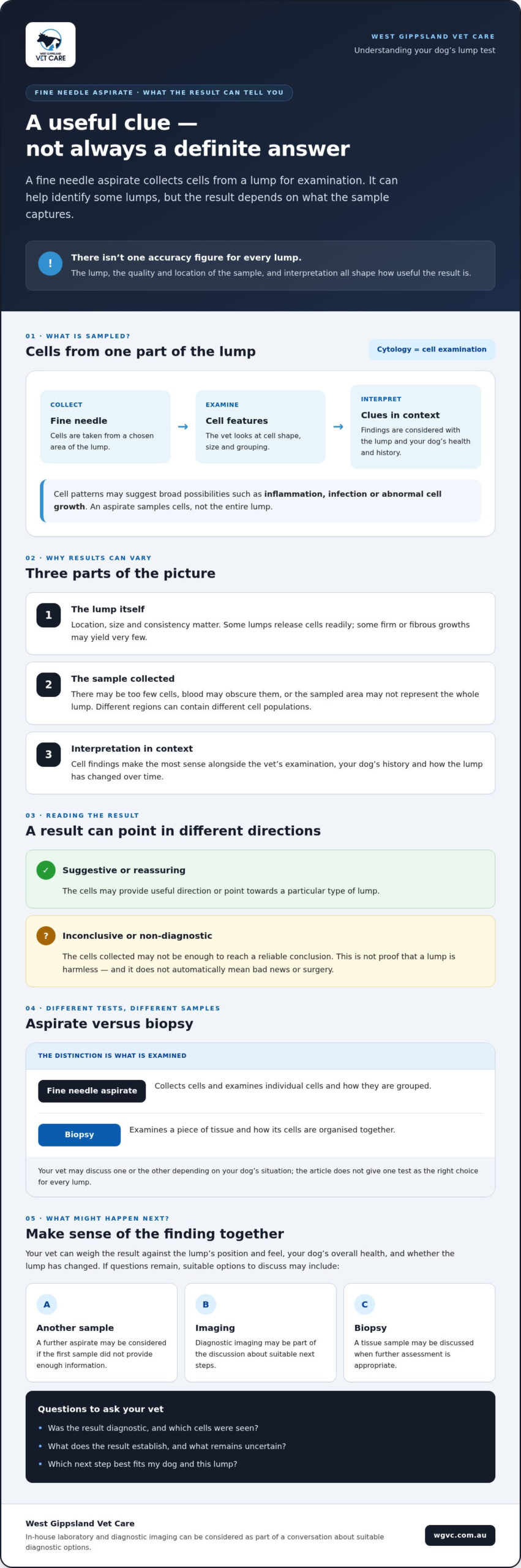
This examination is called cytology. It looks at individual cells and how they are grouped. A biopsy, by comparison, examines a piece of tissue and how its cells are organised together. Microscopic examination of cells can provide useful clues, but an aspirate doesn’t always give a conclusive diagnosis. Your vet will consider the result alongside your dog’s examination and history.
What happens during a fine needle aspirate?
Your vet will assess the lump, including its position and feel, before choosing an area to sample. They use a fine needle to collect cells, which may be transferred onto glass slides for microscopic assessment. Your dog may need gentle restraint to help them stay still. The approach can vary with the lump and your dog, so ask your vet what to expect in your dog’s case.
What does cytology look for?
A vet examining the sample looks at features such as cell shape, size and grouping. These patterns may suggest broad possibilities, including inflammation, infection or abnormal cell growth. Sometimes the cells point towards a particular type of lump, helping your vet consider appropriate options. However, a sample contains only the cells collected from the chosen spot, and the findings need to be interpreted in context.
An aspirate samples cells rather than the entire lump. This is important when thinking about fine needle aspirate for dog lump accuracy. The sample may not capture every feature of a mass, and some lumps don’t release enough cells for a clear assessment. The result may therefore be suggestive, reassuring or inconclusive, rather than a definite answer.
That doesn’t make the test useless. Cytology can help guide a discussion about whether monitoring, further testing or another approach is worth considering. Your vet will weigh the findings against what they observed during the examination, how long the lump has been present, whether it has changed and your dog’s overall health. If the result leaves questions, ask what it establishes, what remains uncertain and which next step best fits your dog.
How accurate is a fine needle aspirate for a dog lump?
There isn’t one accuracy figure that applies to every lump. The usefulness of a fine needle aspirate depends on whether the lump releases enough cells, whether the sample comes from a representative area, and how the cells are interpreted. A clear result can provide valuable direction, but it still needs to be considered alongside your dog’s examination and history.
Some lumps release cells readily, giving the vet a useful sample to assess. Others, including some firm or fibrous growths, may yield very few cells. In those cases, the sample may not provide enough information to identify the lump, even when the sampling and handling are appropriate.
Why can an aspirate give an unclear result?
An unclear result can have several explanations. There may be too few cells on the slide, or blood may obscure the cells that were collected. The needle may also sample an area that doesn’t represent the lump as a whole. Some masses contain different regions with different cell populations, so a sample from one spot may not show what is happening elsewhere.
A non-diagnostic sample is not proof that a lump is harmless. It means the cells collected weren’t enough to reach a reliable conclusion. This can happen because of the lump’s structure or the particular area sampled, and it doesn’t automatically indicate poor care. Your vet can explain what the result does and doesn’t tell you, then discuss whether another sample or a different test may be appropriate.
Which factors affect how useful the result is?
The lump’s location, size and consistency can all affect sampling. A soft, accessible lump may be easier to sample than a small, firm or awkwardly positioned one. The cells available for collection matter too. Certain growths don’t shed many cells, while mixed lumps may have areas that look different under the microscope.
Interpretation is another part of the picture. A cytology reader assesses cell features, but the findings make the most sense alongside what the vet knows about your dog and how the lump has changed over time. For example, mast cell tumours may be identified through their cells in some samples, but a lump’s appearance alone can’t confirm that diagnosis. Your vet may recommend further assessment if the sample and examination don’t fit together.
Ask whether the result was diagnostic, which cells were seen and whether the findings explain the lump’s appearance. If you’re in Warragul, Drouin, Bunyip, Yarragon, Trafalgar, Willow Grove, Hill End or Neerim South, you can discuss your dog’s lump with a local vet and ask which diagnostic options may suit. West Gippsland Vet Care has an in-house laboratory and diagnostic imaging. Ask the clinic whether aspirates are performed and where samples are assessed.
Fine needle aspirate versus biopsy: what is the difference?
A fine needle aspirate and a biopsy both help investigate a lump, but they collect different kinds of samples. An aspirate gathers cells for cytology. A biopsy collects a piece of tissue for histopathology, which examines the tissue structure and how cells are arranged within it.
Neither test is automatically the right choice for every dog or lump. Your vet will consider the examination findings, what an initial sample shows, and the possible benefits and risks of further testing. The aim is to choose an approach that helps answer the clinical question while taking your dog’s circumstances into account.
| Fine needle aspirate | Biopsy |
|---|---|
| Collects cells using a fine needle. | Collects a small piece of tissue for examination. |
| Cytology assesses cell features, which may help identify the type of lump. | Histopathology assesses tissue structure and the relationships between cells. |
| May not provide enough cells or show the full range of features in a lump. | Provides tissue architecture, but the best sampling approach depends on the lump and the question being asked. |
What can a biopsy show that an aspirate may not?
Because a biopsy preserves a piece of tissue, the pathologist can examine how cells are organised and how they relate to surrounding tissue. That extra context may help clarify findings that cell samples alone can’t resolve, or support decisions about treatment. Fine needle aspirate for dog lump accuracy depends partly on whether the cells collected answer the question. A biopsy may be considered if tissue structure is important to the diagnosis, but it isn’t needed for every lump.
When might a vet recommend another test?
Your vet may discuss further testing if an aspirate is inconclusive, if the lump’s examination doesn’t fit the sample findings, or if uncertainty remains important to a treatment decision. Options might include collecting another sample, taking a biopsy or using diagnostic imaging to assess a lump’s position or extent. These aren’t automatic steps. The appropriate choice depends on the individual case.
Ask your vet what each option could clarify, what it involves for your dog, and whether monitoring is reasonable. A clear explanation of what is known and what remains uncertain can help you make a considered decision together. For pet owners seeking guidance on lump investigations and diagnostic options, practices such as Peakhurst Veterinary Clinic and Small Animal Hospital offer comprehensive small animal veterinary care to help owners make informed decisions.
What should you do after your dog’s lump aspirate?
Once the result is available, your vet will interpret it alongside the lump’s appearance and feel, your dog’s health and the history you’ve shared. Reports can use technical terms, so it’s reasonable to ask your vet to explain what they mean and what they suggest for your dog.
Start by finding out whether the sample was diagnostic, suggestive or non-diagnostic. A diagnostic result may identify a likely cause. A suggestive result points towards a possibility but may not confirm it. A non-diagnostic result means there wasn’t enough clear information in the sample to reach a conclusion. On its own, it isn’t a reassuring or worrying diagnosis. Understanding the difference gives you a clearer picture of what fine needle aspirate for dog lump accuracy means in your dog’s case.
Questions to ask when results are discussed
Writing down questions before speaking with your vet can help you cover what matters. For example:
- What did the sample show, and how confident are you in that interpretation?
- Does the result fit the lump’s appearance and what you found during the examination?
- Do you recommend monitoring or further assessment, and why?
- What changes should prompt me to contact you sooner?
These questions can help clarify both what’s known and what remains uncertain. If your vet recommends monitoring, ask for a plan specific to your dog, including how to track the lump and when to arrange a review. There isn’t one recheck interval that suits every lump.
When should a changing lump be reassessed?
Contact your vet if the lump grows, changes in feel or appearance, bleeds, becomes painful, or starts affecting your dog’s movement. A change doesn’t automatically mean cancer or an emergency, but it’s useful information for your vet and may affect what they recommend next. If you’re unsure how soon to get in touch, call the clinic for guidance.
Keep a simple record of what you notice, such as when you first saw a change and whether it continues. You could also ask your vet whether photographs or measurements would help track it. Follow the monitoring plan they give you, and let them know if the lump changes before the planned review.
If you’d like help understanding a lump result or discussing suitable next steps, contact West Gippsland Vet Care.
Getting your dog’s lump assessed in West Gippsland
A new or changing lump can raise a lot of questions. A local vet can examine it, consider your dog’s health and help you weigh up whether monitoring, sampling or another diagnostic option may be appropriate. The next step depends on the lump and your dog, not simply on the fact that a lump is present.
West Gippsland Vet Care supports pet owners in Warragul and nearby communities, including Drouin, Bunyip, Yarragon, Trafalgar, Willow Grove, Hill End and Neerim South. The clinic has an in-house laboratory and provides diagnostic imaging. These services don’t mean every sample is assessed in-house or that every test is suitable or available on-site. Ask the veterinary team where a sample would be assessed and which options may be appropriate for your dog.
What information helps your vet assess a lump?
A few details from home can make the appointment more useful. Before you visit, note when you first noticed the lump and what, if anything, has changed. Share relevant health history, medicines your dog takes and any previous test results or reports.
If the lump is visible, dated photos may help document changes between appointments. Try to take them from a similar angle, and avoid repeatedly pressing or handling an area that seems sore. Your vet can advise whether photographs, measurements or another method will be useful for monitoring that particular lump.
Discussing diagnostic options with a local vet
Your vet will assess the lump and consider its location, feel and appearance alongside your dog’s history. Those findings help guide whether sampling, diagnostic imaging or another form of assessment should be discussed. If an aspirate is considered, ask who will assess the sample and what it may show. Fine needle aspirate for dog lump accuracy depends on the sample and the lump, so it’s reasonable to ask what a clear, suggestive or non-diagnostic result could mean for your dog.
Bring your notes and photos, and mention any concerns or questions you’d like to cover. You don’t need to arrive with a decision already made. A conversation with your vet can help clarify what is known, what remains uncertain and whether follow-up is recommended.
If you’re in Warragul, Drouin, Bunyip, Yarragon, Trafalgar, Willow Grove, Hill End or Neerim South and would like to discuss an assessment for your dog, talk with the West Gippsland Vet Care team.
Take the next step with confidence
A fine needle aspirate can offer useful clues about your dog’s lump, but it doesn’t always provide a final answer. Its usefulness depends on the sample and the lump, while a biopsy may provide tissue detail when further assessment is needed. An inconclusive result isn’t proof that a lump is harmless, so ask your vet to explain the findings alongside your dog’s examination and history.
Understanding fine needle aspirate for dog lump accuracy can help you ask practical questions: Was the sample diagnostic? Does it fit what you’ve observed? What follow-up, if any, is recommended? The right plan is specific to your dog, and not every lump needs surgery.
West Gippsland Vet Care provides local care for pet owners across West Gippsland, with an in-house laboratory and diagnostic imaging. To discuss your dog’s lump and suitable assessment options, talk with our veterinary team about your dog’s lump.
Frequently Asked Questions
Can a fine needle aspirate tell if a dog’s lump is cancerous?
Sometimes, an aspirate can identify cells that suggest cancer, but it can’t always confirm whether a lump is cancerous. The sample contains cells from the area collected, not the entire mass, and some growths are difficult to assess from cells alone. If the result is uncertain or doesn’t fit the examination, your vet may discuss other tests, such as a biopsy, to gather more information.
What happens if a dog’s aspirate result is inconclusive?
An inconclusive result means the sample didn’t provide enough clear information for a reliable answer. It doesn’t prove the lump is harmless, and it doesn’t automatically mean something serious. Ask your vet what limited the result and whether it fits the lump’s appearance. Depending on your dog’s circumstances, they may discuss monitoring, collecting another sample, imaging or a biopsy. The next step depends on the whole clinical picture.
Is a fine needle aspirate painful for dogs?
Dogs can respond differently to having a needle inserted, so it’s not possible to promise that an aspirate will be painless. Your vet can explain what your dog may experience and how they’ll help keep them settled and still during sampling. The approach depends on the lump’s position and your dog’s needs. Some dogs may require more support or restraint. Ask your vet what to expect before the procedure.
Can a dog lump be benign even if it grows?
Yes, a benign lump can grow, but growth alone can’t confirm whether a lump is harmless or concerning. Let your vet know if you notice a change in size, feel or appearance, or if the lump bleeds, becomes painful or affects movement. Note when changes occur, and follow the monitoring plan your vet recommends. They can decide whether the change calls for reassessment or further investigation.
When does a dog need a biopsy instead of an aspirate?
A biopsy may be considered when an aspirate is non-diagnostic, when its findings don’t match the examination, or when the vet needs to assess tissue structure. Unlike an aspirate, which collects cells, a biopsy provides a piece of tissue for examination. It isn’t automatically needed for every lump. Your vet will discuss the possible value and risks of further testing based on the lump and your dog’s circumstances.
How long do fine needle aspirate results take?
Result timing varies depending on how and where the sample is assessed. Ask your vet when you can expect an update, who will explain the findings, and how you’ll be contacted. West Gippsland Vet Care has an in-house laboratory and provides diagnostic imaging, but whether an aspirate is performed or assessed in-house should be checked directly with the clinic. Pet owners in Warragul, Drouin, Bunyip, Yarragon, Trafalgar, Willow Grove, Hill End and Neerim South can contact the clinic to ask about the process.