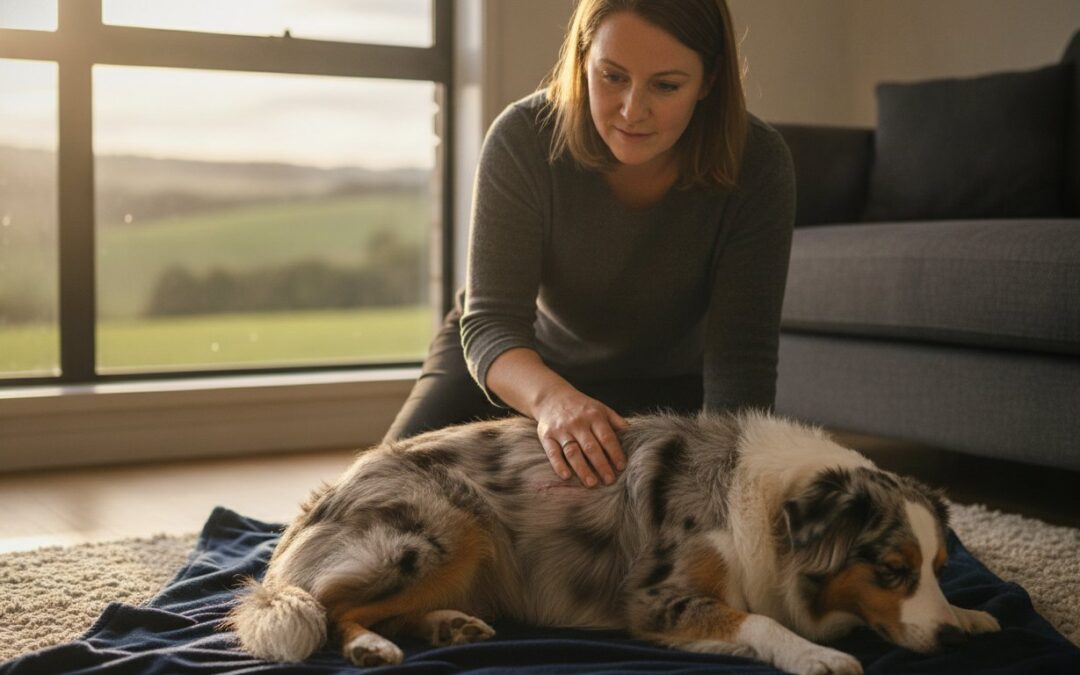
Imagine sitting on the floor with your dog on their first night home, watching them sleep and wondering if that slight pinkness around their incision is normal or cause for alarm. It is a moment many pet parents in West Gippsland know well, and that feeling of responsibility for your best mate’s comfort is a testament to the deep bond you share. It’s perfectly natural to feel a little anxious about missing the subtle signs of infection after dog surgery, especially when you’re worried about their pain or the potential for an emergency visit.
We agree that the days following a procedure should be about quiet rest and steady healing, not second-guessing every mark on their skin. This guide will show you how to identify, prevent, and respond to post-operative infections to ensure your dog’s recovery is safe and stress-free. We will walk through the clear differences between normal inflammation and genuine red flags, giving you the confidence to know exactly when to reach out for a professional hand. Together, we can help your companion get back on their paws without any unnecessary hurdles.
Key Takeaways
- Learn to distinguish between healthy “peak inflammation” and the actual signs of infection after dog surgery so you can monitor the wound with confidence.
- Discover how to use simple physical checks, such as the back-of-the-hand heat test, to assess your dog’s comfort and healing progress at home.
- Identify the specific colours of discharge and subtle behavioural shifts that serve as early warning signs for a professional vet’s attention.
- Gain practical advice for protecting incisions from local West Gippsland hazards, including muddy winter yards and dusty rural paddocks.
- Understand how scheduled post-operative check-ups and advanced surgical techniques work together to ensure a smooth, complication-free recovery for your mate.
Understanding the Normal Post-Operative Healing Baseline
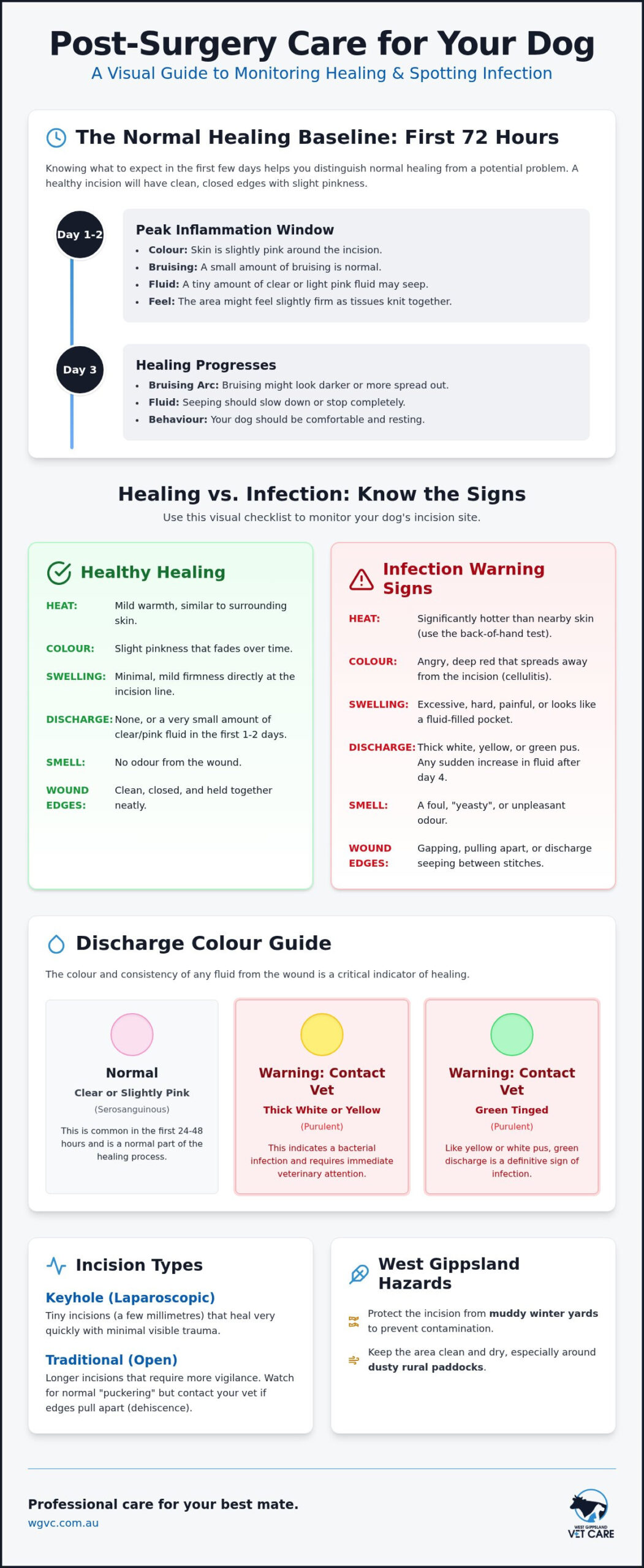
When your dog first arrives home from veterinary surgery, the incision site is often the first thing you’ll want to check. It’s helpful to know what “normal” looks like so you don’t spend the night worrying. A healthy incision should have clean, closed edges with a slight pinkness to the skin. You might see a tiny amount of bruising, which is just a natural part of the body’s response to being mended. To help you distinguish between healing and a complication, a surgical site infection is defined as a bacterial invasion at the wound location that can hinder the recovery process if not addressed by a vet.
The first 24 to 48 hours are usually the most active for the immune system. We call this the “Peak Inflammation” window. During this time, the body sends resources to the site to begin the repair work, which can make the area look a bit more colourful than it did when you left the clinic. Knowing this helps you stay calm when you’re looking for potential signs of infection after dog surgery, as a little bit of initial redness is often just the body doing its job.
The First 72 Hours: What to Expect
During the first few days, you might notice a small amount of clear or slightly blood-tinged fluid seeping from the wound. This is quite common and isn’t usually a cause for concern. You may also feel some mild firmness around the stitches, which is simply the internal tissues beginning to knit back together. It’s also normal to see a “bruising arc.” Much like a bruise on our own skin, your dog’s bruising might actually look darker or more spread out on day three than it did on day one. As long as your dog is happy and the area isn’t hot to the touch, this is usually just the natural progression of healing.
Laparoscopic vs. Traditional Incisions
The type of procedure your dog had will change how the wound looks. If your mate had keyhole surgery, the incisions will be tiny, often just a few millimetres long, and they tend to heal very quickly with minimal visible trauma. Traditional open surgeries, or larger orthopaedic procedures like a TPLO, involve longer incisions that require more vigilance. You might see some “puckering” where the skin is gathered by the sutures, which is normal. However, you should watch for wound dehiscence, which is when the edges actually start to pull apart. While a traditional incision takes a bit more effort to keep clean, both types of surgery follow the same basic healing rules.
The 5 Critical Visual Signs of Surgical Site Infection
Monitoring your dog’s recovery is about more than just a quick glance. It involves noticing the subtle shifts that happen between morning and night. While we’ve discussed what a healthy wound looks like, knowing the specific signs of infection after dog surgery allows you to act before a small issue becomes a larger problem. One of the simplest ways to check for trouble is the “back of the hand” heat test. Gently rest the back of your hand over the incision site, then touch a patch of normal skin nearby. The back of your hand is far more sensitive to temperature than your palm. If the wound feels significantly hotter than the surrounding skin, it suggests the body is struggling with more than just standard inflammation.
Colour is your next best indicator. While a healthy wound is pink, an infected one often looks angry and deep red. If this redness starts to spread away from the incision line in a pattern that looks like a rash or a sunburnt patch, it could be cellulitis. This spreading redness is a sign that bacteria are moving through the deeper layers of the skin. You should also trust your nose. A healthy surgical site should have no smell at all. If you notice a foul or “yeasty” odour when you lean in close, it’s a definitive sign that bacteria are present and thriving.
Discharge: The Good, The Bad, and The Ugly
In the first few days, you’ll likely see serosanguinous fluid, which is clear or slightly pink. This is normal. However, if the discharge turns into thick white, yellow, or green pus, this is purulent discharge and requires immediate attention. These “bad colours” are actually a collection of dead white blood cells and bacteria. Be particularly wary if you see a sudden increase in fluid after the fourth day. By this stage, the wound should be drying out. If it suddenly starts leaking again, it’s time to contact our team for a quick check-up to ensure everything is on track.
Swelling and Skin Integrity
It can be difficult to tell the difference between a seroma and an abscess. A seroma is a soft, relatively painless pocket of clear fluid that the body often reabsorbs. An abscess, however, is firm, hot, and very painful, which usually indicates a deeper infection. You should also look for signs of “dehiscence,” which is when the wound edges begin to gape or pull apart. Gaping skin is an open invitation for environmental bacteria to enter. If you notice the skin puckering tightly around a single stitch, or if the area looks raw from licking, your dog’s discomfort is likely peaking and the integrity of the surgical site is at risk.
Beyond the Incision: Behavioural Red Flags
You know your dog’s “vibe” better than any clinical chart ever could. While the physical appearance of the wound is a vital clue, your mate’s personality and energy levels often provide the first signs of infection after dog surgery. On the first day home, it’s normal for them to be a bit “out of it” due to the anaesthetic. They might sleep heavily, look a bit glazed, or even seem a little confused. This grogginess should lift within 24 hours as the drugs leave their system. If your dog seems to be getting more tired, withdrawn, or “flat” as the days pass, that’s genuine lethargy, and it suggests their body is fighting an internal battle.
One of the most reliable ways to check their status is the “Treat Test.” By the second day, most dogs should be interested in a small piece of chicken or their favourite biscuit. If you reach day four and they suddenly turn their nose up at high-value food, it’s a major warning sign. This sudden loss of appetite, especially when combined with shivering or trembling, often points to post-operative pain or a developing fever. Shivering isn’t always about being cold; it’s frequently a physical manifestation of internal discomfort or a rising body temperature.
Pain Management and Restlessness
If your dog is pacing, whining, or simply cannot settle into a comfortable position, they are likely experiencing significant pain. While some discomfort is expected, extreme restlessness can indicate that an infection is making the surgical site feel tight, throbbing, or hot. Effective pain relief is a cornerstone of a smooth recovery, particularly after complex procedures. Our Orthopaedic Vet Gippsland team prioritises tailored pain management strategies to ensure your dog stays calm and comfortable while their body focuses on knitting back together. An inability to rest is often a cry for help that shouldn’t be ignored.
Fever and Systemic Involvement
You can perform a quick, informal check for fever at home by feeling your dog’s ears or the skin of their belly. If these areas feel unusually hot to the touch, or if their nose is persistently dry and warm, they might be running a temperature. While a local wound infection is manageable, we want to stop it from spreading. Watch for persistent vomiting or diarrhoea that lasts beyond the first 24 hours. These symptoms can signal that a local issue is progressing toward systemic involvement. If your dog’s general behaviour just feels “off” or they seem unusually weak, it’s always better to have a chat with your vet than to wait and see.
Managing Your Dog’s Recovery in the West Gippsland Environment
Living among the beautiful rolling hills of West Gippsland brings specific challenges for a recovering dog. Whether you’re dealing with the notorious winter mud in Warragul or the fine dust of a Drouin summer, the local environment can be a silent enemy to a fresh surgical site. Many owners believe that “airing out” a wound is beneficial, but in our often damp Victorian climate, this is a myth. Excess humidity can keep an incision moist, which creates an ideal environment for bacteria to grow. Keeping the area dry and protected from the elements is the most effective way to prevent signs of infection after dog surgery.
For those with “outdoor dogs” used to roaming paddocks, the mandatory two-week confinement can be a struggle. It’s a significant lifestyle change for a dog that loves the open air. However, letting them out into a rural yard unsupervised, even for a few minutes, exposes the wound to soil-borne pathogens. If your dog must go outside, keep them on a short lead and stick to paved or dry areas. This controlled environment is much safer than a damp paddock during the early stages of healing.
The Garden Rule for Local Pet Owners
Most post-operative complications happen during those “quick toilet breaks” in the garden. It only takes one second for a dog to sit in a patch of damp soil or brush against tall, wet grass. Using a clinical shirt or a protective “onesie” can provide a vital barrier between the incision and the outside world. These are often more comfortable than a traditional cone for sleeping. When you bring your mate back inside, always take a moment to wipe their paws with a clean, damp cloth. This simple step prevents them from tracking garden bacteria onto their clean bedding, which is where they spend the majority of their recovery time.
Licking: The #1 Preventable Cause of Infection
There is an old myth that dog saliva has healing properties. In reality, a dog’s mouth is home to bacteria like Staphylococcus and Pasteurella, which can cause aggressive secondary infections if introduced to an open wound. Licking is often a response to the itching that occurs as skin heals, but it can quickly lead to signs of infection after dog surgery such as angry redness and swelling. At West Gippsland Vet Care, we use a “Fear-Free” approach to make wearing a cone or protective collar as stress-free as possible. If your dog is struggling to settle with their recovery gear, please reach out to our clinic so we can help you find a more comfortable solution for your best mate.
Professional Surgical Aftercare and Emergency Support
Your dog’s recovery is a shared journey between your home care and our clinical expertise. While we’ve discussed how you can monitor your companion, our professional aftercare is designed to catch the smallest signs of infection after dog surgery before they become serious. We schedule specific check-ups at the 3-day and 10-day marks for a reason. The 3-day visit allows us to assess the “peak inflammation” window we mentioned earlier, ensuring the redness is fading as expected. The 10-day visit is our final hurdle, where we often remove stitches and give your mate the “all-clear” to return to their normal Gippsland adventures.
One of the ways we proactively reduce risks is through our investment in advanced technology. For many procedures, we utilise keyhole surgery, also known as laparoscopic surgery. Because these incisions are only a few millimetres long, there is significantly less exposed tissue and a much smaller “gateway” for environmental bacteria to enter. This modern approach results in faster healing times and a lower rate of post-operative complications compared to traditional open surgeries. If we do suspect an issue, our in-house laboratory allows us to run diagnostics immediately, so we can start the right treatment without delay.
When to Call West Gippsland Vet Care
We operate on a “Better Safe Than Sorry” rule. If you are sitting at home in Warragul or Drouin feeling uneasy about a change in the wound, please don’t hesitate to contact us. We would much rather have a quick chat and put your mind at ease than have you worry through the night. If you’re unsure, try to take a clear photo of the wound in bright, natural light. Placing a coin or a ruler next to the incision helps us judge the scale of any swelling or redness during a remote assessment. However, if you notice emergency red flags like extreme panting, a completely gaping wound, or your dog being unable to stand, these require immediate attention. For our existing clients, we provide 24-hour emergency support to ensure your mate is never without help when they need it most.
Our Commitment to Your Pet’s Safe Recovery
If an infection is identified, we will often prescribe a course of antibiotics. It’s non-negotiable that you finish the entire course, even if the wound looks perfectly healed after three days. Stopping early can allow the hardiest bacteria to survive and multiply, leading to a much more difficult secondary infection. We know that managing a post-op dog can be exhausting, especially when you’re balancing work and family life. You’re doing a wonderful job providing the quiet, clean environment they need to mend. By staying vigilant and keeping up with your scheduled visits, you’re giving your best mate the very best chance at a complication-free recovery.
Supporting Your Dog’s Journey Back to Health
Watching your best mate recover from surgery requires a gentle balance of patience and vigilance. By understanding the healthy baseline of a healing incision and staying alert for early signs of infection after dog surgery, you are playing a vital role in their safe return to the local park. Remember that while physical changes like spreading redness or unusual discharge are important, your dog’s mood and appetite are often the most telling indicators of their internal well-being. Keeping them away from the Gippsland mud and ensuring they rest comfortably will make all the difference in these first few weeks.
If you ever feel uncertain, our fear-free accredited veterinary team is here to guide you. We combine our deep community roots with advanced keyhole and orthopaedic surgical suites to provide the highest standard of care. For our existing clients, we also offer 24-hour emergency care, ensuring you have professional support whenever a concern arises. Concerned about your pet’s recovery? Contact our Warragul or Drouin clinics today.
You are doing a wonderful job looking after your companion during this quiet time. With a little extra care and a watchful eye, your dog will be back to their happy, healthy self before you know it.
Frequently Asked Questions
Is it normal for my dog’s surgery site to be red?
Mild pinkness or light redness is perfectly normal during the first 48 hours as the body begins its repair work. This is part of the peak inflammation window we discussed earlier. However, if the redness starts to spread away from the stitches, becomes a deep, angry red, or feels hot, these could be signs of infection after dog surgery. It’s important to watch if the colour fades as the days pass.
How can I tell the difference between a seroma and an infection?
A seroma is typically a soft, painless, and cool pocket of clear fluid that feels like a water balloon under the skin. In contrast, an infection is usually firm, very painful, and hot to the touch. You’ll often see other symptoms like thick, discoloured discharge or a foul smell. If the area is tender or your dog seems unusually flat, it’s more likely to be a genuine infection that requires a vet’s attention.
My dog licked their stitches once; should I be worried?
A single lick is usually not a crisis, but you must prevent it from happening again immediately. A dog’s mouth is home to bacteria that can easily trigger a secondary infection. Check the site for any sudden redness or moisture. If they’ve managed to pull a stitch or the area looks raw, please give us a call. Using a recovery onesie or a cone is the best way to ensure their safety.
When should I call the emergency vet after my dog’s surgery?
You should call for emergency support if you notice a completely gaping wound, heavy bleeding, or if your dog is unable to stand. Other critical red flags include extreme lethargy, persistent vomiting, or a very high fever. For our existing West Gippsland clients, we provide 24-hour emergency care. If your gut tells you something is wrong, it’s always better to seek professional advice rather than waiting until the morning for a check-up.
Can I clean my dog’s surgical wound with antiseptic at home?
No, please don’t apply any antiseptics, creams, or ointments unless specifically prescribed by our team. Many household products like hydrogen peroxide or alcohol can actually damage the delicate new tissue and slow down the healing process. If the wound gets muddy or dusty, gently pat it with a clean, dry cloth. If it requires a proper clean, contact the clinic for instructions on using a sterile saline solution to keep the site safe.
How long does it take for a post-operative infection to show up?
Most surgical site infections appear within three to seven days after the procedure. This is why our 3-day and 10-day check-ups are so critical for your dog’s safety. While some signs of infection after dog surgery can appear sooner, it usually takes a few days for bacteria to multiply enough to cause visible symptoms like pus or spreading redness. Always stay vigilant throughout the full two-week recovery period to ensure a smooth result.
What does a healthy keyhole surgery incision look like compared to a traditional one?
A keyhole incision is very small, often just five to ten millimetres long, and usually looks like a tiny, clean slit. Traditional incisions are much longer and may have visible stitches or staples that cause the skin to pucker slightly. While both should be pink and clean, the keyhole site typically has much less swelling and bruising. Regardless of the surgical type, the edges of the wound should always remain firmly closed together.