
If your dog suddenly starts limping or holding up a back leg, is the best path to recovery a long, stressful trip to a Melbourne clinic, or can the highest level of care be found right here in Gippsland? It’s heartbreaking to see your furry family member in pain; it’s even more daunting to weigh up the choice between a specialist orthopaedic surgeon vs general vet for TPLO when you’re worried about potential complications. You likely feel torn between the desire for expert hands and the practical reality of travelling with a lame dog who just wants to be home in familiar surroundings.
We understand that your dog’s comfort is your top priority, and you deserve a clear, honest look at what each surgical path involves. This guide will help you discover the critical differences between specialist and generalist TPLO surgery so you can make the safest, most informed choice for your dog’s recovery. We’ll walk through the legal definitions of a specialist in Australia, the specific equipment needed for a stable stifle joint, and how to decide which option offers the best outcome for your dog’s unique situation and your family’s peace of mind.
Key Takeaways
- Learn why TPLO is considered the gold standard for canine cruciate ligament repair and how it provides a more stable stifle joint for active dogs.
- Understand the legal and educational distinctions when comparing a specialist orthopaedic surgeon vs general vet for TPLO to ensure your dog receives the right level of care.
- Discover how to assess your dog’s specific risk profile, including factors like weight and age, to determine if a board-certified specialist is necessary.
- Master the essential questions to ask your vet regarding their surgical volume and diagnostic equipment before committing to a procedure.
- Explore the benefits of choosing advanced local care in Warragul or Drouin to reduce travel stress and simplify your dog’s post-operative recovery.
The TPLO Gold Standard: Why Your Dog’s Stifle Injury Requires Precision
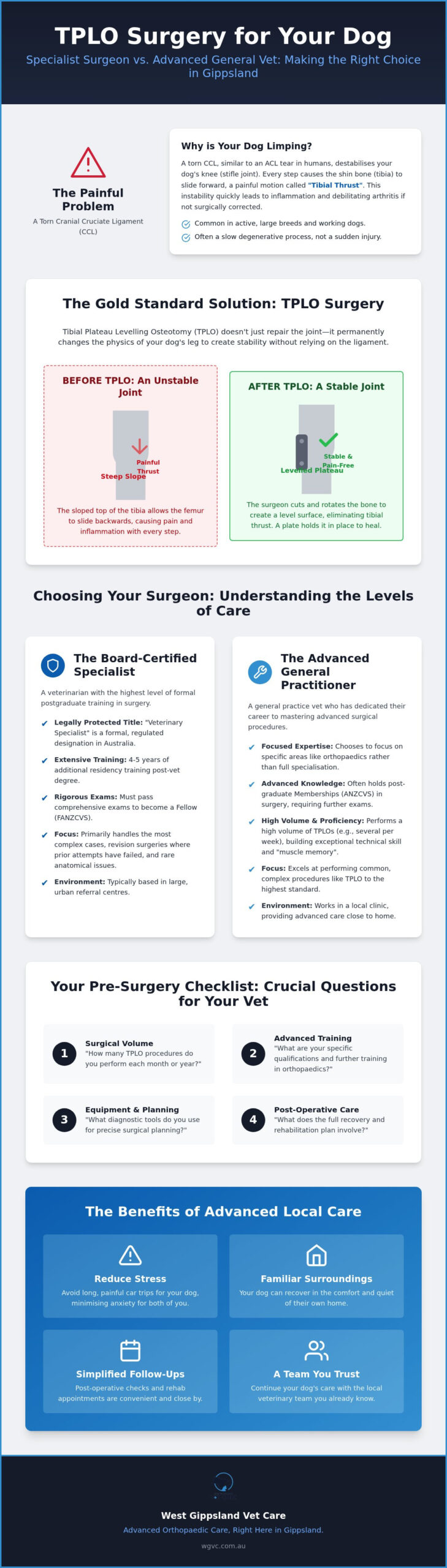
Dogs don’t just “sprain” their knees; they experience a mechanical failure. The Cranial Cruciate Ligament (CCL) is the primary stabiliser of the stifle joint, preventing the shin bone (tibia) from sliding forward against the thigh bone (femur). When this ligament tears, every step your dog takes causes a painful shifting motion known as “tibial thrust.” For active Gippsland dogs, from energetic Border Collies to heavy-set Mastiffs, this instability leads to rapid inflammation and debilitating arthritis if left unaddressed.
Understanding the CCL Tear in Dogs
Vets often look for a “drawer sign” during an exam, which is a specific type of laxity that confirms the ligament is no longer doing its job. In our local community, we see many working dogs and large breeds that are genetically predisposed to chronic degenerative ligament disease. Unlike a sudden sports injury in humans, most canine CCL issues involve a slow weakening of the fibres over months. This makes precision in diagnosis and treatment essential to prevent the other leg from overcompensating and also failing.
How TPLO Changes the Geometry of the Leg
The Tibial-plateau-leveling osteotomy (TPLO) has changed how we approach these injuries. Instead of trying to replace the ligament with a nylon string, which can stretch or break, TPLO actually changes the shape of the bone. Think of it like this: if you park a car on a steep hill, it wants to roll down. The CCL is like the handbrake. If the handbrake snaps, you could try a new rope to hold it, or you could simply level the ground so the car stays put on its own.
TPLO levels that “slope” at the top of the tibia. By making a precise curved cut and rotating the bone, the surgeon eliminates the need for the ligament entirely. High-quality internal hardware, including specialised plates and screws, holds everything in place while the bone heals. This mechanical shift is why TPLO offers a faster return to running and jumping compared to older methods. However, the success of this procedure relies heavily on the technical skill involved. Deciding between a specialist orthopaedic surgeon vs general vet for TPLO often comes down to who has the most experience with these exact geometric calculations to ensure your dog’s long-term mobility.
Specialist vs. General Practice: Defining the Levels of Veterinary Orthopaedic Care
When you’re researching a specialist orthopaedic surgeon vs general vet for TPLO, the terminology can feel a bit overwhelming. In Australia, the title “Veterinary Specialist” is legally protected. It isn’t just a label for someone with experience; it’s a formal designation managed by the Australasian Veterinary Boards Council. Most owners first encounter these terms when their local vet suggests a referral, but understanding the spectrum of care helps you decide what’s right for your dog’s specific needs.
What Makes a ‘Specialist’ Surgeon?
A specialist completes at least four to five years of additional training after their initial degree. This includes a rigorous residency and passing comprehensive examinations to become a Fellow of the Australian and New Zealand College of Veterinary Scientists (FANZCVS). A board-certified veterinary surgeon typically focuses on the most complex cases, such as revision surgeries where a previous repair has failed or dogs with rare anatomical deformities. They operate in high-referral centres where they see the most challenging orthopaedic complications daily.
The Role of the Advanced General Practitioner
There is a vital middle ground often called the “Advanced Generalist.” These are vets who haven’t pursued full specialist registration but have dedicated their careers to surgery. They often hold “Memberships” in surgery through the ANZCVS, which requires passing further exams and demonstrating advanced knowledge. These vets often perform a high volume of TPLOs, sometimes several every week, which builds incredible muscle memory and technical proficiency.
Choosing an advanced local practice means your dog stays in a familiar environment with the team they already trust. The facility itself is just as important as the surgeon’s title. A high-quality theatre should have advanced diagnostic imaging and an in-house laboratory to monitor your pet safely under anaesthesia. This combination of skill and technology allows many Gippsland families to access top-tier care without the stress of a long drive to the city. If you’re feeling unsure about the best path forward, our team is always here for a friendly chat about your dog’s mobility.
Evaluating the Risks: When Does Your Dog Truly Need a Board-Certified Specialist?
Choosing between a specialist orthopaedic surgeon vs general vet for TPLO isn’t about finding the “best” doctor in a vacuum; it’s about matching the surgeon’s expertise to your dog’s specific risk profile. Every dog is an individual. A straightforward cruciate tear in a healthy, three-year-old Kelpie presents a very different surgical challenge than the same injury in an eighty-kilogram Mastiff with bowed legs. Understanding where your dog sits on the “complexity scale” is the first step in making a confident decision for their care.
Patient Factors That Demand a Specialist
Some cases carry a higher risk of complications that require the advanced training of a board-certified specialist. If your dog has “angular limb deformity”—where the bones aren’t just unstable but are naturally curved or twisted—the geometric calculations for a TPLO become significantly more difficult. Specialist intervention is also strongly recommended for giant breeds. When a dog weighs over sixty kilograms, the sheer force placed on the surgical plate is immense, increasing the risk of implant failure.
Additionally, if your dog has significant “comorbidities” like Cushing’s disease or a serious heart murmur, they may benefit from the intensive care and specialist anaesthesia teams found in large referral centres. Finally, “revision” surgeries—where a previous operation from another clinic has failed or become infected—should always be handled by a specialist. These procedures are technically demanding and leave little room for error.
When an Advanced Local Vet is an Excellent Choice
For the majority of Gippsland families, an advanced local vet is a fantastic option. If you have a medium-to-large breed dog, such as a Labrador, Golden Retriever, or a local working dog, a standard TPLO performed by an experienced local surgeon often provides an outcome identical to a city specialist. These dogs typically have standard bone shapes and predictable healing patterns.
The benefit of staying local is often found in the post-operative TPLO care and follow-up support. Recovery from bone surgery takes months, not days. Being able to pop into your local clinic in Warragul or Drouin for a quick check-up is far less stressful for a dog than a two-hour round trip to Melbourne. Since approximately 40-60% of dogs that rupture one cruciate ligament will eventually rupture the other within two years, having a trusted local team who knows your dog’s history is invaluable. You’re balancing the gold standard of the surgery itself with the gold standard of a calm, supported recovery right here in your own community.
The Pre-Surgery Consultation: Crucial Questions for Your Gippsland Vet
When you’re sitting in the consultation room, it’s easy to feel overwhelmed by the technical details of bone cuts and metal plates. However, a vet who truly cares about your dog’s journey back to health will never be offended by direct questions. In fact, they should welcome the chance to put your mind at ease. Deciding between a specialist orthopaedic surgeon vs general vet for TPLO involves vetting the individual’s track record just as much as their formal title. You’re looking for a partner in your dog’s care, someone who communicates clearly and provides a sense of security; if you’d like to find out more about the high standard of communication and care expected in private medical settings like GP Plus, looking at established clinics can provide a helpful benchmark.
The most important factor in a successful outcome isn’t just the equipment; it’s the hands using it. Don’t be afraid to ask how many TPLOs the surgeon performs each month. Consistent surgical volume is the single most reliable predictor of a successful outcome in complex orthopaedic procedures. You might also ask about their specific complication rate for this surgery. A transparent and experienced surgeon will be happy to discuss both minor and major complications openly, showing they have the experience to manage any scenario that arises. It’s also helpful to ask what specific training they’ve undertaken for the TPLO method, as this procedure requires precise geometric calculations and specialised techniques.
Questions About Facility and Aftercare
The surgery itself is only one part of the process. You need to know what happens when your dog is under anaesthesia and what support is available once they come home. Ask about the clinic’s anaesthetic monitoring protocols; is there a dedicated nursing staff member whose only job is to watch your dog’s vitals? High-quality surgical planning also requires advanced digital X-rays to measure the tibial plateau angle with extreme accuracy before the first cut is made.
Aftercare is where local expertise really shines. Ask your orthopaedic vet Gippsland about their pain management protocols. Modern care goes far beyond just a “bottle of pills”; it should involve a multi-modal approach to keep your dog comfortable and calm during those first critical weeks. Finally, check what their protocol is for after-hours emergencies. Knowing that you can reach a familiar team if something feels “off” at 2 am on a Sunday provides immense peace of mind. If you’re ready to discuss your dog’s mobility with a team that values open dialogue, we invite you to book a pre-surgical consultation with us today.
Advanced Orthopaedic Care at West Gippsland Vet Care: Local Expertise for Your Mate
For many Gippsland families, the debate between a specialist orthopaedic surgeon vs general vet for TPLO isn’t just about the technicalities of the surgery, but the weeks of care that follow. Travelling to Melbourne with a dog that has just undergone major bone surgery is a stressful experience for both of you. Bumpy roads, long transit times, and the distance from your support system can make the first few days of recovery feel quite daunting. At West Gippsland Vet Care, we’ve designed our facility to bridge the gap, offering high-level orthopaedic surgery right here in Warragul and Drouin.
Our commitment to successful outcomes is backed by advanced diagnostic imaging and an in-house laboratory. These tools allow us to perform precise surgical planning and monitor your dog’s health in real-time while they’re in our care. We don’t believe in a “one-size-fits-all” approach. Instead, we use our local knowledge to ensure your dog’s TPLO is tailored to their specific needs. We also place a heavy emphasis on fear-free care. We know that hospitals can be scary places for pets, so we use gentle handling techniques and a calming environment to reduce the stress of hospitalisation, helping your mate feel safe and settled from the moment they arrive.
Why Gippsland Owners Choose Our Team
A Clear Path to Pain-Free Play
Choosing the right surgical path is a deeply personal decision that balances medical expertise with the comfort of your dog. The choice between a specialist orthopaedic surgeon vs general vet for TPLO often depends on your pet’s unique risk profile and your family’s needs. Whether your dog is a high-energy working breed or a beloved house pet, the ultimate goal is a safe recovery and long-term mobility without the added stress of long-distance travel to the city.
At West Gippsland Vet Care, we combine an advanced on-site orthopaedic suite with a fear-free certified approach to ensure your dog feels safe throughout their stay. Our existing surgical patients also benefit from local emergency support, giving you peace of mind during those first few weeks at home. We’re here to help you navigate this journey with kindness and professional care. If you’re ready to take the next step, please Book an Orthopaedic Consultation at West Gippsland Vet Care today. We look forward to seeing your mate happy, healthy, and moving freely again soon.
Frequently Asked Questions
Can a general vet perform TPLO surgery safely?
Yes, many advanced general vets perform TPLO safely and successfully. The key isn’t just the title but the surgeon’s specific training, surgical volume, and the clinic’s equipment. While a general vet might handle routine cases, a specialist orthopaedic surgeon vs general vet for TPLO comparison usually highlights that specialists are reserved for complex deformities. For a healthy dog with a standard tear, an experienced local vet is a safe, reliable choice.
How much more does a specialist orthopaedic surgeon cost compared to a general vet?
In Australia, a board-certified specialist typically has higher fees than a general practitioner. This reflects their extensive additional training, the specialised equipment in referral centres, and the complex nature of the cases they handle. While we don’t provide specific quotes here, owners often find that staying local reduces the total cost by eliminating long-distance travel and multiple trips to the city for follow-up appointments and staple removals.
What is the success rate of TPLO surgery for dogs?
TPLO surgery has a very high success rate, with research showing that 90 to 95% of dogs achieve good to excellent outcomes. Most dogs return to their normal activity levels, including running and jumping, once the bone has fully healed. This high success rate is why TPLO is considered the gold standard for cruciate repair in Australia, particularly for active dogs weighing over 15kg that need a stable joint.
What are the most common complications after TPLO surgery?
The most common complications include minor incisional swelling or superficial infections, which are usually managed with antibiotics. More serious but less frequent risks include implant failure or a late meniscal tear if the cushion in the knee was already damaged. Research into surgeries performed by specialists suggests a major complication rate of approximately 3.1% to 6.6%, highlighting why strict rest during the recovery period is so vital for your dog’s safety.
How long is the recovery period after TPLO surgery?
Most dogs require a recovery period of eight to twelve weeks. The first fortnight focuses on wound healing and very short lead walks. By the six-week mark, we typically perform follow-up X-rays to check that the bone is knitting together well. Total off-lead freedom usually isn’t granted until the three-month mark, ensuring the site is strong enough to handle the rigours of Gippsland farm life or backyard play.
Does my dog need a referral to see a specialist in Melbourne?
Yes, most specialist referral centres in Melbourne require a formal referral from your primary vet. This ensures the specialist has all the relevant history, previous X-rays, and blood test results before your appointment. However, if you’re looking for advanced local care, you can book directly with us for an assessment to see if your dog’s case is suitable for our on-site orthopaedic suite without needing to travel to the city.
What happens if my dog tears the CCL in the other leg?
It’s a common situation; approximately 40 to 60% of dogs that rupture one cruciate ligament will rupture the other within two years. This happens because the underlying degenerative disease often affects both knees, and the “good” leg takes extra strain while the first one heals. Having a local team helps you monitor the second leg closely, allowing for early intervention and better long-term management of any emerging arthritis.
Are there alternatives to TPLO for smaller dogs?
Yes, for dogs under 15kg, a lateral suture or extra-capsular repair is sometimes an option. This method uses a strong medical-grade filament to stabilise the joint instead of cutting the bone. While TPLO is often still preferred for its superior stability, smaller dogs sometimes do well with these less invasive techniques. We’ll help you weigh up these options during your consultation to find the best fit for your dog’s size and lifestyle.