Imagine watching your best friend, perhaps a bouncy Labrador or a loyal Kelpie, suddenly stop mid-run and lift a paw in pain. It’s a heartbreaking moment that every pet owner dreads, especially when the diagnosis points toward a ruptured cranial cruciate ligament. You’re likely feeling the weight of two heavy burdens: the worry for your dog’s comfort and the looming anxiety over how to manage the dog cruciate ligament surgery cost Gippsland families often face unexpectedly. It’s a stressful situation that can feel overwhelming when you’re trying to balance the best medical outcome with your household budget.
We believe that high-quality orthopaedic care shouldn’t require a stressful trek to a Melbourne specialist or the inflated fees that often come with city clinics. This guide will help you understand the various factors that influence surgical costs, including the different techniques available and the essential post-operative care needed for a successful recovery. By choosing local expertise, you can ensure your companion receives the gold standard of treatment while keeping them close to home. We’ll explore how Gippsland care provides a compassionate, high-value alternative that returns your dog to their happy, active self without the unnecessary “Melbourne tax” of travel and surcharges.
Key Takeaways
- Learn the difference between surgical techniques like TPLO and Lateral Suture to decide which path is best for your dog’s size and activity level.
- Understand the various factors that influence the dog cruciate ligament surgery cost Gippsland pet owners face, including pre-operative diagnostics and surgical implants.
- Discover how staying local helps you avoid the “Melbourne tax” of specialist surcharges and the logistics of multiple long-distance trips.
- Get professional advice on navigating pet insurance for bilateral conditions, as many dogs will eventually require surgery on their second knee.
- Find out how a dedicated orthopaedic consultation can provide you with a clear roadmap for your pet’s journey back to pain-free mobility.
Understanding Dog Cruciate Ligament Injuries in Gippsland
It’s a distressing sight for any pet owner when a normally energetic dog suddenly begins limping or holding a hind leg off the ground. In many cases, this is due to a rupture of the Cranial Cruciate Ligament (CCL). While you might have heard human athletes talk about “tearing their ACL,” in the veterinary world, we refer to this same structure as the CCL. This tiny but mighty band of tissue is responsible for keeping the knee joint stable, preventing the shin bone from sliding forward against the thigh bone. When this stability is lost, every step becomes painful and unstable.
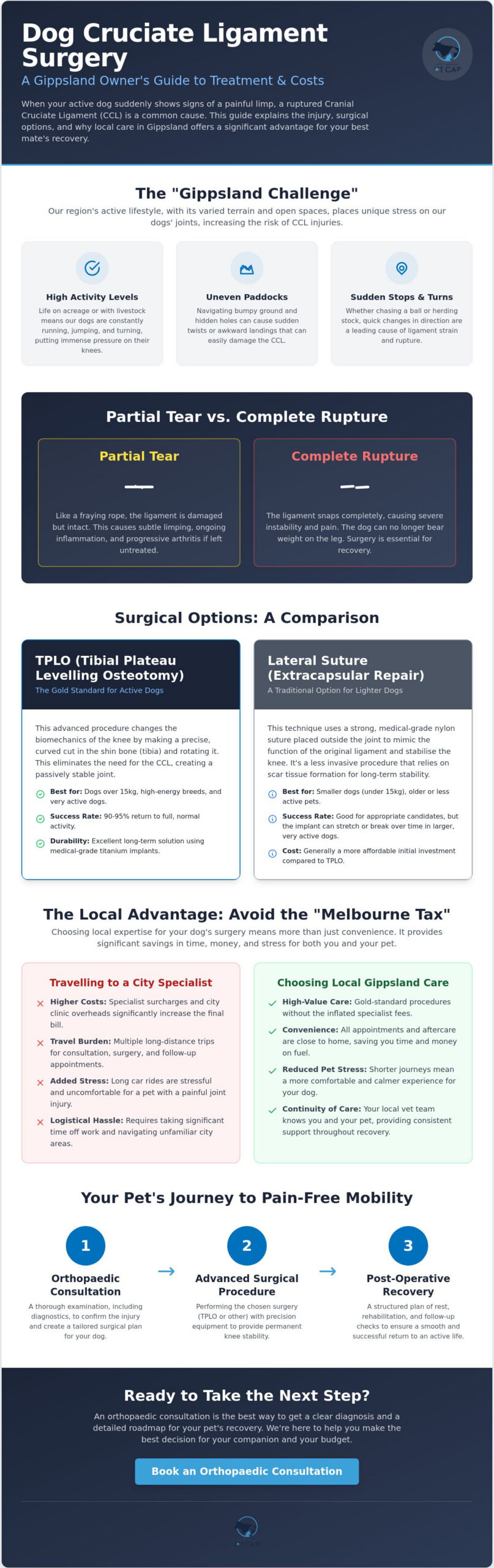
Living in our beautiful region brings unique lifestyle factors that we often call the “Gippsland Challenge.” Many of our local dogs enjoy life on acreage, spend their days navigating uneven paddocks, or perhaps help out with livestock. This high level of activity on varied terrain puts significant stress on the hind legs. When researching the dog cruciate ligament surgery cost Gippsland families often find that these injuries are more common here than in suburban environments because our dogs are simply more active. You might notice your dog “toe-touching” after a long walk, showing a subtle skip in their step, or having trouble rising from their bed in the morning. These are all signs that the joint is struggling to cope.
The Difference Between a Partial and Complete Tear
Not every injury starts as a full snap. Many dogs begin with a partial tear, which is essentially a fraying of the ligament. While your dog might seem to improve with a few days of rest, the underlying instability remains. This persistent “wobble” inside the joint triggers a cascade of inflammation and the early onset of arthritis. If the joint isn’t stabilised, that fraying rope will eventually give way entirely. Waiting to see if it gets better often leads to more extensive damage to the meniscus (the joint’s shock absorbers), which can complicate the recovery and increase the overall care required for cruciate ligament injuries in dogs.
Why Surgery is Usually the Recommended Path
Unlike a cut on the skin or a strained muscle, a ruptured ligament in the knee cannot heal itself back to its original strength. Because the joint is under constant tension, the two ends of a torn ligament simply cannot knit back together. The stifle joint is the most complex weight-bearing joint in a dog’s body. When this complex mechanism fails, conservative management like crate rest and anti-inflammatories rarely provides a long-term solution for active dogs. Surgical intervention is designed to change the mechanics of the knee, providing permanent stability so your companion can return to running through the grass without pain. Addressing the issue early helps protect the joint from the “Melbourne tax” of long-term specialist visits for advanced arthritis later in life.
Surgical Options: TPLO vs. Lateral Suture
Deciding on the right procedure is a significant step in your pet’s recovery journey. It isn’t just a clinical choice; it’s about matching a surgical solution to your dog’s unique personality and the active life they lead here in our community. The specific technique chosen will be the primary driver of the dog cruciate ligament surgery cost Gippsland owners need to consider. We focus on providing Surgical Options: TPLO vs. Lateral Suture that offer the best long-term mobility, ensuring your companion isn’t just “walking” but truly thriving again.
TPLO: Changing the Biomechanics of the Knee
TPLO, or Tibial Plateau Levelling Osteotomy, is widely considered the gold standard for most dogs, especially those over 15kg or those with high energy levels. Instead of trying to replace the ligament with a synthetic substitute, this surgery changes the actual shape of the bone. By rotating the top of the shin bone, we make the original ligament “redundant.” The knee becomes stable simply through the way the bones meet when your dog stands. This procedure requires high-precision equipment and specialised medical-grade titanium plates and screws to hold the bone in its new, stable position. While the initial investment is higher, the success rate for returning to full activity is impressively high, typically between 90% and 95%. For a dog that loves to zoom across a farm or navigate the hills of West Gippsland, the durability of a TPLO is often the most reliable path to a pain-free life.
Lateral Suture: When is it Appropriate?
The Lateral Suture, sometimes called extracapsular repair, is a more traditional approach. It involves placing a strong prosthetic suture, similar to a heavy-duty fishing line, on the outside of the joint to mimic the ligament’s job. It’s a less invasive option that works well for smaller breeds, senior dogs, or those with very quiet lifestyles. However, it does have limitations. Because the suture can stretch or break if put under too much stress, it’s generally not suitable for larger or more boisterous dogs. This technique generally sees a success rate between 65% and 80%, making it a reliable choice for the right candidate but less certain for heavy-hitters. While it is usually a lower-cost option upfront, the weight limits are strict to ensure the repair doesn’t fail prematurely.
Choosing the right path involves looking at your dog’s weight, age, and what you hope they can do after recovery. If you’re unsure which path fits your budget and your dog’s lifestyle, we invite you to chat with our friendly team to discuss the best way forward for your pet.
Factors That Influence the Cost of Dog Cruciate Surgery
When you’re looking into the dog cruciate ligament surgery cost Gippsland clinics provide, it’s helpful to understand that every quote is tailored to the individual dog’s needs. A large, active farm dog requires a different approach than a smaller companion who spends most of their time indoors. The primary factor is often your dog’s weight. Larger dogs require higher dosages of anaesthetic and medications, and the surgical implants, such as the titanium plates used in TPLO, must be sized specifically to their frame. These high-grade materials are engineered to withstand the significant forces of a large dog’s movement, which is reflected in the overall investment.
Complexity also plays a major role in the final cost. During the procedure, the surgeon carefully inspects the meniscus, which acts as a shock absorber in the knee joint. As leading veterinary surgeons explain, many cruciate ruptures are accompanied by meniscal damage. If the meniscus is torn, it must be repaired or partially removed to prevent ongoing pain. This adds time to the surgery and requires specialised skills, but it’s essential for a successful outcome. Additionally, post-operative care, including pain management medications and follow-up consultations, ensures your pet’s recovery stays on track and they remain comfortable throughout the healing process.
What Should Be Included in a Professional Quote?
A transparent quote should provide a clear picture of the entire surgical journey. You should look for inclusions such as:
- Comprehensive anaesthesia and dedicated monitoring by a qualified veterinary nurse throughout the procedure.
- Use of a sterile surgical suite and high-quality, single-use consumables to maintain the highest hygiene standards.
- Premium surgical implants designed for long-term stability and biocompatibility.
- Immediate post-operative hospitalisation and intensive pain management to ensure a smooth transition out of surgery.
A "cheap" quote often excludes essential follow-up X-rays or pain relief.
The Role of Advanced Diagnostics
Precision is the key to a smooth recovery and long-term success. We utilise advanced diagnostic imaging to take precise measurements of the joint before the first incision is made. This allows us to plan the exact angle of the bone cut for a TPLO, ensuring a perfect fit for the implants. Safety is our priority, which is why our in-house laboratory is used for pre-anaesthetic blood checks. By identifying any underlying health concerns before surgery, we can tailor the anaesthetic plan specifically for your dog. This level of meticulous planning significantly reduces the risk of complications, making the dog cruciate ligament surgery cost Gippsland owners pay a high-value investment in their pet’s future mobility and quality of life.
The Local Advantage: Saving on the “Melbourne Tax”
Many families assume that for a complex procedure like TPLO, they must automatically trek into the city. However, the dog cruciate ligament surgery cost Gippsland pet owners pay is often significantly more manageable because it avoids what we call the “Melbourne tax.” This isn’t just a reference to the higher overheads of city clinics. It’s about the hidden costs that stack up when you’re forced to travel for specialist care. When you choose a local option, you’re accessing advanced orthopaedic skills at a community practice price, ensuring your budget goes toward your dog’s actual recovery rather than city surcharges.
Consider the logistics involved in city-based surgery. A trip to Melbourne isn’t just a tank of petrol. It involves hours spent in heavy traffic, the stress of finding parking near a busy hospital, and often taking multiple days off work for a single consultation. Cruciate recovery is a journey that requires several follow-up checks over two to three months. Doing those trips locally is far more manageable for your schedule and your wallet. By staying in our region, you eliminate the specialist referral fees that can often add thousands to the final bill, all while receiving the same high standard of surgical care.
Beyond the financial savings, there’s the emotional well-being of your pet to consider. A long car trip when a dog is already in pain or groggy from surgery is exhausting for them. Staying in a familiar regional environment with a local team they may already know makes a massive difference to their stress levels. It feels less like a clinical ordeal and more like a supported recovery within their own community.
Continuity of Care in West Gippsland
Having your surgeon and your regular veterinary team in the same building simplifies the entire process. There’s no risk of important details being lost between different clinics. If you have a concern during the recovery phase, you have immediate access to emergency care right here in Warragul. This relationship-based approach means we’re with you for the long haul, from the initial diagnosis to managing your dog’s ongoing joint health and arthritis years down the track. We’re invested in the outcome because we’ll be seeing you and your dog for their future check-ups too.
Supporting the Local Community
Choosing an independent, locally-owned practice means your investment stays right here in Gippsland. It allows us to keep expert surgical skills within our region, ensuring that high-level care remains available for all local families. We pride ourselves on offering fear-free care that understands our rural lifestyle. We know our clients aren’t just “pet owners,” they’re neighbours. Keeping these services local ensures that expert veterinary skills continue to grow and thrive in our community rather than being centralised in the city.
If you’re looking for a professional, local alternative for your dog’s orthopaedic needs, reach out to our friendly team to discuss how we can help your best mate get back on their feet.
Next Steps: Managing the Financials and Recovery
The journey toward your dog’s recovery begins with a clear, calm conversation. Once you’ve noticed the signs of lameness, booking a dedicated orthopaedic consultation is the most important step you can take. This isn’t just a standard check-up; it’s a chance for us to provide a definitive diagnosis and a tailored plan that addresses the dog cruciate ligament surgery cost Gippsland families need to manage. During this visit, we’ll discuss the best surgical approach for your pet’s specific needs and provide you with a transparent roadmap for the weeks ahead.
It’s a challenging reality that over 50% of dogs who rupture one ligament will eventually experience the same issue in their other leg within a year or two. This is known as a bilateral condition. When you’re looking at the long-term dog cruciate ligament surgery cost Gippsland pet owners often find that having the right pet insurance in place makes a world of difference. We recommend reviewing your policy early to understand how they handle these “bilateral” claims, as some providers may have specific waiting periods or exclusions that are better to know about before you need them.
Recovery is a marathon, not a sprint, typically spanning between 8 and 12 weeks. While the surgery provides the mechanical fix, the healing happens at home under your watchful eye. We’ll be with you every step of the way, providing guidance on pain management and monitoring their progress during follow-up visits to ensure the joint is stabilising exactly as it should.
Financing and Insurance Tips
We understand that unexpected surgery can bring financial stress. A detailed written estimate is your best tool for planning, and we’re always happy to provide one after your initial consultation. This estimate will break down the essential components of care, from the surgery itself to the necessary follow-up X-rays. If you’re concerned about the upfront investment, ask us about the various payment plans available to help Gippsland families spread the cost over time. Our goal is to work with you to prioritise the most essential aspects of your dog’s care, ensuring they get the treatment they need without compromising their safety or comfort.
Preparing for a Successful Recovery
A successful outcome depends heavily on what happens once your dog leaves the clinic. You’ll need to set up a “recovery zone” at home, which should be a quiet, confined space free from stairs and slippery tiles. Using rugs or yoga mats on floorboards can provide the extra grip your dog needs as they regain their confidence. Controlled leash walking is vital; even if they seem ready to run, the internal healing takes time to reach full strength. We’ll also discuss gentle physiotherapy exercises you can do at home to protect your investment and help your mate regain their range of motion safely.
Ready to help your mate walk pain-free? Book an orthopaedic consult at our Warragul or Drouin clinic to get started on their path to recovery.
Helping Your Companion Get Back on All Fours
Seeing your dog struggle with a cruciate injury is incredibly tough, but you don’t have to face it alone or travel hours into the city for expert care. By understanding the various factors that shape the dog cruciate ligament surgery cost Gippsland families encounter, you can make an informed choice that balances high-level medical outcomes with your household’s practical needs. Whether your pet is a candidate for the gold-standard TPLO or a traditional lateral suture, staying local ensures they remain in a familiar, supportive environment throughout their recovery.
As an independent, locally owned and operated practice, we’re proud to offer advanced TPLO surgical capabilities right here in Warragul. Our compassionate, Fear-Free approach is designed to put both you and your pet at ease from the very first consultation. You shouldn’t have to compromise on surgical standards to stay close to home. If you’re ready to see your best friend running through the grass again without pain, we’re here to help you make that happen. Book an Orthopaedic Consultation for Your Mate today and let’s start the journey to recovery together.
Frequently Asked Questions
How much does dog cruciate ligament surgery cost in Gippsland?
The total investment for surgery varies based on your dog’s weight, the chosen surgical technique, and the complexity of the joint damage. While we don’t provide flat rates without a physical examination, local care in our region generally avoids the higher surcharges and referral fees found at metropolitan specialist centres. We provide a detailed, written estimate after your initial orthopaedic consultation so you can plan for the dog cruciate ligament surgery cost Gippsland families need to manage without any hidden surprises.
Is TPLO surgery worth the extra cost compared to lateral suture?
TPLO is the preferred choice for active dogs or those weighing over 15 kilograms because it offers superior long-term stability and a faster return to function. While the initial outlay is higher due to the specialised titanium implants and precision equipment required, the success rate is significantly higher for larger breeds. For many owners, the peace of mind that comes with a 90 to 95 percent success rate makes it a high-value investment in their dog’s future mobility and quality of life.
Does pet insurance cover cruciate ligament surgery?
Most Australian pet insurance policies cover cruciate surgery under their accident and illness or comprehensive plans, provided the condition isn’t pre-existing. It’s vital to check your specific policy for waiting periods or exclusions related to “bilateral” conditions, which involve both knees. Understanding these details early will help you manage the long-term dog cruciate ligament surgery cost Gippsland pet owners might face if the second knee requires attention in the future.
What happens if I leave a torn cruciate ligament untreated?
Leaving a cruciate injury untreated leads to chronic pain, rapid-onset arthritis, and potential damage to the meniscus, which acts as the joint’s shock absorber. Without surgical stabilisation, the joint remains unstable, causing your dog to overcompensate by shifting their weight to the healthy leg. This extra strain often leads to a rupture in the other knee, effectively doubling the surgical requirements and the complexity of the recovery process. Early intervention is the kindest way to protect your pet’s long-term comfort.
How long is the recovery period after dog knee surgery?
Most dogs require a structured recovery period of eight to twelve weeks to allow the bone or soft tissue to heal completely. The first few weeks involve strict rest and very short, controlled toilet breaks on a lead to protect the surgical site. As the weeks progress, we’ll guide you through a gradual increase in activity and gentle physiotherapy exercises. While it requires patience, following this timeline is essential to ensure the repair remains secure and your dog returns to full strength safely.
Why is cruciate surgery so much more expensive than a routine desexing?
Orthopaedic surgery is a complex procedure that requires high-precision equipment, advanced diagnostic imaging, and specialised medical-grade implants. Unlike a routine desexing, cruciate repairs involve altering bone structure or placing permanent prosthetic supports, which demands a higher level of surgical expertise and more time in the theatre. The cost also covers comprehensive anaesthesia monitoring by dedicated nurses and intensive post-operative pain management to ensure your pet’s safety and comfort throughout their stay with us.
Can my dog tear the cruciate ligament in the other leg too?
There is a high probability that a dog with one ruptured cruciate ligament will experience the same injury in the other leg. Studies suggest that between 40 and 60 percent of dogs will rupture their second ligament within one to two years of the first injury. This often happens because the underlying factors, such as joint shape or age-related wear, exist in both knees. We’ll discuss preventative joint support and weight management strategies to help protect the remaining healthy ligament as much as possible.
Do I need a referral to see an orthopaedic vet at West Gippsland Vet Care?
You don’t need a referral from another clinic to book an orthopaedic consultation with our surgical team. We welcome both our regular clients and new families from across the Gippsland region who are seeking local, high-standard surgical options for their companions. Simply contact our clinics in Warragul or Drouin directly to arrange a time for an assessment. This direct access helps you avoid the extra administrative steps and referral fees often associated with metropolitan specialist centres.